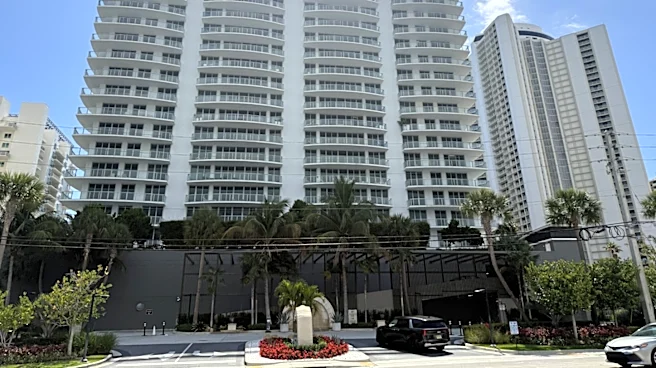






Ocean-front high-rise residents on Singer Island who say they were misled into buying units they believed were condominiums and not hotel rooms have asked Riviera Beach to convert the designation of their units to condos.
That change would allow residents to qualify for a homestead property tax exemption, which is not available for those who live in resort hotel rooms. Homestead property exemptions save homeowners thousands of dollars per year by limiting how much the taxable value of their home can increase, thus limiting the rise of their tax bill.
Jason Detar, president of the Amrit Ocean Resort Condominium Association, said residents have submitted a request to change the designation of all 182 units of the complex from resort hotel to residential
condominium. Any change would require multiple approvals from city council, which got an update on the situation on Sept. 22.
The city has a process for such conversions through its Minority Employment and Housing Opportunity Program, but it's not cheap. The program has a $52,500 per unit conversion fee that would be put into the city's housing trust fund to support the development of affordable housing. And because Amrit was built as a hotel and not a condominium complex, it was allowed to have fewer parking spots than what's required for a residential building.
City rules on parking and project density — how many units are allowed per acre — would limit the number of Amrit units that could be converted to 60, not the full 182, according to a preliminary review compiled in July by Clarence Sirmons, the city's director of development services.
Detar, however, said all of Amrit's units can be converted within the city's rules.
"The earlier reference to approximately 60 units came from a preliminary city analysis and does not reflect the application now submitted," he said. "We are seeking to convert all 182 resort hotel suites to permanent residential condominium use, and the application demonstrates compliance with the applicable parking requirements."
As for the $52,500 conversion fee, Detar said residents in only 40 of Amrit's 182 units would be required to pay it. The conversion application includes a request that the fee be "substantially reduced, to $1,000 per applicable bonus unit, or waived where appropriate, when qualifying extenuating circumstances exist."
If all 182 Amrit owners paid the $52,500 conversion fee, the city's housing trust fund would collect nearly $9.6 million. If 60 paid it, the fund would get about $3.2 million. Neither figure is insignificant in a city that is rapidly redeveloping and starved, like other cities in Palm Beach Couty, for affordable housing.
Hotel or home? Confusion from the start

Detar emphasized that the conversion request is "not just owners asking the city for a financial favor."
He said Amrit buyers were not the only ones unsure about the designation of the building's units.
"Concerns regarding the conflict between the condominium ownership structure and the transient resort-hotel classification were raised during the development process," Detar said. "The project nevertheless proceeded through the city's development, plan-review and approval processes at the density and configuration that exist today."
Detar said Amrit unit owners are asking the city to recognize the reality they face and help them.
"We are asking the city to use its land-use authority to reconcile the approvals with the condition that now exists rather than impose millions of dollars in additional conversion charges on current owners to resolve a regulatory problem they inherited," Detar said.
Residents say Amrit not luxury they paid for

In addition to the question of whether Amrit's units are condos or hotel rooms, owners have complained about what they have described as atrocious conditions at what many thought would be a place of luxury. Owners said they have had to endure a leaky roof, faulty electrical panels and busted drain lines that allowed sewage to seep through walls.
The Palm Beach Post asked Detar for pictures to illustrate those problems, but he declined to provide them.
"Those matters are being addressed through the appropriate engineering, legal and turnover processes," he said. "I am not providing photographs at this time because I do not want those separate matters to obscure what is fundamentally a land-use and regulatory issue."
City council members, led by Glen Spiritis, whose district includes Singer Island, have expressed an interest in helping Amrit residents. Spiritis has held numerous town hall meetings at the Amrit, a twin-tower structure on North Ocean Drive that many had viewed as their own slice of luxury South Florida life only to find it was something else entirely once they bought their units.
"We still don't have homestead," Amrit resident Anthony Curtis said during a July 1 meeting. "I don't know what it's going to take. I've been there two and a half years now, and we're getting nowhere."
Detar said at that meeting that residents are still convinced they bought condos and not resort hotel rooms.
"Why do our architectural drawings show that our areas that are condominiums say 'residential?'" he asked. "Why were they stamped and approved that way? I've spoken to members of the zoning board and involved in the city in the past. They didn't even know. They thought we were residential. We're not fools. Our dozens of attorneys and land planners that we've had involved have found a significant number of inconsistencies. We need all 182 units converted to residential, the way it should have been."
Listening on the dais, Spiritis empathized.
"You've been going through hell," he said. "I understand that."
Wayne Washington is a journalist covering education and Riviera Beach development for The Palm Beach Post. You can reach him at wwashington@pbpost.com. Help support our work; subscribe today.
This article originally appeared on Palm Beach Post: Luxury high-rise owners want hotel units listed as condos | Exclusive