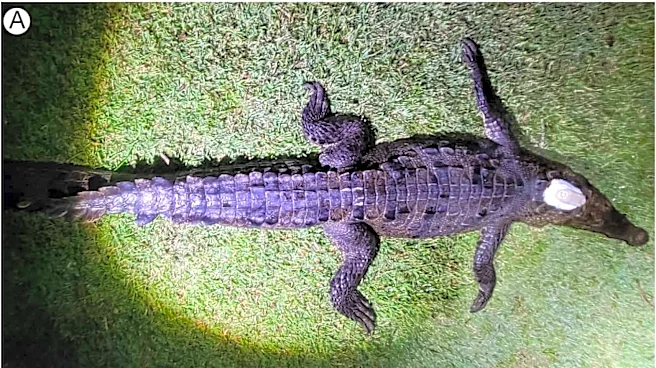




A crocodile died from apparent lead poisoning, according to the Florida Fish and Wildlife Conservation Commission (FWC), the first-known case of its kind in Florida.
The Fish and Wildlife Research Institute (FWRI), the research division of the FWC, made an Instagram post regarding the 2023 incident on Oct. 6, 2026, which says the crocodile "unexpectedly died during routine capture."
Afterward, researchers discovered over 22 grams of lead in its stomach, which is "approximately the weight of a AA battery."
What occurred during Florida crocodile capture
According to the research published by the FWRI on Feb. 26 regarding the crocodile's death, a caller in Miami-Dade County, Florida, made a complaint through the FWC's Statewide Nuisance Alligator Program on Nov. 17, 2023, reporting "that a crocodile had
climbed into his outdoor swimming pool."
A crocodile response agent "captured and secured" the crocodile, an "adult with good body condition." As a part of the FWRI's continuing research on the species, the crocodile was selected to receive a satellite transmitter.
Although the crocodile was "initially active and alert," showing no "obvious signs" of poor health, towards the end of attaching the transmitter, the crocodile started to thrash and emit a "foul-smelling liquid from its nostrils."
The crocodile was released at the edge of the canal behind the caller's home after the transmitter was attached, but the FWRI "observed" that it had died, and conducted an abbreviated necropsy in the field.
What was found in the crocodile's stomach
Upon further examination, the crocodile displayed clinical signs of lead poisoning, such as missing teeth.
The FWRI wrote that they believed the elevated levels of lead in "this crocodile reduced its overall fitness, making it unable to survive the stress of a standard capture and transmitter attachment event."
The large female crocodile's stomach contained 22.42 grams of lead, including "23 air rifle pellets, one fishing weight, and small lead fragments," as well as "at least one green iguana that had likely been shot with lead ammunition."
Are there crocodiles in Florida?
According to the FWC, crocodiles live in coastal areas throughout the Caribbean and in South Florida and are a shy and reclusive species. "They live in brackish or saltwater areas, and can be found in ponds, coves, and creeks in mangrove swamps. They are occasionally being encountered inland in freshwater areas of the Southeast Florida coast as a result of the extensive canal system," an FWC report states.
Do trackers on crocodiles fall off? Are reptiles that are tagged easily tracked?
In an October 2023 story in FLORIDA TODAY, part of the USA TODAY Network, Carly Jones of the FWC explained about trackers on crocodiles after one nicknamed "the Melbourne Beach crocodile" made frequent appearances in the Brevard County area of Florida. Jones had confirmed the "Melbourne Beach crocodile" that was spotted in Satellite Beach had lost its tracker during a routine capture. Said Jones in 2023: "While we attempt to recapture our crocs at the end of our studies to remove the trackers, (this can be difficult, they remember what happened the first time we caught them!) they do eventually fall off on their own (as we recently witnessed with this particular crocodile that managed to knock its tag off when it was removed from the culvert). None of our crocodile data is publicly available while we are tracking them as they are a threatened species and we do not want to give out location information. However, we did recently put out a webpage about our translocation study on our public website that has some movement animations generated from our tracking data."
The FWC's translocation study "Do crocodiles know their way home?" features maps of the range of American crocodiles in Florida along with hotspot maps using data compiled from 2005-2022. The online study shows various photos of crocodiles in common places, with one in a Florida resident's pool.
Whom to call if you see a crocodile in your yard
If you're concerned about a crocodile, call the Florida Fish and Wildlife Conservation and Commission at 866-392-4286 (866-FWC-GATOR), and a FWC crocodile response agent will respond.
Safety tips: How to stay safe around alligators
Remember, alligators may always be present near any body of water in Florida, especially fresh or brackish water. The Florida Fish and Wildlife Conservation Commission offered these tips to stay safe:
- Closely supervise children when they are playing in or around water.
- Never swim outside of posted swimming areas.
- Don't wade in waters where large alligators are known or likely to occur.
- Swim only during daylight hours. Alligators are most active between dusk and dawn.
- Do not allow pets to swim, exercise or drink in or near waters that may contain alligators or in designated swimming areas with humans. Dogs are more susceptible to being bitten than humans because dogs resemble the natural prey of alligators. The sound of dogs barking and playing may draw an alligator to the area.
- Never feed or entice alligators — it is dangerous and illegal. When fed, alligators overcome their natural wariness and associate people with food.
- Inform others that feeding alligators is illegal and creates problems for others who want to recreate in or near the water.
- Dispose of fish scraps in garbage cans at boat ramps and fish camps — do not throw them in the water.
- Observe and photograph alligators only from a safe distance.
- Leave alligators alone. State law prohibits killing, harassing or possessing alligators except under permit.
- Never remove an alligator from its natural habitat or accept one as a pet. It is illegal and dangerous to do so. Handling even small alligators can result in injury.
Jennifer Sangalang and Sarah Perkel are reporters for the USA TODAY Network's Florida Connect team. You can get all of Florida’s best content directly in your inbox each weekday day by signing up for the free newsletter, Florida TODAY.
This article originally appeared on Palm Beach Post: Crocodile with tracker in Florida died of apparent lead poisoning