






As the public debate sharpens over the Palm Beach County Commission’s approval of an Islamic Center in west Delray Beach, it is becoming increasingly apparent that the commission has painted itself into a corner.
On Sept. 28, 2023, the commissioners voted to approve an Islamic community center on a 9.85-acre property in west Delray Beach designated as Agricultural Reserve and zoned for agriculture. Local residents received no actual notice of this zoning hearing. Instead, notice was mailed to the few homeowners within 500 feet of the proposed project. The lax notice requirements in the zoning code itself may violate the due process rights of county residents. It was only recently that residents became aware of the Islamic center and by then it had
already been approved.
On July 14, 2026, the commission voted 6 to 1 to reject a very similar proposal submitted by Calvary Church for a Christian school in Jupiter Farms on land that is zoned Agricultural Residential, and even though educational institutions were expressly contemplated as a conditional use in the county’s own Comprehensive Plan for this area.
While there were differences between the two proposals, both were requests from religious institutions on properties that were similarly zoned and with similar issues related to surface traffic, density, and public safety. Many believe there was disparate treatment between how county zoning authorities green-lighted the Islamic Center proposal while denying the Calvary Christian proposal.
County Mayor Sarah Baxter, the sole vote to approve the Christian proposal, pointed out how Calvary had spent significant sums of time and money to comply with all zoning requirements. Calvary purchased the land for several million dollars in 2024, in reliance on repeated assurances, including that it had been zoned for use as a school. Calvary then spent almost another $2 million on compliance costs to ensure that it satisfied every qualification raised by zoning authorities, including a significant reduction in the size of the proposed school.
It is often considered progressive these days to oppose Christianity, while politically correct to accommodate Muslim populations. Unfortunately, any disparate treatment between these two zoning applications is not just a political issue. Without any compelling justification for favoring Muslims over Christians in these zoning decisions, the commission may have a legal problem as well, one that implicates the U.S. Constitution and federal law.
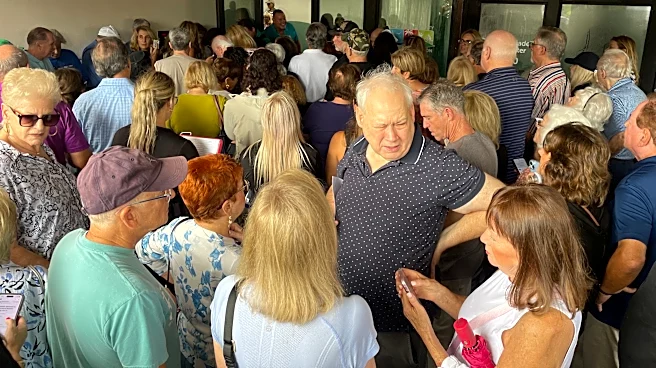
 Delray Beach on Oct. 2, 2026. Many residents were there to urge not just preservation but also rejection of a proposed Islamic Center there." id="92054941007">
The First Amendment commands that the government ― and that includes a county commission ― “shall make no law respecting an establishment of religion, or prohibiting the free exercise thereof.” These are known as the Establishment Clause and the Freedom Exercise Clause and both require strict government neutrality between all religious denominations. Yet, the county may have violated both the Establishment Clause and the Free Exercise Clause by effectively favoring one religion over another without a compelling justification that can survive strict judicial scrutiny.
The commission’s zoning decisions appear unprincipled and arbitrary, given the different decision-making processes and different resolutions of these two proposals. Opponents of the Islamic Center point to the lack of consistency in weighing zoning and density and traffic issues, as well as the lack of actual notice of the zoning hearing, and therefore the absence of any meaningful community involvement.
Calvary could also prevail in an “as applied” challenge if the Commission’s decision-making in these two cases showed a departure from strict neutrality and instead a preference for an Islamic proposal over a substantially similar Christian proposal. If so, Calvary and all non-Muslims in Palm Beach County may have claims, under section 1983 of the federal statutes, against county officials who, acting under color of state law, violated the First Amendment’s Free Exercise Clause and Establishment Clause. Such claims also allow for punitive damages and attorneys’ fees.
In early October, Commissioner Maria Sachs conceded the arbitrary nature of the commission’s zoning decisions in her announcement that the county staff would now be conducting a review of the commission’s approval process on government buildings and religious places of worship because of disparities between its zoning decisions.

This is a prudent time for Palm Beach County to pause this Islamic Center to give state and federal authorities time to investigate any possible ties between the Islamic Center and the wider Muslim community, including possible ties to the Muslim Brotherhood and the Council on American Islamic Relations (CAIR) and dozens of other groups that were recently designated as terrorist organizations by the State of Florida. Likewise, the federal government has already designated branches of the Muslim Brotherhood as terrorist organizations, and these investigations are ongoing.
Under such circumstances, it would be irresponsible to allow this Islamic center to proceed to construction before all such investigations are complete.
Timothy A. Canova is professor of Law and Public Finance at Nova Southeastern University's Shepard Broad College of Law in Fort Lauderdale.
This article originally appeared on Palm Beach Post: Islamic Center decision puts county in a legal corner | Opinion