




Palm Beach County should create a long-term revenue source, potentially including a sales tax, to help pay for transportation improvements needed to tackle worsening traffic congestion as the region's population grows.
That suggestion comes from the county's first comprehensive transportation master plan, a more than 1,000-page document scheduled for presentation to county commissioners on Wednesday, Aug. 26. The report concludes that the Palm Beaches will need a dedicated source of funding in order to lure additional state and federal transportation dollars.
Commissioners are expected to decide whether to move the plan forward.
The report does not recommend a specific sales tax rate but says county leaders should consider a range of funding options,
including the tax on purchases, tolls, congestion pricing, tourism-related fees and charges on vehicles traveling through the county.
It does list, however, numerous efforts to alleviate highway and roadway bottlenecks. Those include more efficient traffic signals, increased mass transit options and expanded sidewalk and bike lanes.
The plan, which covers through 2050, specifically recommends establishing a dedicated transportation fund and reserve to demonstrate that Palm Beach County has "skin in the game" when seeking state and federal grants for major projects.
The recommendation mirrors approaches already used in neighboring Broward and Miami-Dade counties, both of which rely on transportation sales taxes in addition to tolls. Broward County expects to collect about $460 million this year from its transportation surtax, while Miami-Dade County anticipates roughly $424 million in revenue.
Palm Beach County's master plan also calls for closer collaboration with the private sector.
"Given the essential role transportation plays in economic growth, a public/private partnership should be created to enable a future transportation plan," the report states. "The private sector has a front row seat to observe how technology and innovation are changing the way people live and businesses operate. This perspective will enhance future transportation decisions."
Congestion could worsen dramatically over next 25 years

The report warns that traffic congestion could increase sharply over the next 25 years. Roadway snarls, increasing east-west travel demand, transit gaps and pedestrian and bicycle safety concerns require a coordinated countywide response, the study concludes.
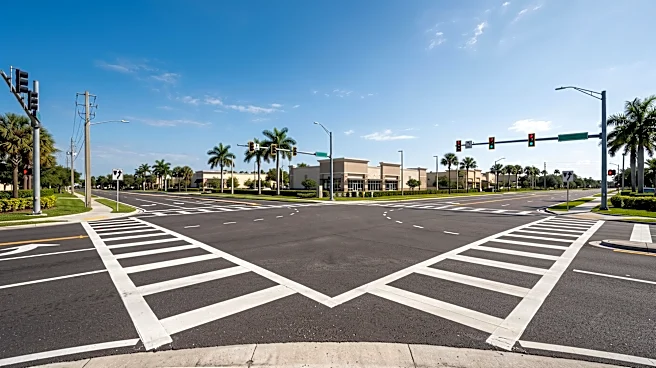
Transportation bottlenecks already exceed 2 miles at major corridors throughout Palm Beach County. Analysts found average travel speeds on those corridors during peak travel periods ranged from 3% to 68% below posted speed limits.
Among the worst-performing segments were:
- 10th Avenue North between Congress Avenue and Interstate 95 near Lake Worth Beach
- Indiantown Road between Interstate 95 and Island Way in Jupiter
- Glades Road between Florida's Turnpike and St. Andrews Boulevard near Boca Raton
The report looked at how many more roadways in the county would operate at failing-level of service under different scenarios of growth. A failing roadway carries more traffic than it was designed to handle, leading to chronic congestion and delays.
Under the medium-high growth scenario, the number of roadway lane miles operating at a failing level of service would increase 42% during the afternoon rush hour and 34% during the morning commute. Under the highest-growth scenario, the increases would reach 77% and 71%, respectively.
The study found the most severe congestion remains concentrated in eastern Palm Beach County, where travel demand is highest and road networks are already heavily used.
Even after accounting for planned and funded road projects, major portions of Okeechobee, Southern and Northlake boulevards; State Road 710, Lyons and Jog roads; Indiantown Road near I-95; and multiple segments of I-95 are projected to experience significant congestion through 2050.
Safety concerns: 5 corridors account for 20% of fatal, serious crashes
Safety was another major focus of the plan.
Consultants found that five county-maintained corridors account for about 20% of all fatal and serious-injury crashes on county roads. They are:
- Sixth Avenue South/Melaleuca Lane in the Lake Worth Beach area
- 10th Avenue North, also in the Lake Worth Beach area
- Linton Boulevard in Delray Beach
- Jog Road
- Military Trail
The report also concluded that many of the county's major transportation corridors present significant challenges for pedestrians and bicyclists.
Recommended projects and technology
Consultants said some of the quickest improvements would not require major new road construction. So-called quick wins include:
- Increasing bus frequencies
- Improving passenger amenities
- Upgrading traffic signals and intersections
- Expanding sidewalks and bicycle connections
- Improving roadway lighting

The plan also endorses adaptive traffic signals, artificial intelligence-driven traffic management, transit signal priority, rail-crossing alerts and other intelligent transportation technologies designed to improve traffic flow.
Among the report's most significant findings is support for a premium transit corridor along State Road 7 and Okeechobee Boulevard connecting Wellington and downtown West Palm Beach.
The study found both bus rapid transit and light rail could attract substantial ridership while improving mobility along one of the county's busiest east-west corridors.
The report also encourages exploration of emerging technologies such as robotaxis, autonomous shuttles, autonomous freight vehicles, drone delivery systems and electric air taxis.
One of the most ambitious concepts is an automated people-mover linking President Donald J. Trump International Airport with downtown West Palm Beach, Brightline, Tri-Rail and the convention center district.
The elevated system would bypass congestion, railroad crossings and drawbridge delays along Okeechobee Boulevard while creating a direct connection between the airport and downtown destinations.
Ultimately, the master plan argues that Palm Beach County cannot build its way out of congestion solely by adding roadway capacity. It recommends a combination of transportation investments, transit-oriented development, expanded bicycle and pedestrian infrastructure, and closer coordination between transportation and land-use planning.
Mike Diamond is a journalist atThe Palm Beach Post, part of the USA TODAY Florida Network. He covers Palm Beach County government. You can reach him at mdiamond@pbpost.com. Help support local journalism. Subscribe today.
This article originally appeared on Palm Beach Post: Traffic master plan backs new tax for transit projects | Exclusive