






A quantitative ecologist is bringing machine learning to Florida’sbattle against the Burmese python — math versus an invasive ambush predator that has so far flouted other control methods.
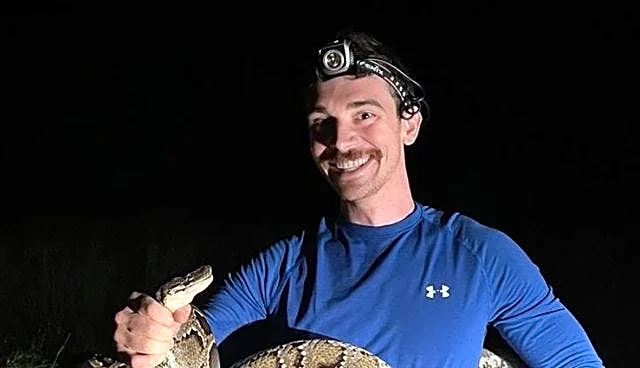
Alex Romer, who is part of an emerging field of study using artificial intelligencewithin the field ofbiological science, is a researcher with University of Florida’s Croc Docs and lead author of a study that used AI to optimize python hunting efficiency.
That means determining what conditions and when is the best time to find thelarge pythonsthat are doing the most harm to the environment.
“We are trying to develop a system to put contractors in the right place to catch snakes,” Romer said. “We know pythons are hard to capture so how do we make the hunts count
the most.”
Three machine learning models using data from the South Florida Water Management District’s python elimination program were tested to predict whenpython hunters were most likely to find snakes.
The program, which began in 2017, includes about 50 python hunters who earn between $14 and $30 per hour as well as bonuses based on snake length. The Florida Fish and Wildlife Conservation Commission has a similar python hunting team.
Because newly hatched and juvenile pythons have a two-year survivorship in the wild of only about 7%, according to the paper, the key target should be mature female pythons thatlay dozens of eggsper clutch and are consuming more animals.
What researchers came up with was the Weighted Removal Index (WRI), a formula that prioritizes python captures based on their potential harm to the environment.
Some of the influences on the index were unsuspected.
When is the best time to hunt pythons in Florida?
The study found:
∎ It's better to hunt under a waning crescent or waning gibbous moon.
∎ Warmer and more humid days early in the wet season can increase catches.
∎ Cool days during the dry season are good for hunting adults basking in the sun for warmth.
While python removal rates were lower during the coolest months of the year, hunters came out with more mature males and females.
“If you just count how many pythons contractors catch in a month, January and February don’t seem that important,” Romer said. “But when you add in the demographic weighting, suddenly those months look a lot more important.”
The WRI also said it’s best to hunt before python hatching season in the summer with catches of large females decreasing after baby pythons emerge from their eggs.
Other connections were more intuitive, such as hunting with a partner increased performance.
“Every Burmese python removed is a win for the Everglades, but targeting large reproductive females is likely to reduce the population most effectively,” said UF assistant professor of invasive wildlife and study co-author Melissa Miller in a statement. “This approach is especially valuable at new invasion sites and along the invasion front, where removal efforts should have the greatest impact.”
State efforts to mitigate python proliferation have included a myriad of efforts with varying degrees of success.
Renowned snake hunters from the Irula tribe in India were brought in to hunt and share their skills. There have been tests using near-infrared cameras for python detection. Special traps have been designed. Pythons are tracked by the DNA they shed in water, with radio telemetry and with dogs.
In the summer of 2025,robot rabbitsequipped with heaters and 30 electronic components that are solar powered and controlled remotely, were placed in strategic areas in the Everglades to lure in pythons. The experiment led by UF is called “Project Hopper.”
And the annual Florida Python Challenge has gainedlegendary status, attracting hundreds of hunters each year vying for the $10,000 grand prize.
How many pythons have been removed from Florida?
As of July, an estimated 21,600 pythons have been removed since the water management district and FWC began their programs in 2017.
There is no good estimate of how many pythons are in the Everglades, but scientists have ceded that eradication is likely impossible and that their range may be expanding.
An established population of Burmese pythons has been identified inCharlotte County outside of the Everglades that FWC is targeting for enhanced elimination efforts.
"Some people want to throw in the towel, but what we can do and should be doing is trying to stop new populations," said UF Wildlife Ecology Professor Frank Mazzotti in a July interview. "We are not at the end of the python story."
Romer’s previous work using math to find pythons included a study that identified hot spots throughout South Florida where hunters can get more bang for their buck.
Two python hot spots have stood out for Florida hunters
While many hunters were found to catch an abundance of pythons in specific condensed areas along the edges of Everglades National Park, and south of Biscayne National Park, there were two locations that stood out as spots where a limited number of hunters were racking up lots of pythons.
One area was along the western edge of Big Cypress National Preserve in Collier County.
The other was in Palm Beach County's Stormwater Treatment Area 3-4, which is about 24 miles south of Belle Glade and adjacent to the Holey Land Wildlife Management Area.
Romer hopes the new AI study can be used in functional ways such as a real time smartphone app that would allow python hunters to make decisions in the field on the best time and places to search.
“It lays the groundwork to move forward,” Romer said.
Kimberly Miller is a journalist for the USA TODAY NETWORK FLORIDA. She covers weather, the environment and critters as the Embracing Florida reporter. If you have news tips, please send them to kmiller@pbpost.com. You can get all of Florida’s best content directly in your inbox each weekday by signing up for the free newsletter, Florida TODAY, at palmbeachpost.com/newsletters.
This article originally appeared on Palm Beach Post: Florida's python problem has defied solutions, now AI is taking a shot