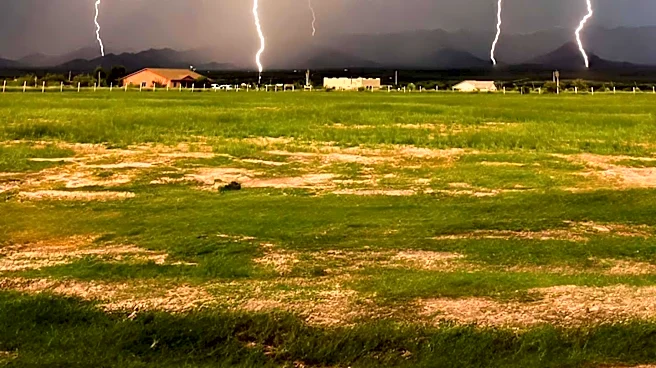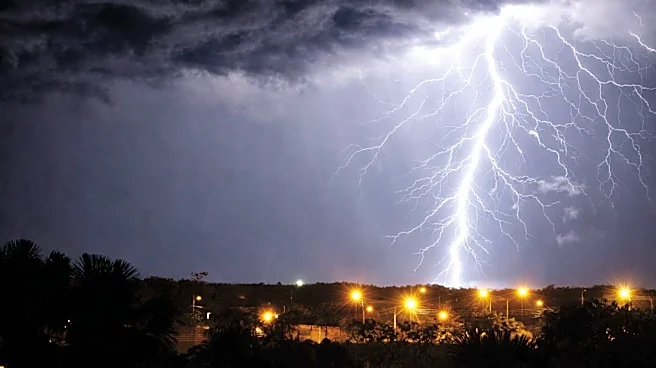


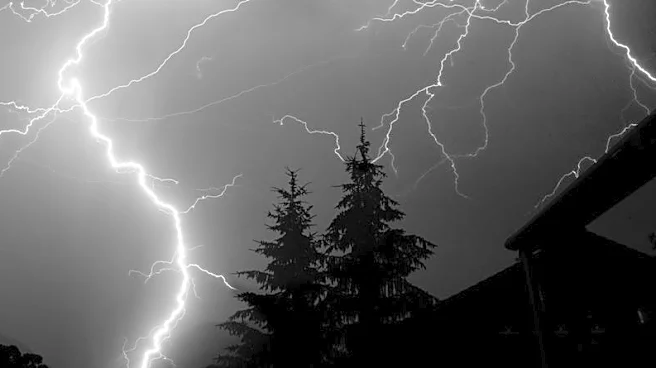
The storms grew on Aug. 23 as they do in South Florida summers, boiling cumulus clouds sparked with lighting riding along pushy afternoon sea breezes that turn sunny days dark.
National Weather Service meteorologists based in Miami issued at least seven special weather statements that day in response to a blister of thunderstorms forming along a north-south line near the coast.
It was status quo. Nothing out of the ordinary.
Then a mother and her toddler daughter were struck and killed by lightning in a Margate driveway as they arrived for Sunday dinner at a relative’s house.
At nearly the same time, about 25 miles north, lightning hit a child playing on a Boynton Beach field. Palm Beach County Fire Rescue officials said the injured person was taken
to a trauma center and met “pediatric trauma alert criteria,” which means they were under 15 years old. The lightning victim's condition was unknown as of Tuesday.
“It’s usually the first lightning strikes that tend to be the most dangerous because people may not be aware what’s coming even if the sky is starting to look dark and threatening,” said Robert Molleda, the meteorologist in charge at the NWS office in Miami. “The storms in the summer develop very quickly. That first rumble of thunder might be too late.”
The Aug. 23 strikes highlight the random, yet common, dangers of Florida thunderstorms, which since May 31 have killed four people, the most of any other state this year.
Michael Aiden Vargas, who went by Aidan, was kayaking on the Blackwater River near the Panhandle town of Milton on Memorial Day weekend when he was struck. He fell into the river and didn’t surface. It took searchers using sonar and dive teams more than 10 hours to find his body.

'Like an atomic bomb went off': Florida lightning strike came out of nowhere
On July 3, 51-year-old Viktar Kiryk was in the water at Fort Myers Beach when he was struck by lightning and died. A vacationing paramedic who tried to help Kiryk told WINK News he had a burn mark that ran from his shoulder over his chest.
“The clouds came in and it just didn’t look right,” witness Debra Crombie said in an interview with WINK. “It started raining and all of a sudden it sounded like an atomic bomb went off. We saw kids running off the beach back to our resort and they were screaming.”
Kameron Glasgow said he was steps away from his wife Kenya Glasgow and 2-year-old daughter when they were fatally struck Aug. 23. His other daughter, a twin to the one who died, was still in the car when the lightning hit, which may be what saved her. Cars with hard tops and the windows rolled up act to conduct electricity around the outside of the vehicle.
“I got the actual aftershock from the ground. By the grace of God, I’m still here as well,” Kameron Glasgow said while speaking with media.
In a social media post about the deaths he wrote: “I thank you both for choosing me as your husband and father.”
Molleda said a lightning tracker used by the NWS identified a strike at 2:25 p.m. on the street where Kenya Glasgow and her daughter were hit.
Florida is a top spot for lighting fatalities
Florida leads the nation in lightning deaths with 100 reported from 2006 through 2025, according to the National Lightning Safety Council. Texas had the second highest number of fatalities at 44, followed by Colorado’s 27.
In Florida last year, four people suffered lightning-related fatalities between June 14 and Sept 22. They died at the beach, while fishing, and on a hunting trip.
The year before, six people died in Florida after lightning strikes. All but one happened between June and mid-September as people sat under a tree in a park, swam at the beach and rode bikes through a neighborhood.
Nationwide, the top three activities that lead to lightning-related deaths from 2006 through 2025 are fishing, being at the beach and boating. Of the top 12, golf is ranked 11, just ahead of doing yard work.
While lightning is not attracted to any specific material — a persistent myth is that it seeks out metal — it is more likely to strike taller objects, making someone in a field, on a boat or beach, repairing a roof or on an open highway more exposed.
NWS meteorologist George Rizzuto said the Aug. 23 thunderstorms were sporadic, spread out and continuously building as rain-cooled air rushed out from one storm to form another.
That rain-cooled air, called an outflow boundary, is a form of lift that pushes warm air at the surface high into the atmosphere to trigger another storm.
“I think one factor is there were a lot of thunderstorms over the same area,” Rizzuto said. “You don’t have to be directly underneath one to get struck.”
In 2018, the National Weather Service in Miami announced fixed dates for the rainy season of May 15 to Oct. 15 in South Florida as a way to highlight summer dangers similar to the June 1 start date of hurricane season.
Why are there so many lightning deaths in Florida?
Florida’sgeography is partly to blame for the summer tumult. Spiking daytime temperatures trigger invading sea breezes from the coasts that force hot moist air over land to rise in a process called convection.
Depending on the conditions higher in the atmosphere, especially if it's particularly cold, ice particles form from that rising air. Colliding ice transfers electrons and separates electrical charges with negatively charged ice falling toward the bottom of the cloud, where it can discharge lightning to Earth.
And unlike hurricanes, which typically get days of advanced warnings, lightning is more random, striking in an instant and sometimes far from where the storm seems the worst.
Crombie, who was nearby when Kiryk was killed on Fort Myers Beach, said there were signs that a storm was coming, but people were still on the beach.
“There were a considerable number of people out and you think, ‘They can’t be from Florida,’” Crombie told WINK. “This lightning came out of nowhere and when I tell you it was so bright, our ears hurt and our eyes were blinded by it. That’s how intense it was.”
Kimberly Miller is a journalist for the USA TODAY NETWORK FLORIDA. She covers weather, the environment and critters as the Embracing Florida reporter. If you have news tips, please send them to kmiller@pbpost.com. You can get all of Florida’s best content directly in your inbox each weekday by signing up for the free newsletter, Florida TODAY, at palmbeachpost.com/newsletters.
This article originally appeared on Palm Beach Post: A family arrived for Sunday dinner, then lighting changed everything