






The well-heeled City of Boca Raton has banned feeding iguanas under threat of a $100 fine as South Florida sees a rebound in the invasive species following alarge die off during a February freeze.
But the iguana edict approved in a 3-2 vote Aug. 25 is as much about pigeons and their poop, as the nuisance lizard.
For years, an unneighborly dispute has simmered between an animal-loving septuagenarian whose backyard feedings attract scores of birds, and a man next door tired of the noise, feathers and excrement.
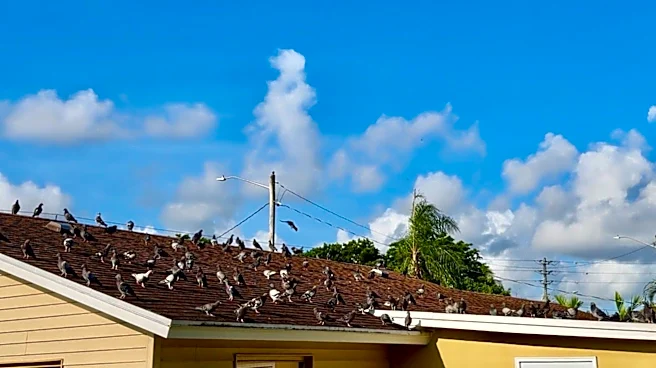
“It’s a constant cyclone of pigeons,” said Mark Stahlbaum, whose complaints about a daily assembly of 150 to 200 pigeons were the impetus for the new rule. “She is throwing out tons of food twice a day. It’s like I live in a bird airport.”
In a city known for its Mediterranean architecture and luxury resort communities, the argument against feeding wildlife — specifically iguanas, pigeons, rats and mice — reached a crescendo with a true Florida feel at the Aug. 25 meeting.
One woman brought her stuffed tortoises Thaddeus and Ted to the podium to oppose the regulation; another speaker complained about iguana poop in his pool but was nonetheless against the new rule and said it was overregulation akin to “renaming water bodies” — likely a dig at President Trump’sGulf of America. There was a question about what will happen to the “pigeon lady on 20th Street”, a call to summon Judge Judy and concerns about how it will be enforced.
Lilia Perez, the alleged pigeon perpetrator who lives next to Stahlbaum, acknowledged there are a lot of pigeons around her house and iguanas and squirrels and “other different animals” that have been feeding in her yard for 29 years.
And she was unyielding, even when faced with the $100 penalty.
“If you want to start fining me now, let’s do it,” Perez said during public comment.

Florida officials say don't feed the wildlife
Florida wildlife officials are generally against feeding wild animals citing problems with the poor nutritional value of the food, and concerns about encouraginglarge numbers of wildlifeto congregate in small areas. The proximity of animals leads to stress, competition and the spread of disease, according to the Florida Fish and Wildlife Conservation Commission.
There is also worry about delaying or altering migration patterns of birds, attracting predators and making a public nuisance.
“Wildlife does not need to be fed. There are very few instances when that is beneficial,” said Frank Mazzotti, a professor of wildlife ecology with the University of Florida/IFAS Fort Lauderdale Research and Education Center. “It tends to be something people do to make themselves feel better.”
He said Florida specifically prohibits feeding alligators, crocodiles, black bears, coyotes, bald eagles, manatees and non-human primates. There was a problem with people feeding rhesus monkeys, which carry diseases, Mazzotti said.
He also warned against feeding Muscovy ducks and peacocks.
“They don’t need it,” he said. “They are smart enough not to poop where they eat, which means they go to your neighbor’s yard and poop.”
What Florida cities have wildlife feeding bans
Boca Raton isn’t the first city to ban feeding wildlife. In January, Royal Palm Beach in Palm Beach County passed an ordinance prohibiting feeding animals in circumstances where it creates a nuisance, such as attracting flies or leaving fecal matter.
In 2024, Daytona Beach banned feeding pigeons in a way that creates a nuisance after merchants complained of droppings.
Coral Gables has a decades-old rule that bans people from keeping, maintaining or “otherwise” contributing to the existence of pigeons in the city.
In 2019, neighbors in the Ibis Golf and Country Club in West Palm Beach complained that a neighbor leaving food out had attracted dozens, if not hundreds of black vultures that left the neighborhood smelling like “a thousand rotting corpses.”
In addition to pooping, black vultures vomit foul smelling stomach fluids as a defense mechanism.
“As a general rule, just don’t do it,” Mazzotti said about feeding wildlife.
Boca Raton iguana-feeding ban has some laughing, others frustrated
Still, the public speakers at the Aug. 25 meeting were opposed to regulating the feeding of iguanas, pigeons, rats and mice.
“When I saw this on the agenda, I thought it was a little bit of humor to see if people were paying attention,” said Brianna Hanquist , who was accompanied by Thaddeus and Ted. “Then I saw it on Channel 5 and just about spit my coffee all over the rug.”
Boca Raton City Councilmember Yvette Drucker, who voted against the ordinance, said she didn’t know whether to laugh or be annoyed at the rule. Councilmember Michelle Grau, who also voted against the ordinance, said she didn’t want to create another level of government to address a single situation between neighbors.
But Boca Raton Mayor Andy Thomson said that’s part of what cities do.
“Believe it or not, not everything we do is landmark legislation,” he said at the meeting. “It is issues affecting residents.”

The ordinance is not expected to affect traditional bird feeders or the feeding of feral cat colonies in trap-neuter-release programs. Instead, it is focused on the quantity and manner in which food is provided and whether it is likely to attract a congregation of iguanas, rats, mice or pigeons.
Perez couldn’t be reached for comment for this story, but said during her three minutes of public comment that her relationship with Stahlbaum is tumultuous.
Last year, Perez was arrested and charged with misdemeanor simple battery after cell phone video showed her spraying Stahlbaum in the face with her garden hose during an argument over the pigeons, according to police and court records. Adjudication was withheld in the case but Perez did pay a fine.
Stahlbaum, who said Perez punishes him when she's mad by feeding the pigeons closer to the fence that separates their homes, pleaded for people to take the situation seriously.
“This isn’t a funny thing," he said. "It’s not something that is rare or weird. The biggest thing I wanted done was the pigeons. I don't know why they added the iguanas."
Because, Florida.
Kimberly Miller is a journalist for the USA TODAY NETWORK FLORIDA. She covers weather, the environment and critters as the Embracing Florida reporter. If you have news tips, please send them to kmiller@pbpost.com. You can get all of Florida’s best content directly in your inbox each weekday by signing up for the free newsletter, Florida TODAY, at palmbeachpost.com/newsletters.
This article originally appeared on Palm Beach Post: Feed iguanas and you face a $100 fine in this Florida city | Exclusive