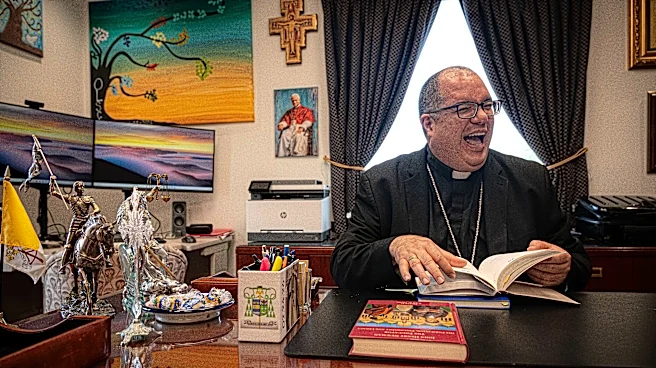



PALM BEACH GARDENS — Manuel de Jesus Rodríguez's decision to become a Catholic priest shocked even Dulce Maria Perez, his mother.
He had a full scholarship to the most prestigious private university in the Dominican Republic. He was in line for a career in criminal law, fighting for justice and defending people's rights.
So why did he want to become a priest?
"All my professors at the university told me, 'No, don't do it. A bright career is right ahead of you. Are you crazy?' "Rodríguez recalled in the melodious voice that now sounds from the pulpit at the Cathedral of St. Ignatius of Loyola in Palm Beach Gardens.
"But God wanted me here."
"Here" at first was a Catholic seminary on the Caribbean island he calls home. Then "here" became parishes
in Brooklyn and Queens, New York, one of which he revived after the COVID-19 pandemic had shut it down.
Now "here" is the seat of the Diocese of Palm Beach where, as Bishop Manuel de Jesus Rodríguez, he presides over about 275,000 Catholics across five counties in the region including the one that President Donald Trump calls home.
New bishop stands out among those who preceded him
Appointed by Pope Leo XIV in December and installed in February, Rodríguez is the sixth bishop of Palm Beach and a break in many ways from the five men who served before him.
He is unmistakable. He stands 6-foot-6 and has a knack for knocking his mitre off his head while passing through church doorways, and then re-placing it with a smile.
He is younger. At age 52, he is the youngest man to hold the office, and he could serve more than 20 years in it before he must retire.
He is the first Hispanic to be bishop of the diocese, which serves an increasing number of people who have come to the United States from the Caribbean, Central and South America.
His manner is playful and disarming. He loves to sing and can talk at length about the joy he gets from watching Disney movies, the waves in Juno Beach and, although he prefers baseball, this summer he followed the soccer World Cup, rooting for the U.S. and Argentina teams.
Often, however, his conversations are about the most serious of subjects: the treatment of immigrants, the dignity of the disadvantaged and the growth of the diocese at a time when Florida is booming.
Rodríguez said his mission is to swing the church’s doors open as wide as possible, even if that means defending people whom the U.S. government is targeting for deportation because of their legal status at the direction of a man whose Mar-a-Lago estate sits 15 miles southeast of the cathedral.
"In the Catholic Church, we will never let immigrants down," he said. "We will never betray them, because they are our people. They have been entrusted to us by the Lord, and it would be very immoral to let them down."
Bishop’s aim is to be out and among region’s people
Rodríguez spoke in a conference room at the cathedral, its red carpet freshly installed and its walls adorned with images of the Virgin of Guadalupe, a wooden cross and a map of the diocese’s territory.
He said he doesn't want to be known as a bishop confined to an office and a pulpit. He wants to be out in the parishes and neighborhoods, listening to people's concerns and engaging with the community.
As of July, he had already visited 50 of the diocese's 54 parishes, brought immigration lawyers to churches and held donation drives for the victims of the earthquakes that killed hundreds in Venezuela and Colombia.
He's attended St. Lucie Mets baseball games, even though he's a diehard New York Yankees fan, and took part in Theology on Tap, a casual gathering of young adults who discuss the Bible over pints of beer.
He’s celebrated Mass at juvenile detention centers and next year plans to take 50 children to South Korea for World Youth Day, the largest annual Catholic youth gathering.
And he said he has no plans to stop, even after a September trip to the Vatican for “baby bishop training,” at which he met with Pope Leo.
"Pope Francis made a point of reminding us we are not only bishops or priests, we are meant to be pastors with the smell of a sheep," Rodríguez said.
“You are a pastor or a bishop, but you are a sheep of the only flock, which is the Lord’s flock. So you belong to something bigger than you, that you are meant to serve.”
Bishop’s life rooted in Catholic teaching in Dominican Republic
The church and its relationship with its people, especially its youth, is personal for Rodríguez.
He was raised by a single mother in Moca, a largely Catholic town of about 165,000 people in the Dominican Republic, about 75 miles north of Santo Domingo.
His home parish is led by the Salesians of Saint John Bosco, an order devoted to the care and education of poor children, and he attended its schools. He recalled fondly their weekly events for children and its “Pascua Juvenil” Holy Week events.
Rodríguez took part in the church’s youth ministry and at age 16 attended a national Catholic retreat. While there, he felt the call to become a priest.

He put his law school career at Universidad Pontificia aside to attend seminary, where he obtained bachelor’s degrees in both philosophy and education. Two years later, he returned to obtain his law degree. He has seven degrees in all — four bachelor’s, two master’s and a doctorate in canon law — and is fluent in English, Spanish, Italian and French.)
In 1999, Rodríguez went on a missionary trip to Cuba as a seminarian, an experience that he said marked him. He said witnessing the island's difficult living conditions alongside the deep faith of its people strengthened his vocation to the priesthood.
Rodríguez became ordained in 2003 in Santo Domingo and celebrated his first Mass the next day in his home parish in Moca. He became a principal in the Don Bosco schools and even taught philosophy and ethics at Universidad Pontificia.
Then, his life changed. The Diocese of Brooklyn invited him to spend a summer in New York. While there, Bishop Nicholas DiMarzio gave him his first parish.
What New York City parishes taught Palm Beach’s bishop
St. Michael’s serves a largely Hispanic congregation near the Verrazzano-Narrows Bridge connecting Staten Island to Brooklyn, and it challenged Rodríguez from Day One.
He took over in the summer of 2020, when the COVID-19 pandemic had forced the church’s doors to close. Over 100 parishioners had died, and many others had lost friends and family members. Several priests Rodríguez knew died from COVID-19, too.
“I needed to act quickly because people were very sad,” he said. “I arrived on June 30, and by July 4 we were already open with all the safety measures.”
Slowly, people returned to Mass and youth groups. Rodríguez established a perpetual adoration chapel inside the church dedicated to the victims of COVID. It remains open.

St. Michael’s taught Rodríguez how to tend both to the faith and the daily needs of immigrants. They needed companionship and resources as much as spiritual formation, he said.
That can mean helping someone to solve a problem or understand their legal rights. It also can simply mean giving people a place to gather as friends and family.
"The church in this context is not only a spiritual place. It's also the only place where they socialize and have a social life," he said.
From St. Michael’s, Rodríguez moved to Our Lady of Sorrows, a Queens parish in the shade of LaGuardia Airport. It was there he received the call from Cardinal Christophe Pierre, the Vatican’s representative in the United States: Pope Leo had appointed him the bishop of Palm Beach.
"At first I never heard the word Palm, only Beach," Rodiguez said laughing. “And I go, ‘Are you sure that you are the apostolic nuncio?’ I will never forgive myself for that.”
Rodiguez though it was a prank until he grasped the nuncio’s French accent, and he accepted the offer.
"He said: 'Everything will change in your life. Your life until this day is going to be a whole different life. Everything is going to change. Get used to it,' " Rodiguez recalled.
"And, oh my dear Jesus, he was right."
So why did he get chosen for the role? Rodríguez said he is still trying to figure that out himself between laughs.
He never expected to leave New York. He told parishioners who had left for the Sunshine State that he’d never move to Florida. Before the phone call, he’d been to Palm Beach County only once, during a work trip.
"I went to Miami that day, and I was driving, and then I told myself, 'Keep driving, don't stop in Fort Lauderdale,' and I arrived in Boca Raton,” Rodríguez said. “And I fell in love with that beach.”
So, what do those parishioners say now? "They look at me and laugh."
Bishop’s immigration stance in line with Pope Leo XIV

Many saw Rodríguez’s appointment as a sign from Pope Leo, who has been at odds with the Trump administration over its treatment of immigrants and the way many of them are living in fear of deportation.
Rodríguez said he doesn't want to undermine the legal immigration system but said addressing the plights of the immigrant community was central to growing his New York parishes and keeping them united. He believes it will be the same case at the Diocese of Palm Beach.
Not long after his installation on Feb. 24, he appealed to first lady Melania Trump to intervene and help restore $11 million in funding for the Miami Diocese to care for unaccompanied immigrant children.
He also called the president’s attacks on Pope Leo — in which the president said the American-born pontiff is “weak on crime,” “terrible for foreign policy” and “very liberal” — "violent and disrespectful."
Rodríguez also has been outspoken against the revocation of Temporary Protected Status for Haitians, thousands of whom live in the diocese and now face return to the nation that shares the island of Hispaniola with the Dominican Republic.
"What benefit is this nation going to find in depriving people who are here legally on TPS working, paying taxes, and contributing to the economic growth of the communities?" Rodríguez said. "This measure will intensify the difficulties concerning the financial struggles for families and businesses."
"We have a wonderful presence of Haitians in our diocese of Palm Beach and we suffer with them and for them,” he added. "This is not something that is indifferent for us or simply a political position. This is the reality of our lives. We cannot remain silent in the presence of these kind of decision that go against the values we stand for: the respect to the people's right to have a future.”
Rodríguez is hopeful the church will prevail. He says the United States is experiencing a "spiritual revival" and that the diocese’ biggest challenge is expanding to keep up with the county’s growth and population boom.
In New York, he said, the talk was always centered around merging and closing parishes.
"Here, the talk is, 'Where do we open a new parish?' ” He said the church is looking at three areas of tremendous growth: Westlake, The Acreage and Tradition in Port St. Lucie.
Rising to meet those challenges, Rodríguez said, energizes him and keeps him "joyful."
"I am in love with Palm Beach Diocese and the five counties. It's a beautiful joyful thriving community of communities,” he said.
Valentina Palm covers immigration and breaking news for The Palm Beach Post. Email her at vpalm@pbpost.com and follow her on X, the platform formerly known as Twitter, at @ValenPalmB. Support local journalism: Subscribe today.
This article originally appeared on Palm Beach Post: A bishop for his time: Manuel Rodriguez new voice of Catholic Church