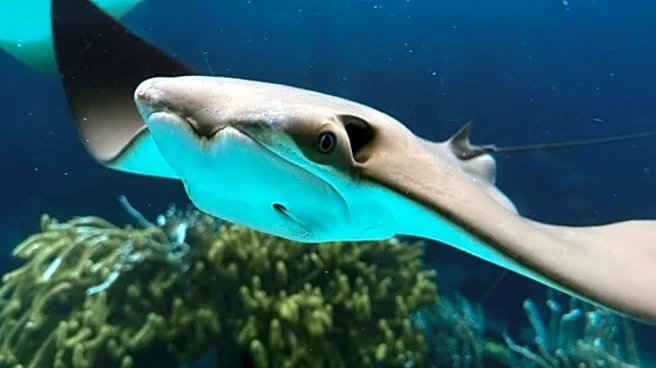










Cownose rays hug Florida’s coast in schools of hundreds, aslow-motion flutter of chocolate-colored wings in the upper reaches of the water column both conspicuous and captivating.
But they also grow dense fibrous muscletissue wrapped in a tough skin that stays together on fishing hooks, making them popular bait, especially for fishermen stalking shark and grouper.
With anecdotal reports that cownose ray populations may be slipping, the Florida Fish and Wildlife Conservation Commission is considering the first harvest regulations on the animal whose schooling habits also make them easy and efficient prey for humans to catch en masse.
Because they have similar or lower reproductive rates than other ray and shark species that cannot be harvested in
state waters, conservationists are surprised that protections haven’t been sought in the past for cownose rays.
The season for cownose rays is year-round. There is no size limit or quantity restrictions for commercial fisheries. And any fishing method allowed in Florida — cast nets, spears, hook-and-line — may be used.
“One thing that came up repeatedly is we have a completely unregulated cownose ray fishery where very similar species that are equally charismatic have a completely prohibited status,” said John Hlavin, an assistant professor of marine science at Eckerd College in St. Petersburg. “Primarily these are being harvested for bait, which I think is not a particularly high-priority use of a very low reproductive organism.”
Erica Burgess, FWC section leader for marine fisheries, recommended regulations during an Aug. 5 commission board meeting, noting that cownose rays have among the lowest reproductive rate of any fish allowed to be harvested in Florida.
Cownose rays, so named because oftheir distinctivedual-lobed forehead, don’t reach maturity until between 5 and 8 years old with females having about one pup per year. A typical female lives to about 20, which means each one has an estimate of just 15 pups in a lifetime.
“They mature late and have a gestation of 10 to 11 months. In the Gulf, females may produce a pup every other year,” Burgess said. “They are vulnerable to declines and cannot sustain high levels of harvest.”
What are the population estimates of cownose rays?
But there are no population estimates or stock assessments in the U.S., partially because their schooling behavior can mask changes in abundance, Burgess said.
“Some stakeholders and scientists have noticed declines,” she added.
Anglers who spoke against regulating the harvest of cownose rays pointed to the lack of population estimates, or proof that their numbers are dropping.
Karen Bell, who oversees the 103-year-old A.P. Bell Fish Co. in Cortez near Bradenton Beach, said cownose rays are a small but important part of her business.
“For us to lose any of what we target is continually chipping away at our commercial fishery,” Bell said at the Aug. 5 FWC meeting. “We’ve been called greedy and that’s so offensive. I don’t think there are many people out there that are more conscientious of the environment than commercial fishermen.”
The state’s recommendations for restricting cownose ray fishing would be to limit recreational fishermen to two per person or vessel. Commercial fisheries would have bag limits of 20 per commercial harvester or per vessel, whichever is less.
Burgess said the limits would maintain access but also reduce the risk of whole schools being harvestedon a single trip.
Opponents disagreed.
“The science should come first and the regulations should follow, not the other way around,” said Cortez Bait and Seafood owner John Banyas. “This does not explain how staff arrived at 20 fish per vessel.”
Why cownose rays are important to Florida
But Hlavin argued that the lack of a population estimate means it’s only prudent to safeguard the rays with minimal disturbance to the people who earn a living off catching them.
“Twenty actually seems like a lot when I think the species should be prohibited,” Hlavin said. “But they are used to going out and getting a couple hundred at a time.”
Hlavin said cownose rays are important players in the coastal ecosystems, acting as are both predator and prey.
They keep the ecosystem below them “in check” by eating mollusks, crabs and snails, while also providing food for apex predators such as sharks.
At the same time, Hlavin said cownose rays have tourism value, wowing people with their large migrating schools.
The FWC Commission postponed a vote on potential harvest regulations, asking its scientists to speak more with the community about the potential effects of restrictions.
“The bare minimum would at least be a start,” said Spencer Roberts, a University of Miami PhD candidate researching shark conservation. “The whole scientific community has come together to rally around the rays.”
Kimberly Miller is a journalist for the USA TODAY NETWORK FLORIDA. She covers weather, the environment and critters as the Embracing Florida reporter. If you have news tips, please send them to kmiller@pbpost.com. You can get all of Florida’s best content directly in your inbox each weekday by signing up for the free newsletter, Florida TODAY, at palmbeachpost.com/newsletters.
This article originally appeared on Palm Beach Post: Cownose ray population may be slipping and that's bad for Florida