





After about a dozen ocean cruise vacations, a river cruise to a part of the world we had never experienced was next on our list. And the Danube River, especially in Eastern Europe, offered a winding, scenic journey through history, a trip that combines the beauty of its river ports combined with a passage through time.
But if the goal was to enjoy the full river cruise experience, including an actually 'full' river, this was not the summer to sail through Europe. When Renee and I arrived we embarked on far different trip than promised, all due to a continent in the throes of a record drought.
Intense heat and ultra-dry conditions dropped river levels to historic lows this summer and several cruises in the region have been altered, forcing companies
to modify itineraries.
Historic sites were on our list, but receding waters were delivering more history than anyone expected. Along the Danube, Europe's second-longest river, World War II relics have been exposed. The remains of two German soldiers were found in the riverbed in Budapest along with identification tags, dozens of German warships, an intact German army motorcycle and unexploded ammunition. (Not that these were stops on our itinerary.)
Also not included in our trip, but of further note with regard to the drought: The remains of a woolly mammoth were found on the river bed in Bulgaria and nuclear power plants were taken off line in Romania.
Booked in December, our trip on the Viking Eldir, a longship accommodating 190 guests plus a crew of 53, was scheduled to set sail in Bucharest and conclude more than a week later in Budapest while visiting five countries — Romania, Bulgaria, Croatia, Serbia, Hungary.

We were grateful to get to all five countries, part of the reason we chose this cruise. But what was supposed to be about a 500 miles on the river turned into 230 miles of cruising, along with two long bus rides and an couple of extra nights in a hotel with half of the six ports where we were to dock in water too shallow to reach.
We felt the impact of the drought on day 1. Rather than boarding at the port in Bucharest, we arrived in that city and took a bus to Vidin, Bulgaria, where the ship awaited. And even then we were lucky — we were told we were the last ship to sail before that port was closed.
The cruising ended three days early, in Belgrade, a bus taking us from Belgrade to our final port in Budapest. There we spent three nights in the Corinthia, a five-star hotel located in the center of the city.
The change in transportation and sleeping arrangements weren't all bad. We still got in one day of scenic sailing and we were not detoured from the three main attractions — Bucharest, Belgrade and Budapest. We also got an extra day in Budapest. Traveling by land also allowed us the unusual experience of having breakfast, lunch and dinner in three countries: Serbia (Belgrade), Croatia (Osijek) and Hungary (Budapest).
We never regretted the trip or the timing. Travel never goes off as planned, and what we experienced was historic, beautiful and fascinating.
The Danube was low, but the trip still delivered

Revolutions, dictators and kings
Eastern Europeans speak openly about the past — the triumphs and the tragedy. They acknowledge their heritage, from dictators to uprisings to reconstruction.
And they believe the only way to learn from the past — and to assure history does not repeat itself — is embrace it. Not erase it.
The trip along the Danube from Bucharest to Budapest is a journey taking you from four decades of communism to the rebuilding and renaissance that came after some very painful and costly wars and revolutions.
From the personal story of a man who was on the frontline of the Romanian Revolution in Bucharest that led to the overthrow of a brutal Communist dictator, to visual reminders of the Croatian War of Independence, to a chilling Holocaust memorial on the Dunube, to Budapest with its awe-inspiring architecture.
This journey took us through parts of Europe not open to visitors a few generations ago.
"We do not hide from our history," said Marko, a tour guide in Belgrade whose high school in downtown was built just before communism was established.
Before we met Marko, we were introduced to Egmont Puscasu, who at 15 joined the Romanian Revolution on Dec. 21, 1989. The revolution to overturn 42 years of communist rule had been brewing with bloody riots for several days and on that day had reached the capital of Bucharest and dictator Nicolae Ceausescu.
Puscasu spoke just feet from Revolution Square in the center of Bucharest where the fighting took place and where a famous photo was taken of him standing on the top of a truck with several revolutionists. He displayed his arm scarred by a bullet wound and recounted standing next to a friend when the friend was fatally shot in the head.
That day marked Ceausescu's final speech. He and his wife were executed four days later.

Puscasu proudly held up a Romanian flag in which he had cut out the communist symbol. Blood stains are still visible on the flag.
Like many of these large Eastern European cities, Bucharest has a vibrant nightlife and is a mixture of modern growth and communist-era architecture. Green spaces have been carved out between the large, gray, block-style apartment buildings. Or what locals call "Commie Condos."
Bucharest is home to the second-largest administrative building in the world and the heaviest building on earth, the Palace of the Parliament, which was commissioned by Ceaușescu in 1984.
The building is famously known as the spot where Michael Jackson stepped onto the central main balcony during his World Tour in 1992, raised his hands to greet thousands of Bucharest residents, and said: "Hello, Budapest." Oops.
We remained in Romania for two more days, sailing to Turnu Severin and visiting a museum and the remnants of baths, a cemetery and a bridge built in the 2nd century. From there it was onto Orsova, a port city in southwest Romania with picturesque riverfront scenery. We visited the Hercules Baths and the Hercules Statue in the spa town of Băile Herculane.
Our lone scenic sail took us from Orsova to Golubec, Serbia, where we passed the rock sculpture of Decebalus, a 180-by-82 foot carving of the king of the Dacia at the Iron Gates gorge. Dacia is a region in Southeastern Europe and Decebalus was its last king, who battled to maintain independence against the Romans in the early 100s.

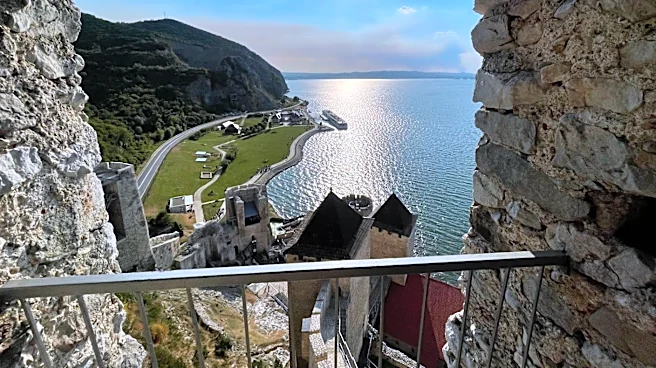
We docked in time for a busy day that included a mile hike up a peak overlooking the Iron Gates that offered views of where the Danube cuts between the Carpathian and Balkan mountains; and a 230-step climb, some on very uneven rock, to the top of the 14th-century medieval stone Golubac Fortress, built to guard the entrance to the Iron Gates gorge.
This was one of several fortresses and castles we either visited or passed during the trip. Europe is home to thousands of fortresses built during the middle ages to protect their land. Many are strategically built by river bends, on hills and mountain passes, offering sweeping views of the area.
That night would be the last time we sailed, docking in Belgrade for two days of tours, before our final bus ride to Budapest.
Belgrade, the capital of Serbia, once served as the capital of Yugoslavia. Each of the five countries we visited were under communist rule from the mid- to late-1940s to around 1990, with Croatia and Serbia two of six republics that made up the Socialist Federal Republic of Yugoslavia. All six became independent nations after the Yugoslav Wars in the early 1990s.
The region has battle scars dating further back, but also remarkable efforts to reclaim the inherent beauty.
Belgrade was bombed heavily in both World Wars. The city has turned the Belgrade Fortress, and the park in which it sits, into an scenic destination for locals and tourists, complete with several basketball courts, on which a camp was being held the day we visited, and a children's dinosaur-themed attraction with more than 35 life-size dinosaur statues and animatronic models that move and make sound.
The fortress overlooks the Sava and Danube rivers. The city offers a mix of modern buildings with the 19th century European and brutalist block buildings.
Basketball is a growing sport in Serbia. The country is especially proud of native son and superstar Nikola Jokic, the Denver Nuggets center who is a three-time NBA MVP.
We said goodbye to the Eldir, hopping on another coach for a long day through the Romanian and Croatian countryside before arriving in Budapest for a three-night stay. This part of the trip was supposed to be a cruise through several riverside towns. Instead, after a roughly 90-minute pause to get through border control and customs checks crossing from Serbia to Croatia, we bussed through the city of Vukovar before stopping for lunch in Osijek.
Vukovar is a key historical marker of the 1991 Croatian War of Independence. It was the site of a battle in which a small group of Croatian defenders held off the Serbian-led federal army, earning the city the name "City of Heroes."

The trip was a constant reminder of the conflict, which led to 20,000 deaths. Although the town was flattened and most of it rebuilt, many homes remain in the same condition as they were after being reduced to rubble with a couple of cement block walls standing. The city's water tower remains as it was following the attack in which it was damaged by artillery and missiles, a powerful symbol of resistance and survival.
Budapest breathtaking beauty from hills to flatland
The best was yet to come. We were not prepared for the stunning views and beauty Budapest offered from either side of the river.
Budapest, the capital city of Hungary, is split by the Danube. The hilly side is Buda with historic royal sites and medieval streets. Across the Danube is the flat land of Pest, more vibrant and cultured.
Our two days covered both sides. Heroes Square, the National Museum, Great Market Hall, Hungarian State Opera, City Center, St. Stephen's Basilica and Hungarian Parliament Building on the Pest side. The Buda Castle, Fisherman's Bastian, Liberty Monument and sweeping vistas of the Danube and entire city on the Buda side.

The city is home to a very poignant Holocaust memorial honoring the Jewish men, women and children executed along the edge of the Danube during World War II.
The Shoes on the Danube Bank sit steps from the Parliament. The 60 pairs of bronzed shoes represent the thousands who were forced to remove their shoes before being executed and left to fall into the water. At the time, shoes were considered a valuable commodity.
The area is solemn with most people respectful of its historical significance. The somber atmosphere is comparable to what I felt visiting sites like the Pearl Harbor Memorial, the Memorial to the Murdered Jews of Europe in Berlin, and where the Twin Towers once stood in New York.
Travelers frustrated over changes forced by drought
For those like us whose trip ended in Budapest, the drought-imposed changes were inconvenient but manageable and understandable. Nobody can control Mother Nature. Although the cruise line did a good job scheduling last-minute ports and excursions, some were frustrated over the lack of communication.

The most frustration was felt by our travel companions who continued on to Amsterdam. A trip on which they expected to be sailing for 23 days on the same ship. One passenger was told they would be changing ships several times to complete the final 12 days of their journey.
We returned home to emails offering credits and discounts to future cruises. By this time, the company was allowing travelers to reschedule their vacations.
Would we do it over knowing the disruptions? Absolutely. We visited a part of the world we never had and likely never will again.
But lesson learned: Never book a summer European river cruise eight months out. This likely is not the end of extreme vacation-altering conditions.
Tom D'Angelo is a senior sports columnist and reporter for The Palm Beach Post. He can be reached at tdangelo@pbpost.com.
This article originally appeared on Palm Beach Post: Getting through Eastern Europe when drought detours your river cruise