
Unlike most races on Florida's 2026 general election ballot, voters will not be choosing between competing candidates in appellate judicial retention contests. Instead, voters will decide whether certain
judges and justices should remain in office.
Florida uses a merit-retention system for its Supreme Court and District Courts of Appeal. Judges and justices, who are nonpartisan, are appointed by the governor after a screening process and later appear on the ballot for a yes-or-no retention vote.
A majority "yes" vote allows them to remain on the bench for another six-year term. A majority "no" vote creates a vacancy that is filled through the state's judicial appointment process.
No Florida Supreme Court justice or District Court of Appeal judge has ever lost a retention election since the state adopted its merit-retention system in the 1970s.
Key facts
- Type of election: Judicial retention
- How it works: Voters decide whether judges and justices should remain in office.
- Political parties: Judicial retention elections are nonpartisan.
- Vote required for retention: A majority of voters must vote "Yes" for a judge or justice to remain on the bench.
Florida Supreme Court
The Florida Supreme Court reviews and decides cases involving major questions of state law and constitutional interpretation, reviews death penalty challenges, resolves conflicts among lower courts, and oversees the administration of Florida's judicial system.
This year, one Florida Supreme Court justice is up for retention statewide:
Justice Carlos G. Muñiz

Muñiz was appointed to the Florida Supreme Court by Gov. Ron DeSantis in January 2019. Before joining the court, he served as chief of staff to former Attorney General Pam Bondi and held legal positions in both Florida state government and the federal government. As a member of Florida's highest court, Muñiz has participated in decisions involving constitutional amendments, congressional redistricting, election law, death penalty cases and other major legal disputes affecting the state.
Notable decision: As author of the court's 2025 majority opinion, Muñiz upheld Florida's redrawn congressional districts map backed by DeSantis, rejecting challenges to the redistricting plan that eliminated a north Florida district previously designed to provide Black voters an opportunity to elect their preferred candidate.
What voters will see on the ballot: "Shall Justice Carlos G. Muñiz of the Supreme Court be retained in office?" Voters will mark either "Yes" or "No."
First District Court of Appeal
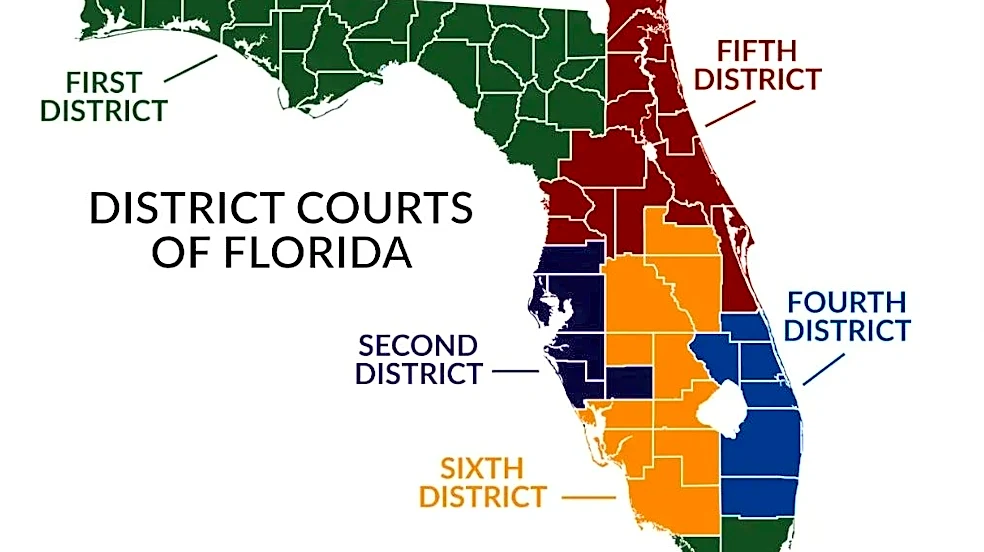
The 1st District Court of Appeal hears appeals from trial courts and state agencies across north Florida, including Tallahassee and the surrounding region. District Court of Appeal judges review appeals from trial courts and government agencies, determines whether legal errors occurred, and issues opinions that help guide the interpretation of Florida law.
Five judges on the court are up for retention this year:
Judge Joseph Lewis Jr.

Lewis has served on the court since 2001, after being appointed by Gov. Jeb Bush, including as chief judge 2013–15. A Tallahassee native, Lewis received a B.S. from the University of Montana in 1974 and a J.D. from Florida State University College of Law in 1977. Before joining the bench, he served as an assistant public defender and held senior and bureau chief positions with the Florida Attorney General’s Office. His honors include the Florida Bar Meritorious Public Service Award and the Claude Pepper Outstanding Government Lawyer Award. He has also contributed extensively to bar, civic, and pro bono legal organizations.
Notable decision: As lead author of a 2-1 ruling, Lewis upheld a decision barring a Republican House candidate from the ballot after her qualifying check was returned by her bank. Lewis wrote that state law required candidates to cure returned checks before qualifying ended, calling the result harsh but legally mandated.
Judge Rachel E. Nordby

Nordby has served since 2019, following her appointment by Gov. Ron DeSantis. Before joining the court, she was a partner and vice chair of the appellate practice group at Shutts & Bowen LLP and previously served as senior deputy solicitor general in the Florida Attorney General’s Office, handling constitutional and other high-profile state cases. A graduate of the Florida State University College of Law, where she was editor-in-chief of the law review, Nordby has been active in legal education and bar leadership. She also clerked for the First District Court of Appeal early in her career.
Notable decision: As lead author of a 3-0 ruling, Nordby reversed a lower-court decision that the DeSantis administration improperly delayed producing public records related to the 2022 migrant flights to Martha’s Vineyard. Nordby wrote that the records response was reasonable given the requests’ scope, a backlog, and preparations for Hurricane Ian.
Chief Judge Timothy D. Osterhaus

Judge Timothy Osterhaus has served on Florida’s First District Court of Appeal since 2013, when he was appointed by Gov. Rick Scott. Before joining the court, he served as Florida’s solicitor general and deputy solicitor general, representing the state and its agencies in appellate cases before Florida courts, the U.S. Supreme Court and other federal courts. He also worked for the Florida Department of Education, practiced law in Washington, D.C., and clerked for a federal judge. Osterhaus earned a bachelor’s degree with highest honors from King College and a law degree from the University of Virginia.
Notable decision: Osterhaus wrote a separate opinion in a 2023 major Florida redistricting case involving legislative maps. While agreeing with the court’s decision, he emphasized that Florida lawmakers and courts must comply with the U.S. Constitution’s equal-protection requirements when drawing and reviewing voting districts. His opinion addressed the role of race in redistricting and the interaction between federal and state constitutional law.
Judge L. Clayton "Clay" Roberts

Roberts has served on Florida’s 1st District Court of Appeal since 2007, when he was appointed by Gov. Charlie Crist. A West Point graduate and Florida State University law alumnus, he previously held senior legal and elections posts in state government, including deputy attorney general and director of the Division of Elections. Roberts has taught constitutional and election law and he served as chief judge of the 1st DCA from 2015 to 2017. He received the Florida Chief Justice’s Award for Judicial Excellence in 2026.
Notable decision: Roberts authored a 2024 opinion in a public-records dispute involving Gov. Ron DeSantis’ office. The court dismissed a lawsuit seeking records about advisers who helped DeSantis select Florida Supreme Court justices, ruling the requester could not proceed anonymously. Roberts declined, however, to endorse a lower court’s discussion of executive privilege, saying it was unnecessary to resolve the case.
Judge Raymond F. Treadwell

Treadwell joined Florida’s 1st District Court of Appeal in 2024 after being appointed by Gov. Ron DeSantis. A graduate of the University of Florida and Yale Law School, he previously served as the governor’s chief deputy general counsel and helped oversee litigation involving state laws and policies. Before joining the court, he practiced with a Tallahassee law firm and served as general counsel for Florida’s Department of Business and Professional Regulation. He has also been active in legal and constitutional-law organizations.
Notable decision: Treadwell authored a 2025 opinion affirming the dismissal of a workers’ compensation claim for medical benefits. He wrote that claimants must provide evidence linking requested treatment to a work-related injury and that claims lacking evidence to support an essential element may be resolved without a trial.
What voters will see on the ballot
Voters will answer the following questions individually:
- Shall Judge Joseph Lewis Jr. of the First District Court of Appeal be retained in office?
- Shall Judge Rachel E. Nordby of the First District Court of Appeal be retained in office?
- Shall Judge Timothy D. Osterhaus of the First District Court of Appeal be retained in office?
- Shall Judge L. Clayton Roberts of the First District Court of Appeal be retained in office?
- Shall Judge Raymond F. Treadwell of the First District Court of Appeal be retained in office?
For each, voters will select either "Yes" or "No."
How much are they paid?
A Supreme Court justice's pay is $264,136 yearly and a District Court of Appeal judge makes $223,318 a year.
Important election dates
- General election: Nov. 3, 2026
- Vote-by-mail request deadline: Oct. 22, 2026
- Early voting statewide: Oct. 24-31, 2026, with some counties offering additional days and hours
- More information: dos.fl.gov/elections/for-voters/
Some biographical and other information comes from The Florida Bar and court websites. Additional background is from USA TODAY Network – Florida reporting. Jim Rosica also contributed.
This article originally appeared on Palm Beach Post: A Florida voter guide to judicial retentions on the ballot