

In the hardened coastal landscapes of South Florida where solid seawalls replaced sandy shorelines, where’s an American crocodile to go to catch some rays?
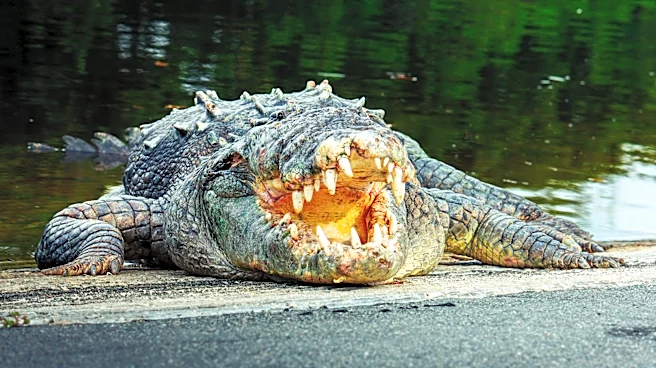
Increasingly, state officials expect to see the slim-snouted reptiles on paddleboards and jet skis and floating docks where they can more easily climb out of the brackish murk to bask.
Because crocodile habitats are the same briny waterways that humans have shellacked with concrete for waterfront homes, the ashen-colored predators are coopting manmade structures and seafaring toys for their own survival, according to a paper written by Florida Fish and Wildlife Conservation Commission scientists.
And as the population of American crocodiles grows, their ability touse modified environs beyond
protected areas may be key to their prosperity, notes the paper titled “American crocodiles on jet skis: Conflict or coexistence.”
“If a crocodile is in a canal with seawalls, the only place for them to go is a dock, or the back of a jet ski,” said Ryan Gradney, a reptile expert and owner of West Palm Beach-based Scales Exotics. “It’s not like they are seeking these items out, that’s their only option.”
What are key differences from Florida crocodiles and alligators?
Crocodiles and alligators are both ectotherms, meaning their body temperatures are controlled by their environment and they sunbathe to warm themselves. But alligators are more cold tolerant with vast freshwater resources, which allows them more room to roam away from humans.
Alligators are also less likely to linger in the salted waterways cut into Florida’s southernmost reaches because they lack a key resource that allows crocodiles to withstand brackish water — salt glands near their tongue where they can excrete excess salt.
“Alligators tend to have more options in the freshwater environments where they live when it comes to basking locations,” FWC said in an email response to questions about why crocodiles are using jet skis to bask.
In recent years, crocodiles have been seen:
- Lounging on a kayak and a jet ski in Broward County.
- Sunbathing on the deck of a derelict boat in the Keys.
- Chilling on the sun shelf of a pool in Monroe County.
- Swimming with the tarpon at Robbie’s Dock in Islamorada.
- Hanging at the eighth hole of the North Palm Beach Country Club golf course.
- Bogarting platforms at the Flamingo Marina — the southernmost tip of Everglades National Park.
“It’s almost like a private dock for them to sit out and sunbathe,” said naturalist and photographer Alexander Joseph, who is with the non-profit group Xplorist. “Swimming is not advised.”
How many Florida crocodile attacks on humans have there been?
Swimming and snorkeling are prohibited in all canals, ponds, freshwater lakes, marked channels and boat basins inside Everglades National Park, partly because of alligators and crocodiles.
In 2024, a 68-year-old man capsized his sailboat at the Flamingo Marina and said he was bitten by a crocodile while trying to swim his boat to shore, according to a park press release. He was treated for a laceration on his leg.
Still, while the number of crocodiles has rebounded from a few hundred in 1975 to an estimated 2,000 today, the 2024 incident is one of only two attacks recorded by FWC. Neither were fatal. The first attack was in 2014 when a Miami man was bitten after jumping into a Coral Gables canal.
“America crocodiles don’t go out looking for people,” Joseph said. “They eat fish, amphibians and other reptiles, and for the most part are rather timid.”
That doesn’t keep people from confusing American crocodiles with the saltwater crocodiles of Australia that can grow to 23 feet and have fatally attacked humans. And then there’s the 1999 movie “Lake Placid” where a giant crocodile snacks on people after being fed by Delores Bickerman (Betty White).
Someone posted on Trip Advisor about the Robbie's Dock croc that it was "going to kill a child BEWARE!"
“It’s just about using precautions and knowing that these animals are predators," Gradney said. "This is not a Disney movie.”
American crocodiles are protected as a threatened species
American crocodiles, distinguished from alligators by their grayish coloring and pointed snout, were named federally as an endangered species in 1975. Florida is the only state in the country where crocodiles live in the wild.
In 2007, crocodiles were downgraded from endangered to threatened.
Most live in Everglades National Park, Florida Bay and Biscayne Bay, building nests in the soft Earthen berms of Florida Power & Light's Turkey Point cooling canals and the exposed shoreline of Florida Bay.
But with more people and more crocodiles, there’s bound to be some overlap.
“In some areas, it is difficult to imagine a crocodile fulfilling its physiological requirements without the ability to bask on docks, jet skis, or other floating recreational equipment,” the FWC paper notes. “Rather than just amusing anecdotes or an inevitable consequence of growing populations of people and reptiles, these observations help to explain how American crocodiles can persist in a heavily developed landscape.”
Kimberly Miller is a journalist for the USA TODAY NETWORK FLORIDA. She covers weather, the environment and critters as the Embracing Florida reporter. If you have news tips, please send them to kmiller@pbpost.com. You can get all of Florida’s best content directly in your inbox each weekday by signing up for the free newsletter, Florida TODAY, at palmbeachpost.com/newsletters.
This article originally appeared on Palm Beach Post: Florida crocodiles are turning jet skis and kayaks into vital habitat