
The Palm Beach Post's recent reporting of two new food and dining concepts coming to Clematis Street could be seen as another reinvention of West Palm Beach's long-time main street.
Two new Mexican-inspired
places will land on Clematis soon: Taquerías Carnalito, a taco place that will take the space at 301 Clematis St. formerly occupied by Nico's Pizza, and Tragos Amargos, a speakeasy that will be inside Taquerías Carnalito.
Some see the move as another rebirth of Clematis Street, the downtown business district that has been around as long as the city.
It started with humble beginnings in 1894 when West Palm Beach’s first grocery store and post office opened in a tent at the corner of Clematis and Narcissus, making the street one of the city's earliest commercial centers.
While Henry Flagler built his empire across the Intracoastal Waterway in Palm Beach, businesses, banks, professional offices and merchants clustered around downtown West Palm Beach, where it grew from a frontier settlement into the county’s economic center.
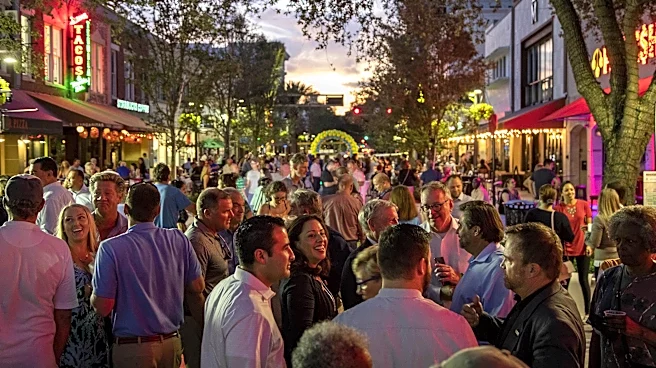
When shopping centers and suburban development spread west in the late 20th century, Clematis lost its commercial luster and reinvented itself as an entertainment district. Restaurants, bars and nightclubs replaced many traditional retailers, turning the street into one of South Florida’s best-known nightlife corridors.
In 1999, during the grand opening of CityPlace, Donald Trump, then a New York real estate mogul living in Palm Beach, called Clematis “the hottest street in Florida."
Over the years, while some places came and went, Clematis continued to draw late-night crowds, live music and club-hopping.

Then the COVID-19 pandemic hit and West Palm Beach became known as “Wall Street South," because of an influx of finance firms, Class-A office towers, luxury residential development and new corporate investment. It's brought a new mix of residents, workers and visitors into the urban core.
Clematis now isn't just nightlife but it has matured as a city center defined by walkability, new housing, office development, neighborhood-serving businesses and upscale dining.
There are more restaurants than bars, and office workers, residents and tourists help support businesses throughout the day rather than just at night.
Since the 2020 pandemic, more than 250 financial services firms have established offices in Palm Beach County, said Kelly Smallridge, president of the Business Development Board, the county's business recruitment arm.
Although many of these firms are clustered in office towers at CityPlace or in office towers along Flagler Drive, some tenants are seeking out more boutique buildings in and around the downtown.

Several new firms have landed at the Banyan and Olive complex, where Wall Street is mixing with the city's historic Main Street. The two-building complex features a new, modern tower next to a restored, 90-year-old building designed in the Art Moderne style.
Among the office complex's tenants are telecom service provider Dycom Industries, which moved its headquarters to the building from Palm Beach Gardens; and Alvarez & Marsal, a global management-consulting firm, which expanded to West Palm Beach to serve high-net worth clients and companies.
National law firm Taft occupies space in the building after its merger with Mrachek Law, a longtime boutique litigation firm.
In addition, at the 111 Olive next door, the Edward Jones brokerage occupies a full floor.
For Danny Cruz and his wife, Vilexis, the owners behind the new Mexican-inspired concepts coming to Clematis, they saw the growth and opened a Mexican eatery called Tacos del Cartel at 533 Clematis St. in mid-2025. It was the couple's first such franchise outside of Louisiana.
"We chose West Palm Beach because we believe in the city's future," the couple said in a statement. "We've always been welcomed by the community, and we love its energy and growth. It's a place we're proud to invest in and grow with."
Taquerías Carnalito and Tragos Amargos will be in the Banyan & Olive office complex, stretching along Olive Avenue from Clematis Street on the south to Banyan Boulevard on the north. The property, which consists of a modern new building and a restored post-Art Deco building, is in the heart of the city's business core.

Both concepts are important additions to downtown, said Andrew Dance, managing partner of Brand Atlantic Real Estate Partners, one of the property's owners.
"Carnalito addresses the growing need for high-quality fast-casual food in downtown," Dance said. "And Tragos Amargo introduces a proper, upscale cocktail lounge with a beautiful design and great vibe in an intimate speakeasy setting."
The venues are expected to open in late 2026 or in the first quarter of 2027.
The Veho restaurants join two other restaurants at the Olive & Banyan complex.
One is Kyma, a New York restaurantserving Greek cuisine, which opened its first location outside New York in the complex.

The modern Greek restaurant with the cuisine of a traditional taverna leases ground-floor space and outdoor space in the alley between 300 Banyan and 111 Olive. It also has a rooftop bar atop 300 Banyan.
In addition, Pubbelly Sushi restaurant recently opened in the ground floor of the 111 Olive complex.
Alexandra Clough is a business writer at The Palm Beach Post. You can reach her at aclough@pbpost.com. X: @acloughpbp. Help support our journalism. Subscribe today.
This article originally appeared on Palm Beach Post: More new places head to Clematis, which enjoys another rebirth