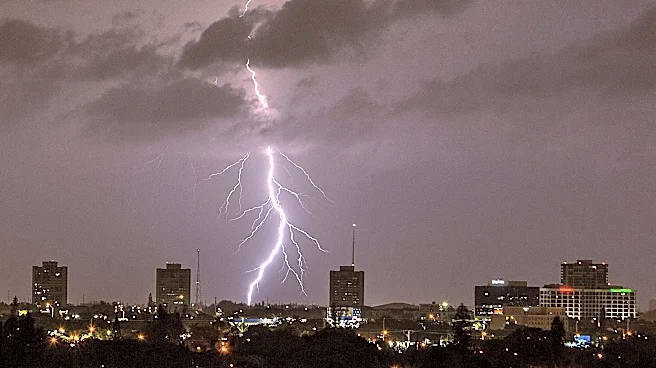


Florida traditionally wears the crown of lightning strike capital of the nation, or at least earns a runner up, and this year has been extra sparky with a clear increase beginning in July.
From Jan. 1 through mid-September, 3.34 million cloud to groundlightning strikes have hit Florida, according to Martin Murphy, a senior scientist at Vaisala XWeather.
That’s about a 15% increase over the six-year average and more than any year going back to 2021.
“In theory a more numerous lightning season should caution people to stay out of a storm’s path,” Vaisala said in a statement.
Six people have so far died in lightning-related incidents in Florida this year, which is nearly 40% of the total deaths nationwide.
It began with Michael Aiden Vargas, who was
struck in late May while he was kayaking in the Panhandle, and escalated in August with four deaths in about a two-week period, including two-year-oldKennedi Glasgow and her mother Kenya Glasgow as they stood in the driveway of a Margate home.
Chris Vagasky, a lightning data specialist with the National Lightning Safety Council, said lighting strikes tend to have a 7% to 10% fluctuation from year-to-year based on overall weather patterns.
“So, I would consider a 15% change to be significant,” Vagasky said about the Vaisala data.
In his own research, Vagasky found Florida had 28% more lighting strikes this year than the 10-year average with May and June seeing a marked lull in activity.
But by July, lighting strikes were about 12% above average and climbed to 58% higher in August.
Through mid-September, he said lighting strikes were 212% above the 10-year norm.
“Things have really ramped up over the last couple of months across Florida,” Vagasky said. “When you have an above average amount of lightning and people are outside, that sets things up for bad stuff to happen. It loads the dice so to speak.”
What's triggering all the lightning in Florida this year?
This year, dueling lightning reports alternatively named Florida and Oklahoma as the 2025 lightning capital of the country. Environmental research firm AEM anointed Oklahoma No. 1 based on flash density with 73 flashes per square mile compared to Florida's 72.9.
Vaisala XWeather said Florida still dominated followed by Oklahoma then Louisiana.
"There are a lot of complexities to this," Murphy said at the time about how lightning is measured.
Part of the reason for the lower activity in May and June of this year may be attributed to a rainy season that started off sluggish and was drier than normal through much of the state.
Florida's geography typically makes summer one of the more dangerous seasons meteorologically with spiking daytime temperatures that trigger invading sea breezes from three coasts.
Those breezes force hot air over land to rise. Depending on the conditions higher in the atmosphere, especially if it's particularly cold, ice particles form. Colliding ice transfers electrons and separates electrical charges with negatively charged ice falling toward the bottom of the cloud, where it can discharge lightning to Earth.
“If you don’t have thunderstorms, you are not going to have lightning and obviously you will see a spike when the weather pattern is wetter,” said National Weather Service meteorologist Sammy Hadi. “This year the wet season stuttered at first.”
Closer to the end of summer, temperatures and humidity rose — both ingredients for thunderstorms — with five of Florida's seven NWS offices issuing a near record or a record high number of heat advisories. The Mobile office, which forecasts for Pensacola, issued 19 heat advisories compared to a recent high of 40 in 2023. Key West data was incomplete.
Why there has been an overall increase in strikes is less clear. A La Niña climate pattern was in place for much of the winter, which would traditionally mean clearer skies with less rain and fewer storms.
“We try and set rules for lightning and lightning does whatever it wants to,” said John Jensenius, lightning safety specialist for the National Lightning Safety Council.
Kimberly Miller is a journalist for the USA TODAY NETWORK FLORIDA. She covers weather, the environment and critters as the Embracing Florida reporter. If you have news tips, please send them to kmiller@pbpost.com. You can get all of Florida’s best content directly in your inbox each weekday by signing up for the free newsletter, Florida TODAY, at palmbeachpost.com/newsletters.
This article originally appeared on Palm Beach Post: What's triggering Florida's deadly lightning strikes this summer?