



For nearly a decade, Timothy Hullihan's preferred method of travel has been by bicycle.
Whether it is a commute to his office, a trip to the doctor, or to get a haircut, you're more likely to see the North Palm Beach resident on a bicycle than behind the wheel of a car. In recent years, too, Hullihan has become an outspoken proponent of finding alternate means of travel in a region that is heavily dependent on cars.
"Even though I live in a community designed for cars to dominate transportation, I was motivated to reduce my car dependency," Hullihan, a local architect, told The Palm Beach Post. "My wife and I gave my car to our youngest son, and began sharing hers. The carpooling was hard at first, but we soon realized that the adjustments were
simple and we were spending more time together."
Mayor says town 'bound and determined' to improve traffic
As Palm Beach County's population continues to grow, its cities, towns and villages, and residents, are searching for solutions to increasingly congested roadways, including ways to reduce dependency on cars.
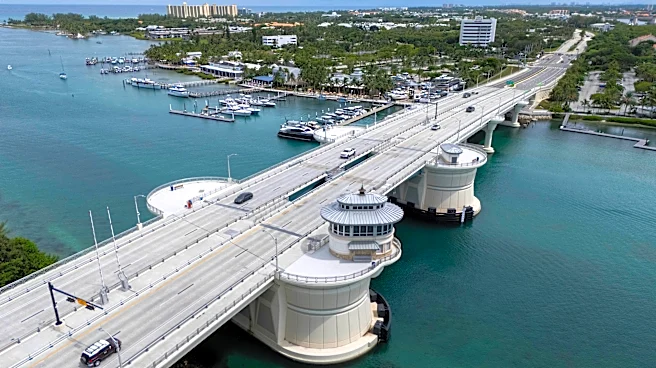
In northern Palm Beach County, recent projects such as a widening of lanes on Indiantown Road in Jupiter, an extension of Congress Avenue in Palm Beach Gardens and replacing the U.S. 1 Earman River bridge in North Palm Beach have been undertaken in effort to give drivers relief.
Jupiter contributed nearly $4 million to the first phase of a lane-widening project on Indiantown, between Interstate 95 and Central Boulevard. The second phase of the Indiantown Road widening project is expected to begin soon, adding a fourth westbound lane between Island Way and Central Boulevard.

Jupiter Mayor Jim Kuretski said the town decided to contribute financially to the state road improvement after determining that it was best way for the project to move forward.
"We've actually contributed funds on a state road improvement on Indiantown Road because it was the only way to get the project implemented and accelerated," he said. "You have to make those kinds of decisions. But we are bound and determined, even if we have to provide the funding, as opposed to just letting the status quo of gridlock continue."
Jupiter has committed funding for other roadway projects, including $1.3 million intersection improvement at Jupiter Park Drive and Central Boulevard. Jupiter and a developer are planning to share the cost of a proposed new roadway, Island Way South, that would connect commerce park to Indiantown Road.
A recent report presented to the Jupiter Town Council showed that Indiantown Road has been one of the busiest six-lane roadways in Palm Beach County. George Dzama, Jupiter's director of engineering, said the town's most significant traffic challenges have occurred along the Indiantown Road between Island Way and Maplewood Drive, particularly during peak traffic hours.
Dzama said traffic flow on Indiantown has improved since travel lanes were widened.
"While no single project eliminates congestion, these improvements represent an important step toward increasing capacity, improving safety, and enhancing regional mobility, " he said in an email to The Palm Beach Post. "Significant improvements have been observed in the morning peak hour."

Traffic trouble on PGA, Northlake boulevards
In Palm Beach Gardens, a traffic study released in October of 2025 showed that five roads accounted for 73% of serious crashes within the city, with the Northlake Boulevard and PGA Boulevard corridors accounting for 51%. Alternate A1A, Military Trail and Beeline Highway accounted for 22%.
City documents show that Northlake Boulevard, a major east-west route owned by Palm Beach County, averages 60,000 vehicles daily at I-95 interchange area, its widest and busiest stretch of the roadway, and 43,500 daily at its eastern segment near U.S. 1. PGA Boulevard, which is owned by FDOT, has a daily average of 70,500 vehicles near the I-95 interchange area and 30,000 daily at its eastern segment near U.S. 1, city records show.

City officials did not respond to interview requests to discuss Palm Beach Gardens' future plans for transportation. However, the city has introduced several transportation-related proposals in recent years, including a mobility plan aimed at reducing the number of cars on local roads, and a mixed-used transit hub near PGA Boulevard and Alternate A1A, where the city hopes to establish a connection to Tri-Rail.
Tri-Rail is a passenger rail service that connects Palm Beach, Broward and Miami-Dade counties. In Palm Beach County, its northern terminus is currently in Mangonia Park. A Tri-Rail spokesperson told The Post there are no immediate plans to extend service to Palm Beach Gardens.
However, the city has spent years preparing for Tri-Rail expansion into northern Palm Beach County, acquiring a $120,000 federal grant in 2017 to plan a new station. Transportation officials have said that a Tri-Rail stop in Palm Beach Gardens could alleviate traffic by providing an alternative to commuters to who work at businesses along PGA Boulevard.
Hulliahan said he would encourage other residents to seek alternate means of transportation when possible.
"Until we stop paving over Palm Beach County to perpetuate our car-dominant existence, there’s still something some of us can do," he said. "Buy a bike, consolidate your commuting distance, change your habits, and start living a cleaner, happier, healthier life. After all, we are traffic, and the solution starts with us.
Julius Whigham II covers northern Palm Beach County and public safety for The Palm Beach Post. You can reach him at jwhigham@pbpost.com and follow him on X, the platform formerly known as Twitter, at @JuliusWhigham. Help support our work: Subscribe today.
This article originally appeared on Palm Beach Post: Can new bridge, wider roads, and bikes help ease north county traffic?