





Publix says that its plans for a full-service supermarket in downtown West Palm Beach are “in jeopardy” if it doesn’t get its way at City Hall.
Bringing a large supermarket downtown has been a priority of the city. To make it happen, city leaders approved the sale of an 0.8-acre lot on part of the store’s prospective site, and commissioners have repeatedly expressed their support for a new store.
The downtown currently has no full-service grocery store. A Publix store in CityPlace, with a 23,000-square-foot footprint, is less than half the size of a typical Publix store.
But now the popular Florida grocer is saying the store can’t happen without some significant exemptions to the city’s rules.
1. What's being planned?
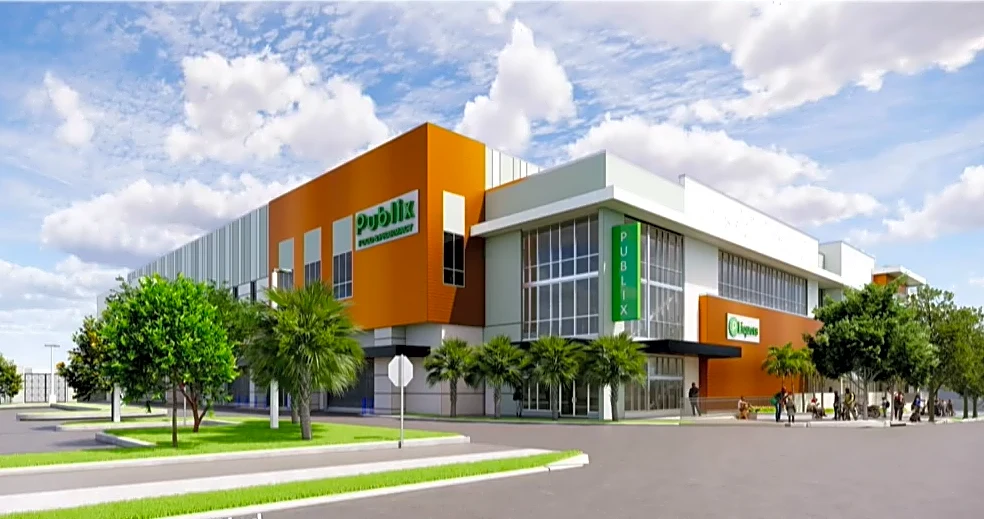
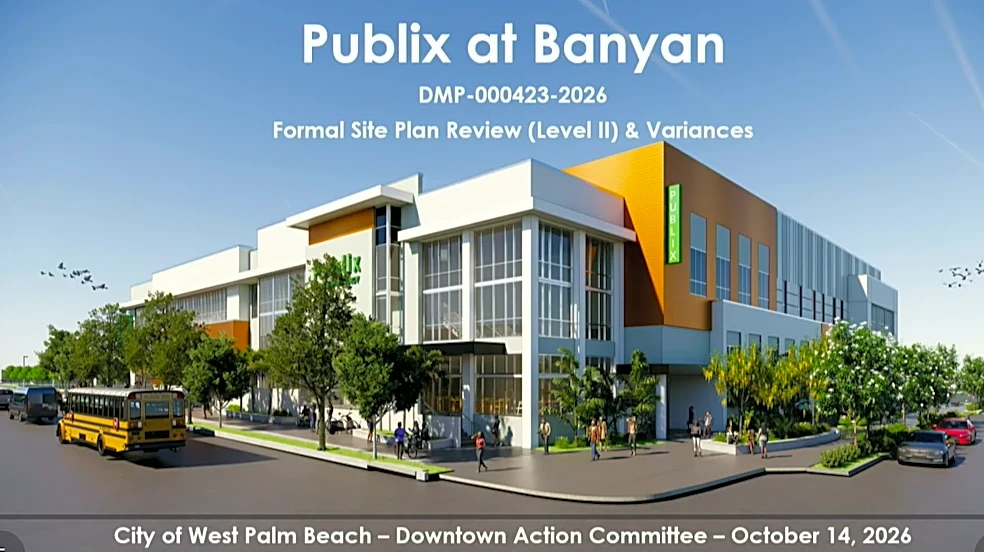
Publix is planning a two-story, 70,000-square foot store
one block north of Clematis Street, complete with a liquor store, an in-store dining area, an outdoor plaza and a separate retail space.
The 51-foot-tall building and a surface parking lot would occupy the entire 600 block of Banyan Street, including the 0.8-acre lot sold to it by the city.
2. What's the problem?

Publix says the city’s rules for downtown projects weren’t written with grocery stores in mind and need to be rewritten for what would be the downtown’s only full-service supermarket.
The main concern: Downtown development rules call for most of the property along Rosemary Avenue to include storefronts or other “active uses.”
The regulations also require 5% of the 3-acre lot to be developed as public open space and 25% as private open space.
3. What does Publix propose?

Publix wants a waiver that reduces the amount of “active uses” required along Rosemary, as well as a new set of city rules for grocery stores that loosen the open space requirements.
Publix says the open space requirements don’t make sense for a full-service grocery store. Providing enough space for parking and a delivery area is critical, making the requirement to set aside so much space for other uses problematic.
It doesn’t plan to provide private open space at the store, a requirement that it argues makes no sense for a grocer.
It does propose to develop the required amount of public open space — a narrow outdoor plaza that stretches along Rosemary Avenue — but the space is too long and slender to meet the city’s requirements.
4. What does the city say?

The city’s planning staff said it supported the proposed reductions in open space but opposed Publix’s request to reduce the amount of storefronts along Rosemary Avenue.
The city says it’s a priority to extend a pedestrian-friendly corridor north along Rosemary and into the city’s Historic Northwest neighborhood.
Leaving that corridor without active storefronts “establishes an undesirable street condition on Rosemary Avenue,” a city planner said told members of the city’s Downtown Action Committee this month.
“We want these smaller commercial bays within the downtown,” he continued. “We want them to extend along North Rosemary Avenue.”
5. How did Publix respond?

Publix said requiring storefronts was a major sticking point.
A land-use lawyer representing the grocer warned that the requirement to provide storefronts along Rosemary could endanger the project.
“I'm just going to be direct,” he said. “If we don't get the (exemption) on that, the project's in jeopardy.”
6. What did the city do?
Despite the city administration's opposition, members of the Downtown Action Committee were sympathetic to the store’s requests, endorsing a waiver that reduces the amount of “active uses” required along Rosemary. They also supported a new set of city rules for grocery stores that loosen the open space requirements.
But ultimately, it will be city commissioners who decide whether to approve those exemptions.
Andrew Marra is a reporter at The Palm Beach Post. Reach him at amarra@pbpost.com.
This article originally appeared on Palm Beach Post: Is a new downtown West Palm Publix ‘in jeopardy’? Six things to know