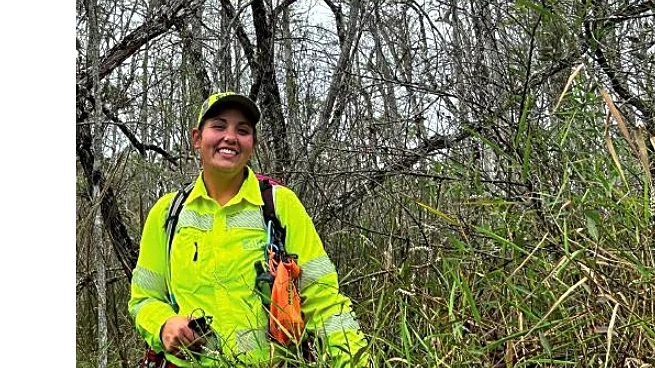







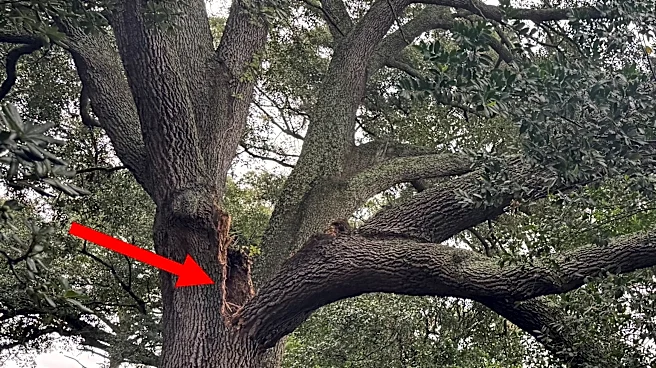
Scientists studying Burmese python reproduction in Florida’s southwestern cypress swamps and willow marshes stumbled upon an unusual behavior that had yet to be documented in modern research — the invasive Everglades scourge is climbing trees.
Burmese pythons are known to be semi-aquatic
, using the vast River of Grass, canals and freshwater sloughs to expand their dominion in subtropical South Florida.Yet besides thehaphazard anecdoteabout a python up a tree, there was no data on when or why they would climb a tree or what kind of trees they prefer, if they have a preference.
“One of our research leads noticed an observation that stuck out of a snake up in a tree,” said Mark Sandfoss, a USGS biologist stationed in Everglades National Park. “To
her, it was an uncommon sighting, and she made a mental note.”
Then it happened again, and a few times more. The researchers started documenting their sightings of snakes in trees and published a novel study in the Journal of Herpetology in September 2026.
“We didn’t set out to study arboreality, but you make an observation and then go through the dataset to find a pattern,” Sandfoss said.
Burmese pythons gained a foothold in Everglades National Parkby the mid-1980s, which is flatter and marshier than Big Cypress, which is more forested and is at a slightly higher elevation. By 2000 multiple generations of pythons were living in the park and spreading.
They decimate the landscape as an apex predator with an appetite for anything furry, feathered or reptilian, eating white-tailed deer as well as alligators.
How many Burmese pythons live in South Florida?
Today, it is extremely difficult to estimate how many pythons live in South Florida.
That’s one of the things the USGS researchers were looking into when they noticed the snakes in the trees. They’ve been using radiotelemetry to track hundreds of adult and juvenile pythons in an effort to better understand survivorship and reproduction to estimate the population and assess how python management tools, such as using paid hunters to try and cull the population, is working.
That population study is ongoing, but the tree study could aid hunters, who may not think to look up when stalking their prey, and lead to a better understanding of the threats tree-climbing pythons may have on birds and their nests.
“In regions such as southern Florida, where habitats are ecologically divers, reapidly changing, and undergoing restoration, these insights are vital,” the study notes. “Moreover, linking habitat use with species-specific behaviors can help refine control efforts and improve long-term management outcomes.”
While Burmese pythons are bulkier and lack the long tails of common tree-climbing snakes, they nonetheless made their way vertical, although the overall rates of tree-climbers was low.
University of Florida wildlife biologist Frank Mazzotti, who leads the school's Croc Docs, said the first time he saw a python in a tree was while he was in a canoe searching a canal bank for pythons.
"There were people walking on a trail and they were looking down," Mazzotti remembered. "I looked up and I saw a python in a tree right above their head and they blissfully walked by it."
Mazzotti said researchers are probably underestimating how often python are in trees.
"Certainly if you looked at their size and shape, you would probably say they don't climb trees, but they do," he said.
Of 188 adult pythons tracked by USGS, about 14% were observed in trees. About 17% of the 168 juveniles were tree climbers.
Adult pythons were most often found in sturdier cypress tree species including plain willows that could handle their weight. Models found that pythons weighing between seven pounds and 17 pounds could also be found in wax myrtles and cocoplums.
Juvenile pythons were most frequently found in cabbage palms, with models predicting their lighter weights would be supported by pond apple trees, pop ashes and saw palmettos.
They also noted that the cooler months of the year attracted pythons into the trees for basking in the sun as a means to thermoregulate their temperature. Pythons are ectothermic, meaning they rely on outside influences to control their temperature.
“Pythons are incredible generalists. They eat everything and go everywhere so I’m not surprised they are making use of anything available to them,” Sandfoss said about using trees for sunbathing. “If they are becoming arboreal, I can’t speculate. If you learn one rule with pythons, it’s that there is no rule.”
Can the Florida python population be slowed anytime soon?
But pythons are a particularly challenging problem because of their effortless ability to camouflage in the sawgrass tangles and tea-colored waters of the Everglades.
A University of Florida study published in 2020said while hunters catch between 95% and 99% of the snakes they see, 100 to 1,000 snakes go unseen.
Sandfoss said it ultimately may take a biological approach to dim python populations, including something similar to sterilizing mosquitoes to reduce breeding or the spread of a sexually transmitted disease.
The snakes the USGS team is following will all ultimately “meet their demise.”
“The initial approach was to catch and kill everything you see but some questions need long term datasets to answer,” Sandfoss said. “Our role right now is to fill a lot of gaps in the knowledge.”
Kimberly Miller is a journalist for the USA TODAY NETWORK FLORIDA. She covers weather, the environment and critters as the Embracing Florida reporter. If you have news tips, please send them to kmiller@pbpost.com. You can get all of Florida’s best content directly in your inbox each weekday by signing up for the free newsletter, Florida TODAY, at palmbeachpost.com/newsletters.
This article originally appeared on Palm Beach Post: Look out above! Burmese pythons are starting to climb trees in Florida