






Palm Beach County’s western communities are experiencing a population and development boom but its aging roadways are overflowing. Could a light-rail system that connects residents as far as Wellingtonto downtown West Palm Beach help ease traffic?The county’s Metropolitan Planning Organization is proposing a light-rail system along Okeechobee Boulevard as part of its 2050 long-range transportation plan. The project, however, would cost over $1.9 billion and it could take decades to be completed.
Valerie Neilson, the executive director of the Palm Beach MPO, said the light-rail system has the potential of transforming Okeechobee Boulevard into a mixed-use, dense urban corridor that can support the region's surging population and its economic growth.
"We can't only plan for everyone driving forever because we are running out of space," Neilson said. "We have to offer other options that can move a lot more people."
Few areas in Palm Beach County have grown as rapidly as the western communities over the last 20 years. Yet, many of the area's roadways were built in the previous century and are increasingly strained by traffic.
Since 2000, the populations of Wellington and Royal Palm Beach have increased by more than 60% and 80%, respectively. Nearby Greenacres and Palm Springs have roughly doubled in size, too.
New developments, including the Arden community and the city of Westlake, have added thousands of residents to the area once considered the county’s rural western frontier as well.

The unique traffic hurdles of the western communities
Traffic congestion is a countywide challenge, but the western communities face unique challenges.
The western suburbs are home to bedroom communities where most residents travel 30 minutes to work in jobs across the county. Their daily trips crowd narrow, inner-city streets and funnel traffic onto major east-west corridors such as Okeechobee and Southern boulevards, the north-south routes of State Road 7/U.S. 441 plus Seminole Pratt Whitney Road.
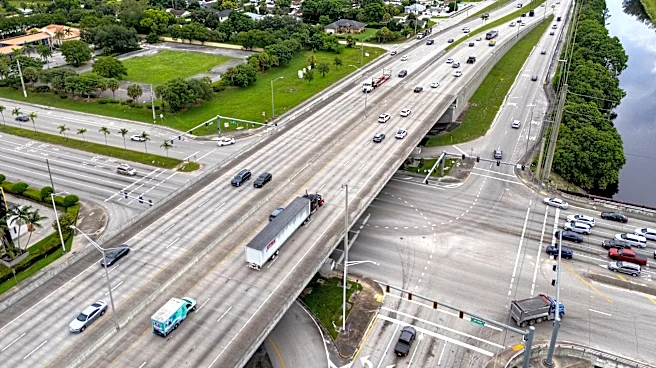
The area is also home to the county’s busiest intersection: Okeechobee Boulevard and Jog Road, which records over 60,000 daily trips.
In May, the intersection had 8,964 vehicles in the morning rush hour and 8,573 in the afternoon rush hour. That is enough traffic to cause a motorist to wait at least three traffic light cycles.

To improve traffic flow, the Turnpike Widening Project will add new northbound and southbound ramps to provide direct access from Jog Road to the Turnpike by late 2027.
Moreover, the following roads in the western communities are at overcapacity, according a map by the Palm Beach County Engineer's Office.
- Okeechobee Boulevard from Lyons Road to the Turnpike.
- Southern Boulevard from Forest Hill Boulevard to the Turnpike.
- Northlake Boulevard from Seminole Pratt Whitney Road to Coconut Boulevard.
- In addition, Forest Hill Boulevard and Haverhill Boulevard are considered heavily transited thoroughfares.

Light rail could link the west to downtown West Palm Beach
The MPO’s proposed light rail transit system would cover a 13.5-mile stretch along Okeechobee Boulevard with 17 stops from downtown West Palm Beach to The Mall at Wellington Green. It would initially serve about 6,300 riders daily.
Transit planners say they chose Okeechobee Boulevard because it is the county's most centrally located east-west corridor connecting the western communities to West Palm Beach. It is also the only roadway that directly links to the Tri-Rail and Brightline stations.
According to the MPO's study, the light rail would be built within the existing median of Okeechobee Boulevard. Construction would require converting one travel lane in each direction along portions of the eight-lane corridor.
Neilson said the project's $1.9 billion price tag might seem expensive but, the county will invest $2 billion over the next five years to widen roadways that will soon be overcapacity again.
"Widening roads is like loosening your belt to deal with weight gain," Neilson said. "It helps in the meantime but it doesn't work forever."
Neilson added: "A light rail is a permanent investment that invites economic redevelopment that can brings jobs and housing to benefits the community as a whole."
How western communities handle present traffic snarls
Each city within the western communities is dealing with its own traffic woes.
In Wellington, rush hour congestion concentrates along Southern and Forest Hill boulevards and State Road 7 (U.S. 441), the village's primary north-south artery. Traffic frequently backs up around The Mall at Wellington Green and K-Park property, where developer Related Ross is building a mini-downtown next to a private K-12 school.
To ease congestion along State Road 7, the village plans to add a traffic light at the entrance of Life Church, and add a northbound turning lane. The project also calls for a roundabout along Stribling Way, directly across from the private K-12 school.
The Village also deals with a seasonal surge in traffic during the equestrian season.
What began as a four-month winter event is now projected to expand from October to June with the opening of new showgrounds this fall. Congestion is especially heavy near Wellington International, along South Shore Boulevard and the intersections of Pierson and Lake Worth roads.
Last year, Wellington began widening portions of South Shore Boulevard and Pierson Road, adding travel and dedicated turn lanes to improve traffic flow to and from the showgrounds. It is also adding a roundabout to the intersection on Lake Worth Road and 120th Avenue, another vital access point to the village's equestrian area.
In Royal Palm Beach, the stretch of Okeechobee Boulevard that cuts through the middle of the village serves as a primary gateway to the western communities, often creating bottlenecks during the morning and evening rush hours.
The intersection of Southern Boulevard and State Road 7/U.S. 441, a retail hub on the border of Wellington and Royal Palm Beach, is among the county's busiest and most crash-prone.
Greenacres and Palm Springs function largely as pass-through communities, with drivers using their major roadways to bypass congestion elsewhere.
In Greenacres, traffic is heaviest along Lake Worth Road, the area's primary east-west corridor, and on Jog Road and Military Trail, two major north-south routes. In Palm Springs, congestion routinely builds on South Congress Avenue, particularly near its intersection with 10th Avenue North.
Farther west, rapid growth in Westlake, Loxahatchee, The Acreage and Avenir has strained Seminole Pratt Whitney Road, the area's primary north-south corridor, pushing it beyond its intended capacity and creating frequent traffic backups.
Westlake is widening Seminole Pratt Whitney Road from two lanes to four between East Sycamore Drive and 60th Street. The project, scheduled for completion in 2028, will expand capacity along a key north-south route serving the rapidly developing western communities.
A long-awaited project to widen State Road 7/U.S. 441 to four lanes between Okeechobee Boulevard and Northlake Boulevard is expected to be completed by 2031. The project is expected to ease congestion along a critical north-south corridor used by residents of Wellington, Loxahatchee and The Acreage.
"South Florida is expected to grow by one million people in the next 20 to 25 years," Neilson said. "In Palm Beach County, that is another 300,000, but as one region we have to look at how are we are going to be moving all these people."
Valentina Palm covers immigration and West Palm Beach for The Palm Beach Post. Email her at vpalm@pbpost.com and follow her on X, the platform formerly known as Twitter, at @ValenPalmB.
This article originally appeared on Palm Beach Post: Lightrail and wider lanes: Western communities address traffic snarls