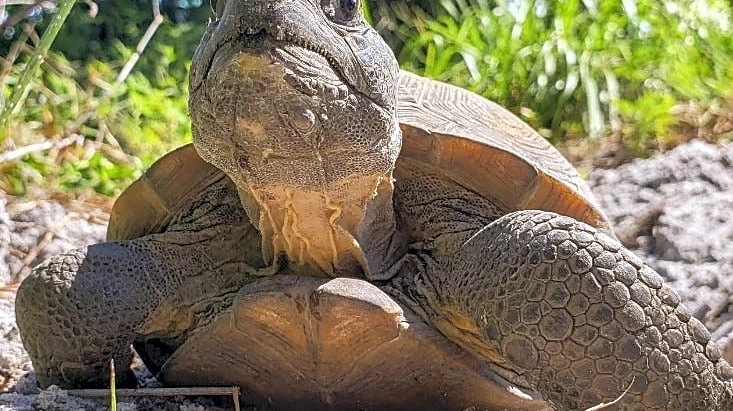









They’ve been buried alive, made into stew, raced for charity, sent to reservations, cut up by heavy machinery and drowned by well-meaning but unaware Good Samaritans who think all turtles swim.
Florida’s threatened gopher tortoises, a terrestrial reptile whose burrows give refuge to more than 350 other species, have been under duress for decades with more recent stresses comingfrom developers wanting their sandy upland and coastal dune habitat for homes.
Now, the International Union for Conservation of Nature (IUCN) has upgraded the gopher tortoise’s fragilityrating from vulnerable to critically endangered — one category down from being extinct in the wild — with populations declining by about 80% over the past 120 years.
Of “great concern”, the
IUCN report notes, is that there are no monitored gopher tortoise populations in Florida that are growing.
“The IUCN started their new gopher tortoise assessment in 2024, and it changed their status in a pretty dramatic way,” said Jeff Goessling, a gopher tortoise researcher and a biology professor at Eckerd College. “The tortoises are modeled to have humongous losses in the future and are known to have had humongous losses in the past.”
The ecological landslide of gopher tortoises has negative impacts on animals that use their deep, multi-chambered burrows as habitat including a plethora of insects, owls, skunks, armadillos, coyotes, snakes, the gopher frog, gopher mouse and the gopher cricket
But the IUCN status is informational only and holds no authority when it comes to state or federal designations to protect a species. It is a global hybrid partnership of non-government scientific and volunteer groups, whose role, in part, is to make people more aware of the crisis status for a particular animal.
Why tortoise geography sparked a lawsuit
And the U.S. Fish and Wildlife Service disagrees withthe international review.
In October 2022, the service said listing the gopher tortoise in Florida under the federal Endangered Species Act was not warranted. As part of its reasoning, the service separated gopher tortoises into to geographically distinct groups. Those in the western group, including animals in western Alabama, Mississippi and Louisiana were deemed a threatened species under the Act.
Those in Florida, Georgia, South Carolina and much of Alabama were considered to have “robust” tortoise populations.
The Center for Biological Diversity and Nokuse Education, Inc. sued the service in federal court in August 2023 hoping to force it to reconsider its finding, which the lawsuit called arbitrary.
Nokuse Education is tied to the Nokuse Land Conservancy, which is one of Florida’s largest sites that rehomes gopher tortoises taken from burrows because of development or other projects, including the construction of roads, solar energy fields, canals and berms.
Elise Bennett, a senior attorney at the Center for Biological Diversity, said there was an oral argument about the case in February and they are waiting for the court’s decision.
“It’s time for federal wildlife officials to reconsider their decision to deny Endangered Species Act protections to gopher tortoises across their range,” Bennett said in a statement. “There’s no time to lose. It will only become more difficult to pull these charming creatures back from the brink of extinction the longer they go without the protection they so desperately need.”
Is it against the law to eat gopher tortoises?
While adult tortoises have few natural predators, they have been meals for humans. During the Great Depression, they were nicknamed “Hoover Chickens” after President Herbert Hoover’s “chicken in every pot” promise.” Eating gopher tortoises is now prohibited.
But habitat destruction is their most pressing peril and Florida listed them as threatened in 2007 and there are strict rules about moving the long-lived reptiles from construction projects. Before that, developers could pay to legally entomb them in their burrows, leaving them to starve to death over as much as a month's time or suffocate in the dark.
The housing market crash that followed the 2007 protections left less money in state coffers for the acquisition of land earmarked for environmental purposes and a cottage industry of gopher tortoise relocations grew organically from that budgetary restraint.
Today, dozens of gopher tortoise recipient sites are available to accept relocated gopher tortoises for fees that can range into the thousands of dollars.
Goessling estimated it could cost $2,000 to $4,000 to relocate a tortoise in the Panhandle and up to $7,000 in central and southern reaches of the state. Tortoises must remain within 100 miles of where their original burrows were.
More than 56,000 tortoises were relocated between 2007 and through 2020, according to FWC. In 2021, the Florida Fish and Wildlife Conservation Commission made a public plea for landowners to become recipient sites as post-pandemic growth caused more tortoise relocations. Updated relocation numbers were requested but not immediately available.
“Florida gets a lot of credit because the level of burrow protections are pretty good and progressive,” Goessling said. “The challenge is just because you say something is protected; the enforcement has to be there.”
At an Oct. 14 meeting of the state Gopher Tortoise Technical Assistance Group, 40-year gopher tortoise advocate Steve Godley brought up the IUCN report and its finding that no gopher tortoise populations in the state were increasing.
“If that is true, that really portends a very tenuous situation for the viability of tortoise populations,” Godley said. “It’s a very dire situation for tortoises and we are not dealing with the problem adequately or collectively.”
Kimberly Miller is a journalist for the USA TODAY NETWORK FLORIDA. She covers weather, the environment and critters as the Embracing Florida reporter. If you have news tips, please send them to kmiller@pbpost.com. You can get all of Florida’s best content directly in your inbox each weekday by signing up for the free newsletter, Florida TODAY, at palmbeachpost.com/newsletters.
This article originally appeared on Palm Beach Post: Gopher tortoise buried alive, relocated and drowned faces extinction