








Live in a home governed by a condominium, co-op orhomeowner's association? Have questions about what they can and cannot do? Ryan Poliakoff, an attorney and author based in Boca Raton, has answers.
Question: Our HOA community has 1,286 units and a population of roughly 2,000 to 2,200 residents. I am seeking your guidance on how the "reasonableness standard" applies to a recent board decision regarding our main common amenity.
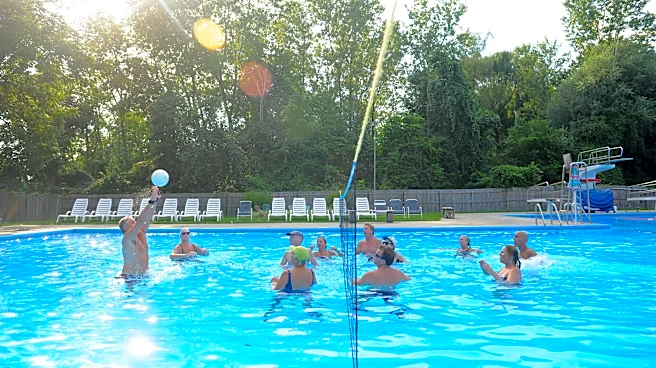
Our community has a water volleyball club with about 165 members (roughly 8% of the total population). The board recently passed a motion granting this club exclusive use of a large portion of the main pool from 9:00 a.m. to 12:00 p.m., 365 days a year, plus two evenings a week.
This club activity takes up 40% to 50% of the
total pool area and 90% of the mid-to-deep end. Our community's smaller pool is not an equivalent substitute, as its design causes it to be shaded by early afternoon. Numerous residents have strongly objected because they can no longer use the deep end for floating or sitting on the edge during prime morning hours. Furthermore, the club is highly disruptive and loud.
During the meeting, I asked if the board had obtained a written legal opinion regarding this massive allocation of a common amenity. The board claimed they had "verbal approval" via a phone call, though the attorney was not present in person, on the phone, or via Zoom during the meeting.
In your opinion, does granting a small minority of residents exclusive daily access to most of a prime amenity pass the legal "reasonableness standard" under Florida HOA law? Does a "verbal phone call" from an attorney insulate a board from liability if residents sue for breach of fiduciary duty? Signed, B.S.
Dear B.S.,
A few things before we analyze the reasonableness of the decision itself. First, the lawyer’s opinion is just that — an opinion. In the end it has little effect on the outcome of this dispute. It’s hard for me to believe that any lawyer told their client “Yes, you can do this, no question,” when this is clearly a situation where the outcome in court is almost impossible to predict. I’m sure the attorney advised the board on the arguments both for and against their decision, and ultimately the board made the final call. If one of your owners were to sue, it’s going to be a judge or jury that decides whether it’s reasonable to restrict use of the pool in the way you described.
However, it’s also important to know that this is not a situation where the board members, individually, would have personal liability in the event of a suit. The outcome of the suit would simply be the to determine whether the exclusive use was reasonable or not, and to direct the association to act accordingly. So, the lawyer’s opinion is largely irrelevant, other than to the extent helped the board evaluate the risks and decide whether to implement the rule.
I think your situation is a close call. On the one hand, it’s not unusual for clubs to be granted occasional exclusive use of a common area. There are tennis clubs, pickleball clubs, and golf tournaments that happen in HOAs across the state every day.

Some important factors are whether the club is open to everyone (if the club excludes people who want to participate, I think it makes it a lot harder to justify) and whether the club charges a fee for participation (which could be viewed as a fee to use the pool during those times). Assuming that anyone is entitled to play water volleyball if they choose, you’ve described a situation where a portion of the pool is used for a specific purpose for three hours each day. During that time residents are entitled to use the pool, although not the deep end; and while the games are a distraction and noisy, they don’t prevent other ordinary uses of the pool.
On the other hand, this is not a club that meets once a week — it’s an exclusive use by a small fraction of the community every single day, and that use does effectively exclude everyone else (it’s not as if someone can safely swim laps while a volleyball game is being played).
Honestly, if there were a dispute in court, I think the outcome might depend on specific language in your declaration and the strength of the arguments made by the attorneys. I’ll also note that there is language in the HOA Act that recognizes that different classes of owners may be charged based on their varied rights to use of the common areas — so it at least anticipates situations where that use may not be equal.
But overall, the solution here, as is so often the case, is political. If the 90% of the community that isn’t playing water volleyball disagrees with the scope of the use by the volleyball club, they should either convince the board to change the policy or change the board. That’s how things are supposed to work.
Ryan Poliakoff, a partner at Poliakoff Backer, LLP, is a Board Certified specialist in condominium and planned development law. This column is dedicated to the memory of Gary Poliakoff. Ryan Poliakoff and Gary Poliakoff are co-authors of "New Neighborhoods — The Consumer’s Guide to Condominium, Co-Op and HOA Living." Email your questions to condocolumn@gmail.com. Please be sure to include your location.
This article originally appeared on Palm Beach Post: Florida HOA gives volleyball club daily pool access. Is it legal?




