







West Palm Beach’s police department is investing millions of dollars in artificial intelligence programs that it says will enhance its ability to surveil the city, spot crime trends and quickly identify criminal suspects.
Police leaders say the expansion of their surveillance capabilities will lead to safer neighborhoods and help to compensate for the department’s officer shortages.
But the move inserts the city further into a fast-growing national debate about law-enforcement agencies’ increasing use of AI to track and monitor citizens.
In an Aug. 3 presentation to city commissioners, the department’s homeland security manager, Paul Allen, highlighted three software programs the department is buying that use AI to analyze police videos and reports.
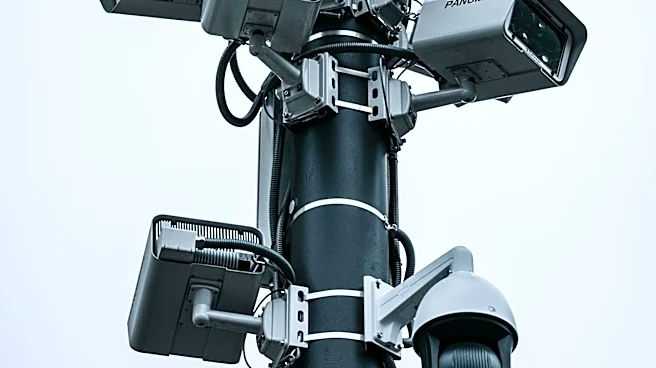
The police department has access to hundreds of cameras across the city, a mixture of city-owned cameras and private ones connected to the police’s network.
A program called BriefCam now will allow AI to search quickly through hundreds of hours of video from those cameras to identify people of interest based on physical descriptions.
Allen told commissioners that “the sky is the limit” for the department’s ability to use cameras to track potential criminal activity, using the example of a person of interest who police can only identify by a description of their clothes.
“All we have is information that the suspect is wearing tan pants and a black shirt,” he said. “We can type that in now into the AI database, and it's able to look through all the cameras and identify that individual.”
The department says its new AI abilities will go well beyond enhanced video surveillance. Investigators will also be able to outsource many investigative tasks to the technology.
A program called Peregrine will pore through and analyze troves of the city’s police reports, interviews and camera footage to create investigative leads and spot trends or patterns.
The company boasts that its program, which lets officers simultaneously search and analyze information from disparate sources, allows police to “find information and uncover hidden connections fast, with a single password.”
Allen told commissioners that other agencies that have purchased Peregrine called it “a game changer for the entire department.”
“It takes AI analytics and takes our current investigative databases, pulls that information into the cloud and uses analytics AI-wise and starts connecting the dots,” he said, adding that it “does a massive amount of analysis and pushes information back to the end-user that we can exploit and use for investigations and other events.”
AI is a 'force multiplier' for police, city official says

Allen said that a third program called Axon will give its AI systems much more intelligence to pore over by creating transcriptions of the department’s videos, including countless hours of footage generated by officers’ body cameras.
Doing so, he said, “turns video into searchable intelligence.”
“All our historical video that has been collected and our current video will now be transcribed into PDF, into text” he said. “Why is that important? It's because now all our video will be searchable.”
“I'm excited to see what that will do for cold cases, for new cases, and how we connect the dots,” he said.
A police spokesperson did not immediately respond to questions about the programs.
The department is making these acquisitions thanks to a large cash infusion from the city’s Community Redevelopment Agency. The agency, which is overseen by the city commission, is planning to invest about $10 million next year in “innovative policing” initiatives.
CRA Executive Director Chris Roog said the agency originally planned to finance the acquisitions over several years but decided instead to fund it all at once, which will “make a very large impact, earlier and faster than anticipated.”
“It will be, as they like to say, a force multiplier in enhancing police service and safety and security in our city, primarily in the CRA districts,” Roog told commissioners.
Mayor Keith James expressed his support for the new initiatives, calling them “very exciting.”
“I think (it) will only enhance the services that you all are providing,” he told Allen.
Detractors warn AI could soon create 'surveillance state'

The programs the department is acquiring have come under scrutiny around the country as Americans become more worried about the emergence of an AI “surveillance state.”
AI allows thousands of cameras in a city to work together as a single, 24/7 monitoring system, an advance that has led to widespread opposition to the growing popularity of Flock cameras and similar cameras that instantly scan license plates.
Many AI systems used by police, including Flock and Peregrine, let law enforcement across the country share video footage, allowing hundreds of agencies the ability to track a citizen's daily movements through license-plate scanners.
Gov. Ron DeSantis has waded into the issue, railing against the automated license-plate reader cameras in use across the country, including in West Palm Beach.
He said during an Aug. 26 event that the cameras had grown “out of control” across the state and warned that Florida could become “a surveillance state” unless lawmakers step in to curb their use.

“I don’t want to be in a situation where these tech companies, a handful of tech companies, know everything about you and know where you’re going,” he said. “And I know they collect a lot as it is, but I think it’s going to get a lot worse unless we have some protections for the people in Florida.”
Peregrine has been expanding rapidly across the United Sates. Its CEO told Forbes magazine in June that it was working with more than 400 agencies, including eight cities that hosted World Cup games this summer, and expected to be operating in nearly 1,000 cities by the end of the year.
The company's growth has been especially strong in Florida, where its lobbyists have close ties to DeSantis. This year, the Florida Department of Law Enforcement has given millions of dollars in grants to law-enforcement agencies around the state to buy Peregrine's software, the Orlando Sentinel reported in July.
A report by the nonprofit Brennan Center for Justice that cited Peregrine warned that AI’s ability to amass large amounts of data and intelligence about citizens can be abused.
“While these data sharing capabilities may be a boon to police departments, the easy access to massive troves of data and ability to repurpose sensitive information far beyond the purpose for which it was initially collected can also facilitate intrusive searches and misuse of data for non–law enforcement purposes,” the report stated.
Axon, which uses AI to generate reports and transcripts, is also susceptible to making errors and can insert false information into reports, a Forbes magazine investigation found.
The expansion of AI tools in law enforcement is generating more calls for regulation.

With AI's enhanced ability to gather troves of information about citizens, West Palm Beach police and other agencies have an obligation to be transparent about how they’re using it, said Robert Wilkins, a West Palm Beach attorney who co-chairs the Florida Bar’s Cybersecurity and Privacy Law Committee.
“The question becomes how is it used, how is it retained,” said Wilkins, an attorney in Jones Foster’s West Palm Beach office. “If you have no regulations regarding what’s being collected, then you have no idea how it’s being used, who’s monitoring it.”
Wilkins said there is no federal privacy law regulating such technology, but that some states have stepped in to control how police are using information gathered and analyzed with AI.
Maine and New Hampshire have passed laws to restrict the use of automatic license-plate readers, and several other states are considering similar measures.
DeSantis told reporters he was studying New Hampshire’s law and planned to propose new restrictions for Florida.
“I’m all about having law enforcement have tools to be able to hold criminals accountable,” he said. “But I don’t want to have this become a surveillance state.”
Andrew Marra is a reporter at The Palm Beach Post. Reach him at amarra@pbpost.com.
This article originally appeared on Palm Beach Post: West Palm police spend on AI surveillance, investigations | Exclusive