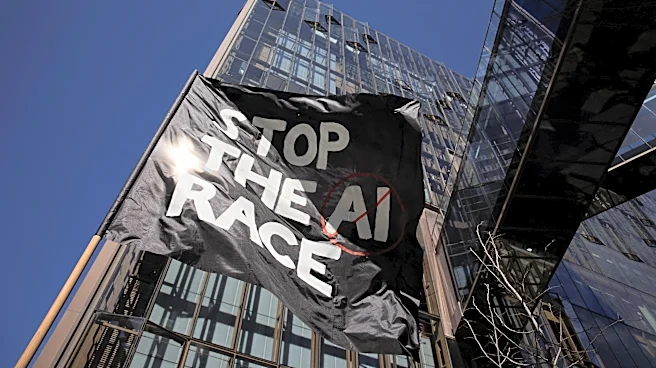








On the same week that the nation was commemorating the 25th anniversary of the 9/11 terror attacks, a former employee of both Anthropic and OpenAI was warning the world of a far greater threat to our future existence: AI.
Jacob Coxon, who says he voluntarily resigned from his position as a researcher at Anthropic, posted on his X (formerly Twitter) account that the two AI companies are more focused on defeating each other and other potential competitors around the world in developing the most advanced model possible than they are on ensuring that safety of the products they create.
Financial experts say both Anthropic’s and OpenAI’s goal is to have initial public offerings in place before the end of the year.
With both companies determined to be
the "winner" at any cost in this sprint to superintelligence superiority, Coxon said they "are racing straight to self-improving superintelligence and gambling with our lives. Do not underestimate the power of this technology. These will soon be superhuman systems that can hack anything, revolutionize any field overnight, and acquire real power and resources. We have all witnessed the progress in each of these domains, and progress is not slowing."

Coxon also asserted that those building AI believed that it could “kill us all by the end of the decade.”
In the following days, other current senior Anthropic employees echoed many of Coxon’s concerns — including Evan Hubinger, Anthropic’s alignment lead, telling media outlets that he thought there was a greater than 10% chance that Coxon’s doomsday scenario could happen.
Subsequently, the industry's titans ― OpenAI Chief Executive Sam Altman, SpaceX founder Elon Musk, and Anthropic CEO Dario Amodei ― called on their fellow magnates to slow the pace at which the capabilities of AI models are being developed.
The alarms being sounded by, well, everyone involved with AI about what it could do to us in the very near future are certainly troubling.
And somewhat ironic considering what the best aspects of AI are doing for us right now.
Medical research is being transformed
Around the globe, medical researchers, mathematicians, and other statistical experts are using AI to help savelives.
That’s because mathematical modeling helps physicians treat their patients in myriad ways. For instance, oncologists are now able to treat various cancers while the disease is still survivable, and the data often help guide physicians in developing the treatment protocols that are the most likely to be effective.
The latest local example comes from Florida International University.
A new model developed by FIU researcher Deborah Goldwasser uses mathematical modeling to pinpoint the critical window when an aggressive lung tumor is still curable.

Goldwasser’s latest research, which was recently published in Cancer Epidemiology, Biomarkers & Prevention, focuses on the point at which an aggressive lung cancer progresses from being curable through surgical removal to becoming inoperable.
These findings could help refine lung cancer screening strategies and identify cancers before they cross that threshold, leading to more personalized screening schedules. This would allow patients at higher risk of developing fast-growing tumors to be monitored more frequently while reducing unnecessary screenings for others.
That distinction is important because current lung cancer screening guidelines primarily focus on determining whether a lung nodule is likely to be cancerous. While that is an essential finding, it does not account for the “cure threshold” — i.e., the point at which an aggressive cancer progresses beyond the window in which it can still be cured through surgery alone.
“I study the most aggressive lung cancers, those that would lead to death without early detection,” said Goldwasser. “This work informs how frequently high-risk individuals should be screened and how quickly small, aggressive nodules must be managed.”
Answering those questions is at the heart of Goldwasser’s cancer progression modeling, which has become increasingly important as advances in imaging have changed what researchers can observe about lung cancer.
Unlike earlier models of lung cancer progression, which relied largely on chest X-rays and cancer registry data, newer, more sensitive low-dose CT (LDCT) scans are providing researchers with a much clearer picture. Because LDCT can detect very small cancers, researchers are finding some fast-growing, aggressive tumors at smaller sizes than traditional models predicted.
Goldwasser’s work accounts for this, using the data from smaller-sized nodules to provide more accurate estimates of how long these fast-growing cancers may remain curable.
“If every lethal cancer you detect before the cure threshold is contributing to mortality reduction, that’s where you’re getting a benefit of screening,” said Goldwasser.
In other words, the goal of screening is not simply to find cancer earlier — it is to find aggressive cancers early enough that treatment can still cure them.
That was not always the case.
Earlier studies using chest X-rays failed to demonstrate a survival benefit, leading many physicians to question the effectiveness of routine screening.
That changed in 2010, when the National Lung Screening Trial found that low-dose CT screening reduced lung cancer deaths by approximately 20%.
In simple terms, that meant screening with LDCT reduced the number of people who died from lung cancer because their cancers were more likely to be found early, when treatment had a better chance of working.
Goldwasser is further building on her findings by working to determine which screening regimens provide the greatest benefit. Her mathematical framework could help optimize future screening recommendations.
“My hope is that the work I’m doing will help physicians not only detect cancer earlier, but also at the exact time when treatment is most likely to be lifesaving,” said Goldwasser.
And as for those widespread fears about AI going rogue and causing doomsday scenarios, only time will tell if they ever prove accurate.
Steve Dorfman is a journalist for The Palm Beach Post, part of the USA Today Network of Florida. He writes about all aspects of health, fitness, and wellness. If you have news tips, please send them to sdorfman@pbpost.com. Help support our local journalism, subscribe today.
This article originally appeared on Palm Beach Post: Even amid dire warnings, AI is helping doctors save lives