






The Everglades is facing yet another threat. This time, it comes from slimy invasive fish that might be even more harmful than Burmese pythons.
Asian swamp eels
are mucous-covered air-breathing fish that implode marshland food chains from the bottom up and are difficult to catch. They were discovered in 2025 in the treasured Arthur R. Marshall Loxahatchee National Wildlife Refuge in Palm Beach County.Florida International University Associate Professor and aquatic ecologist Nathan Dorn confirmed the find by his laboratory, which studies the restoration of the Everglades with a focus on Asian swamp eels.
He believes the voracious invasive eels could have reached the refuge in 2024. Dorn said during a March presentation about the invasive eel and
its spread into Tampa and even Orlando that he doesn’t like “doom and gloom” scenarios.
But the Asian swamp eel is a multifaceted menace — unregulated, not easily trapped, cold tolerant, and it has evolutionary advantages over native species, including the ability to withstand long dry periods.
“I want to point out that this animal may be coming to your water bodies soon and in terms of threat to the Everglades, this is a big threat,” Dorn said. “In some ways this is a more dangerous and devastating predator than even the pythons.”
Here are 5 things to know about Asian swamp eels.
What is an Asian swamp eel?
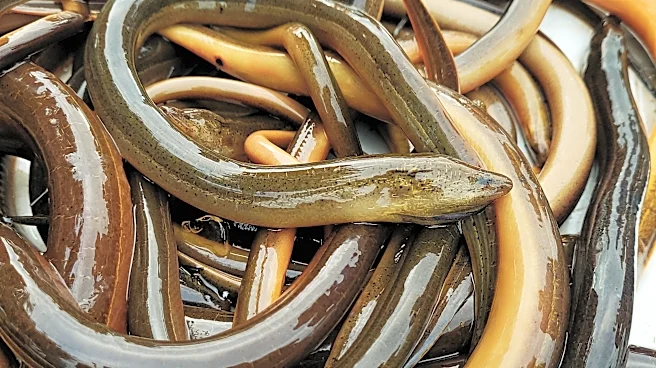
Asian swamp eels are snake-like fish that are popular in Asian cuisine. They are native to eastern and southeastern Asia, according to the U.S. Fish and Wildlife Service.
They are freshwater fish with snake-like bodies and no noticeable scales or fins, according to the U.S. Geological Survey.
Their skin is dark olive or brown with a lighter-colored underside that is often orange. Some have yellow, black and gold spots. Their skin is covered in a layer of mucous, which makes them difficult to hold.
What do Asian swamp eels eat?

Asian swamp eels eat crayfish, frogs and small fish that are also menu mainstays of Florida’s heralded long-legged wading birds.
The eels have already gorged their way through parts of Everglades National Park, annihilating crayfish, Florida flagfish and marsh killifish populations. They was also recently linked to the devastation of amphibian populations across the southern reaches of the state.
Why is it hard to catch Asian swamp eels?
They are nearly impossible to see in water, and they hibernate in mud when it’s dry.
Because the Arthur R. Marshall Loxahatchee National Wildlife Refuge is covered by more peat soil than parts of the southern Everglades, University of Miami biology professor Chris Searcy believes the eels will find better burrowing there.
“I’m struggling with the fish question in general as far as how do you get rid of an established aquatic organism,” said University of Florida wildlife ecology professor Frank Mazzotti. “We can see the iguanas and tegus. When you look at the water, all you see is water. There is a whole other layer of sampling and detection that really complicates it.”
Are Asian swamp eels harmless?
Asian swamp eels seemed innocuous when first reported in Florida in 1997. Originally confined to urban freshwater canals in Tampa and southeast Florida it’s thought they were introduced as a food source or when someone released them from a fish tank.
But two years after the first report, another population was found in Homestead, and a decade after that, they had infiltrated the Everglades.
And where they’ve been the longest has a dearth of aquatic amphibians.
“We heard a few tree frogs calling, but those were the only species in any abundance,” Searcy said about the 2026 study.
Typically, when larger predatory fish move to deeper ponds during regular Everglades dry periods, small prey are left alone to spawn and grow. When the rains swell the landscape again, the small prey are big enough to survive a return of the larger fish.
Because the Asian swamp eel can hibernate during the dry periods alongside the small prey, they are there to eat them without any relief period for the prey to repopulate.
“In some locations we’ve had documented impacts, in other locations it looks like they are the likely suspects,” Mazzotti said about the eel.
Where have Asian swamp eels spread in Florida?
They have made their way to Palm Beach County, the Hillsborough and Peace rivers, Lake Wales and Orlando.
Researchers found there was a rapid expansion in swamp eel territory beginning in 2015 either through migration because of man made hydrologic changes or new introductions.
A Tampa population has since spread throughout the region, bounded by the Lake Wales Ridge to the east and the Caloosahatchee River to the south.
In 2021, they were found in the Myakka River State Park. By 2022, the swamp eels had spread to the Hillsborough River. That same year, they showed up in the Mead Botanical Garden in Winter Park.
In May, an eel was found at Manatee Park in Fort Myers.
Searcy believes the eels found in the refuge are part of a new introduction that someone released. In 2016 they were found in a manmade wetland attached to the refuge, but at the time, the closest population was nearly 40 miles south.
They have also been found as far north as Georgia, so they are “clearly cold tolerant”, Dorn said.
Dorn said the eels should be considered for regulation, possibly as an “injurious” species that restricts bringing them into the country or possessing them without a permit.
Until then, he said, send him trap ideas.
“We have no way to remove this animal from the wetlands,” Dorn said in his March presentation. “If someone wants to come up with a great trap, I’ll try it.”
Kimberly Miller is a journalist for the USA TODAY NETWORK FLORIDA. She covers weather, the environment and critters as the Embracing Florida reporter. If you have news tips, please send them to kmiller@pbpost.com. You can get all of Florida’s best content directly in your inbox each weekday by signing up for the free newsletter, Florida TODAY, at palmbeachpost.com/newsletters.
Maya Washburn is a Trending News Reporter for The Palm Beach Post, part of the USA TODAY Florida-Network. Reach her at mwashburn@pbpost.com. Support local journalism: Subscribe today.
This article originally appeared on Palm Beach Post: More harmful than pythons? Asian swamp eel expands in the Everglades