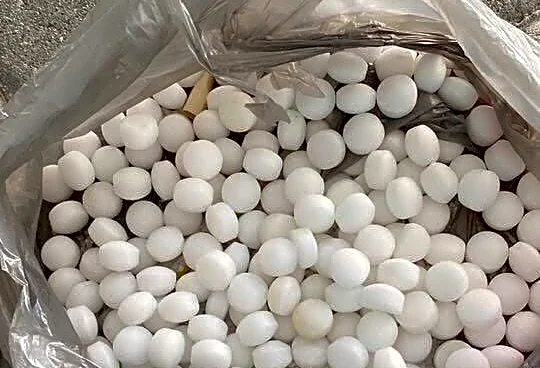

Two people were charged with counts related to commercial littering and wildlife harassment after spreading an estimated $60 worth ofmothballs on St. Pete Beach to deter shorebird nesting, according to a Florida
Fish and Wildlife Conservation Commission investigation.
FWC officers said their first clue in the April case that stoked the small town's ire and triggered the offer of a $300 reward for information, was a tip about someone who purchased a large amount of mothballs at a local store.
The men charged, one who owns a St. Pete Beach hotel, were allegedly trying to thwart the state threatened black skimmer shorebird from nesting on the beach behind the hotel because they believed it cost the hotel money, FWC said in the Wednesday, July 29 announcement.
Text messages retrieved during the investigation discussed the potential loss of $25,000 to $50,000 because of the birds.
"They are the worst birds and then the bird people put up fences and the beach people cannot get to and from because they will fence around that place," one of the text messages said according to FWC.
Some people on Facebook had speculated soon after the incident that the mothballs were in retaliation to the relocation of the Country Thunder Music Festival to Clearwater from St. Pete Beach after concerns were raised about the potential disturbance to nesting seabirds and sea turtles.
Others speculated it was beach chair commandos unhappy about sharing their sand with chattering black skimmers.
At an April 30 City Commission meeting, a speaker said mothballs are actually used to protect bird nests from predators.
"Definitely not true," Audubon Florida said in a statement.
The state-threatened black skimmer is a shorebird with an underbite made for scooping prey on the fly. It lays its eggs in shallow dimples on wide-open areas of sand, making the nests vulnerable to predators and accidents alike.
Habitat for the striking black and white bird is shrinking. Squeezed between rising seas and coastal high rises, skimmers are more prevalent on the Gulf Coastof Florida with only sparse nesting along east coast beaches. When a couple of nesting pairs found refuge in 2020 on restoration islands in Palm Beach County's Lake Worth Lagoon, conservationists were overjoyed, calling it a "thumbs up from Mother Nature."
In 2011, a Florida Fish and Wildlife Conservation Commission report estimated there were 3,670 breeding pairs of skimmers in the state. That was down to a minimum of 2,834 in 2018.
“I would say 95% of the people are receptive and kind but there are others who try to cause harm,” said Audbuon Florida volunteer Maryalice Anderson a week after the mothballs incident.
Anderson lives a couple blocks from where the mothballs were scattered and spends nesting season educating beachgoers about the black skimmers.
“While I am not certain, I would guess this egregious act was to cause harm,” she said in an April interview.
Anderson helped with the mothball cleanup. She said the odor was so potent, she could smell it as she approached the beach and that tourists were asking about they eye-watering aroma.
“The worst part was the smell,” she said. “The mothballs were also very hard to find as they blended into the sand.”
St. Pete Beach mothball incident may be novel but nests have been threatened before
It may be the first time a threatened species was attacked with mothballs but interfering with shorebird nesting has happened before in Florida.
In 2019, vandals were blamed for wrecking snowy plover bird nesting enclosures on Sarasota County beaches. According to a coordinator for Florida Audubon’s Bird Monitoring and Stewardship Program, people barged through roped off areas and pushed down signs explaining that the snowy plover nests directly on the beach.
In 2021, an entire colony of state-threatened least tern chicks and 100 eggs were removed from the roof of the Futura Yacht Club on Plantation Key because it was getting replaced. According to a WLRN story the yacht club homeowner’s association was told in 2019 that least terns were using its roof as a nesting site and they could not be disturbed.
In 2023, Florida Fish and Wildlife Conservation Commission officers arrested a man after he they said he sped his golf cart through a flock of black skimmers on a Marco Island beach.
Kimberly Miller is a journalist for the USA TODAY NETWORK FLORIDA. She covers weather, the environment and critters as the Embracing Florida reporter. If you have news tips, please send them to kmiller@pbpost.com. You can get all of Florida’s best content directly in your inbox each weekday by signing up for the free newsletter, Florida TODAY, at palmbeachpost.com/newsletters.
This article originally appeared on Palm Beach Post: St. Pete Beach mothball mystery solved, two people charged