





Bells will toll. Heads will bow, and tears will flow.
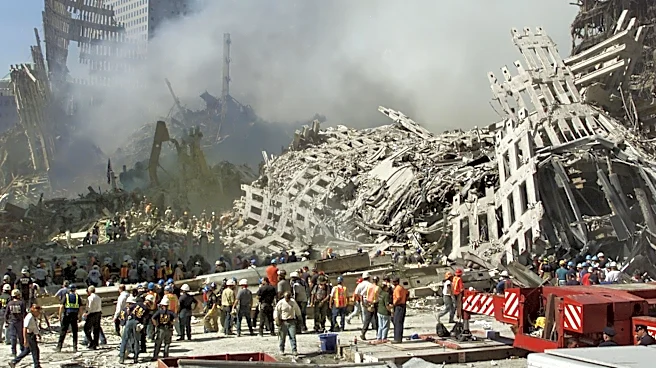
A quarter century has passed since terrorists hijacked four airplanes, crashed two into the twin towers of the World Trade Center in New York City, another into the Pentagon, and another went down in afield in Pennsylvania, killing nearly 3,000 Americans and changing the world forever.
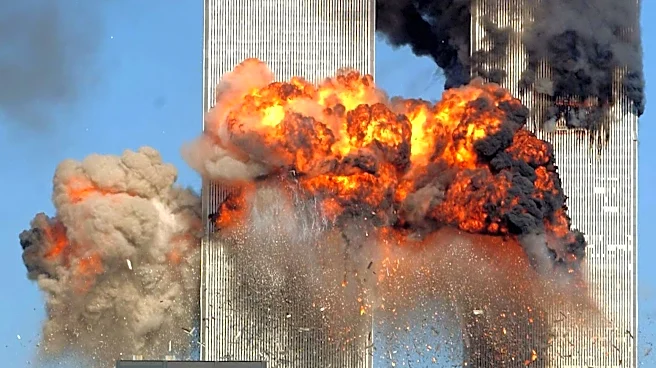
The hijackers are dead. Osama bin Laden, their murderous spiritual mastermind, is gone, too. But the images ofSept. 11, 2001, of jetliners flying close to and then into those soaring exemplars of American might, of the sounds and the fire and the glass that exploded out from their fall, coating everything in deadly dust and ash, none of that has lost its power. The sights and sounds of 9/11 are still so potent
for Americans who lived through the trauma that, even now, 9,131 days later, many look away when television seeks to bring it all back.

Michael Barasch, 71, doesn't need a television screen to see the horror of that day. It's in his mind's eye, still.
Barasch, who would later buy a home on Palm Beach, was working as an attorney in New York City, representing firefighters and police officers who were injured on the job.
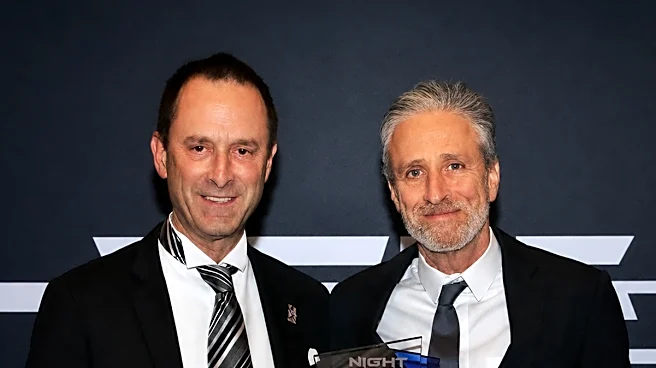
The attacks would kill hundreds of them and sicken thousands more. Barasch would eventually be in their number but not before he and his clients would, with a huge assist from comedian Jon Stewart, get a reluctant Congress to establish funds to compensate 9/11 victims.
Bobby Farber, now 66 and a Westlake resident, was a Brooklyn electrician whose workday on 9/11 called for him to be at what would be known as Ground Zero. Gary Miller, now 69 and a West Palm Beach resident, was an emergency medical technician with the New York City Fire Department when the planes plowed into the towers. And William Callahan, now 87 and a Jupiter resident, was spurred out of what was then an 11-year retirement as a lieutenant with the New York City Fire Department by the tragedy.
For each man, 9/11 lives on and has marked their lives in profound ways.
Three blocks away from the World Trade Center, Barasch did not see American Airlines Flight 11 fly into the North Tower at 8:46 a.m. on Sept. 11, 2001. He did not need to see it.
"I had unobstructed view, but, of course, I wasn't looking at the trade center when the first plane hit," he recalled. "But I heard it. I felt it, and I watched this little hole in the World Trade Center get bigger and bigger and bigger. And then I saw people jumping, and that's something that you will never get out of your brain."

'Dude, you're not supposed to be here'
The night before 9/11, Bobby Farber's foreman had given him his work assignment for the next day. He was to do electrical work at Washington Street and Liberty Street. That the work was at the base of the World Trade Center complex was unremarkable. Farber was an experienced electrician and had handled many jobs throughout the area.
He got to the job site about 6:45 a.m. and met with a colleague.
"We kind of talked about what a nice, crisp September morning it was," he said. "Clear blue skies. Minutes after that, we heard what sounded like a sonic boom."
Suddenly, the location of Farber's work site near the Twin Towers was very remarkable. "This is beyond near," he said. "We were under it. I watched it. Everything. Second by second by second."
His ex-wife learned of the attack and called him.
"First call I got was from my ex-wife, who said, 'You're not there, are you?'" Farber recalled. "I said, 'I'm right under it.'"
He wasn't under it for long. Farber took off as what was happening became clear.
"I'm running," he said. "My hands are over my head. I'm running as fast as I can. I look up, and I can see the building burning. You could see people running in horror. We witnessed what we call human remains."
Amid the chaos and mayhem, there was no way out of Lower Manhattan. Finally, Farber made it back to his truck and began the trek back to Brooklyn.
He thought there was something on top of his truck, could hear something up there as he drove. Farber was afraid it was a body part.
Instead, it was brown piece of what was once someone's work desk.
Farber did not stay safely away from Ground Zero. He took a day to process what he had been through — and then he went back to the site to fix traffic signals and handle other electrical work so first responders would safety get in and out. He got a pass from the Federal Emergency Management Agency and went back repeatedly, three days on, three days off, for months.
That first day back, co-workers gave him a big hug.
"They knew my location," Farber said. "They looked at me, like, 'Dude, you're not supposed to be here.'"

Chaos and call to action
Gary Miller immediately understood the gravity of that plane hitting the North Tower.
"As soon as the plane hit, I knew it was going to be something," he said.
Miller dropped his son off at school and made his way to the FDNY's fire academy at Fort Totten, where he was an instructor. There was a discussion of how to respond. No one said they would not go.
"I don't think that was a thought," Miller said. "The thought was, 'We gotta go!' We left there in a caravan down to the World Trade Center."
When Miller and his colleagues left for Ground Zero, the towers still stood. By the time they go to the site, both had come down.
"Everything was just chaos," he said. "Dust was everywhere. Some police officers approached us, and they were covered from head to toe. We gave them oxygen and took them to a hospital. We didn't do any paperwork. As soon as we dropped them off, we went right back."
Miller was at Ground Zero for 11 or 12 hours that day. He was surprised by the limited number of severe injuries he observed.
"Everybody was dead," he said. "I didn't have anybody that was critical."
He walked up 30 flights of stairs to check on an elderly woman he had been told might be injured. She was not there, and Miller does not know what became of her.
Miller worked 12-hour, overnight shifts for several days.
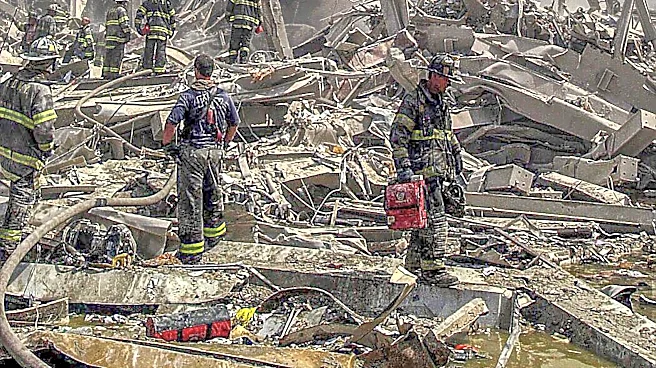
"After the first few days, it just became a recovery effort," he said. "We would be removing bodies. We're removing body parts."
But that wasn't the toughest job Miller handled in the aftermath of the attacks.
He had been assigned to accompany families that were being taken down the Hudson River to a platform where they could observe crews clearing the site and looking for remains. It was the last place family members knew their loved ones were, and observing the site was often too much for them. And for Miller.
"I would say that was probably the most psychological trauma that I felt," he said. "I hear husbands, mothers, wives go on the platform and just scream. That was horrible."
Miller asked off that assignment after a single day.
"I said, 'I don't want to do that anymore,'" he recalled. "'Send me down to the pile. Let me transport bodies.'"
A round of golf interrupted
Sept. 11, 2001, was a perfect day for golf, and that's what retired firefighter William Callahan was about to do at the Montauk Downs State Park Golf Course in Montauk, about 120 miles from the World Trade Center in Lower Manhattan.
"We went to a restaurant, and this woman said someone just flew at plane into the World Trade Center," Callahan said.
Like many others, Callahan figured it was a horrible accident, not terrorism.
"We didn't think nothing of it," Callahan said. "We went out, and, when we were on the second hole, someone came out and told us about the second plane."
That's when Callahan knew something especially awful was underway. And he knew something else, too.
"A lot of my friends were killed," he said. "A lot of guys I knew."
Retirement, golf, it was all going to have to be put on the back burner. He was a firefighter again, even if it meant joining a bucket brigade to haul out debris.
"It wasn't just me," Callahan said. "A lot of the retired guys went down. It was, 'You going down there today? Yeah, I'll go down with you.'"
As they cleared debris, work would pause when remains were found.
"You're glad it you didn't know 'em, but you hate it for those you did know," he said.
A fellow firefighter, a good friend, was hoping against hope that his son, also a firefighter, had survived. Callahan kept the young man in his heart as he dug through debris.
"I was digging for him," he said. "You're looking for him even though you know you're not going to find him."
That young firefighter was among the 343 FDNY firefighters who were killed Sept.11.

Help for those at Ground Zero
Federal officials had declared the air at Ground Zero safe not long after the attacks. They'd later learn it was not.
Thousands would come down with "World Trade Center Cough," respiratory illnesses or rare, exotic cancers.
Through one of his clients, Barasch would push Congress to establish a fund to cover medical costs and provide a benefit to those who were at or near Ground Zero and were sickened. Congress balked at fully funding it on a permanent basis, though, prompting fiery testimony from comedian Jon Stewart, who had made compensating 9/11 victims an important cause.
"They responded in five seconds," Stewart said of the first responders, many of whom sat behind him, sickened with cancer or respiratory illnesses. "They did their jobs with courage, grace, tenacity, humility. Eighteen years later, do yours!"
Stewart's comments are widely credited with spurring Congress to pass funding on an ongoing basis. Barasch's firm — Barasch and McGarry — has helped thousands get compensated from the fund, which he emphasized is still active, with eligibility requirements that are far less restrictive than many people might think.
"You just have to prove that you were exposed for a sufficient amount of time, and (the payout amount) depends whether you were a responder or a student or a civilian," Barasch said. "But anyone basically who came back to work, live or go to school full time."
Barasch would get a combined $250,000 in payouts from the fund after being diagnosed with prostate and skin cancer. He donated that money to charity.
Farber would be afflicted with bronchitis, and he said he got COVID three times. He got a payment from the September 11th Victim Compensation Fund and has had his medical care handled by the World Trade Center Health Program.
Miller developed a cancerous mass near his adrenal gland that had to be removed. He is getting his care through the World Trade Center Health Program, and, Barasch and McGarry helped him submit a claim for assistance from the victim's compensation fund.
Callahan developed heart and respiratory problems and was diagnosed with prostate and skin cancer. He, too, got help from the compensation fund and the World Trade Center Health Program.
Long after the debris has been cleared, 9/11 is still killing Americans.
"People keep getting sick and dying every day," Barasch said. "I lose two clients a day to 9/11 illnesses."
Farber helped establish the 9/11 Remembrance and First Responder Group, which will hold a ceremony commemorating the 25th anniversary of the attacks at 6:30 p.m. on Sept. 11 at the Westlake Lodge.
The commemoration is for Westlake residents and is free, but Farber said he hopes people who turn out will consider making a donation to the Tunnel to Towers Foundation, which provides assistance to the loved ones of those who were killed on 9/11.
Leading Westlake's commemoration is a small token of thanks, Farber said, to those who sacrificed and suffered in the wake of the attacks. And it's an acknowledgement that he is fortunate not to be among those who were lost.
"9/11 was a second birthday for me," he said. "I shouldn't be here, but I am."
Wayne Washington is a journalist covering education and Riviera Beach development for The Palm Beach Post. You can reach him at wwashington@pbpost.com. Help support our work; subscribe today.
This article originally appeared on Palm Beach Post: 25 years fail to dim 9/11 memories for Palm Beach County transplants