




West Palm Beach leaders are making plans to tap deep into the brackish Floridan Aquifer for more drinking water, an effort to diversify the city’s water supply away from the surface water it relies on today.
Administrators told city commissioners Aug. 25 that they are moving to spend hundreds of millions of dollars to build a water desalination plant and about 11 wells that would provide an estimated 10 million gallons of water a day.
The new water source is intended to supplement, not replace, the surface water that the city currently uses to supply tap water to its roughly 125,000 residents, along with residents of Palm Beach and South Palm Beach.
Customers of the city’s water utility consume more than 32 million gallons a day on average, below
the current system’s 47-million-gallon capacity, officials said.
But the city’s surface water system is susceptible to droughts and contaminants. And in little more than a decade the city’s demand is projected to exceed what its current system can provide.
“About 2037 or so is when the existing capacity of our surface water treatment plant would be met, and that’s why we have to start our planning cycle now,” said Victor Carosi, the city’s public utilities director.
The plan for a new water treatment facility comes five years after a bacteria outbreak in Clear Lake forced the city to warn children, the elderly and people with certain medical conditions to refrain for weeks from drinking the city’s tap water.
The incident was a striking demonstration of the city water system’s vulnerability to fluctuations in South Florida’s environment, one that prompted city leaders to investigate alterative water sources.
“We never want to hear those three words released back in May of 2021: ‘Do not drink,’” Carosi said.
Now city leaders want to dig 11 wells more than 1,000 feet deep into the aquifer, suck up brackish water from South Florida’s limestone bedrock and purify it with a reverse-osmosis desalination plant.
The plan has been in the works quietly for years but an Aug. 24 city commission workshop was the first public presentation of the project’s scope and timeframe.
In 2024, the South Florida Water Management District gave the city permission to tap into the Floridan Aquifer. The city has hired Carollo Engineers, an engineering consulting firm, to steer it through the process of planning and developing a new treatment system.

Carollo representatives told commissioners they estimate it will take about five years to design the project and complete construction.
In addition to the desalination plant and an estimated 11 wells, the city would need a new pump station, a water storage facility and a deep-injection well, which pushes the salts, minerals and contaminants removed during the desalinization process back into the aquifer.
The cost of the project will be massive by city standards. Carosi estimated the price at somewhere between $350 million and $750 million. Most of the cost would be paid by higher water rates for the city’s utility customers.
The firm expects to work on conceptual designs for another two years and plans to provide a more specific cost estimate by September 2028. If plans are approved, construction could start in 2029 and be finished by September 2031, Carollo estimates.
While the undertaking would be costly, Carosi said it was incumbent on the city to avoid repeats of 2021, when dry conditions caused the formation toxins produced by cyanobacteria in Clear Lake, prompting the do-not-drink warnings.
“We need to have a more reliable system,” he said.
While West Palm Beach would still rely primarily on surface water, officials said the city could increase the amount of water it pulls from the aquifer over time by adding more wells.
“It’s scalable,” said Lisa Arroyo, a project manager for Carollo Engineers. “It’s easy to implement more if planned correctly.”
Eventually, she said, the city could pump more than 50 million gallons a day from the aquifer.
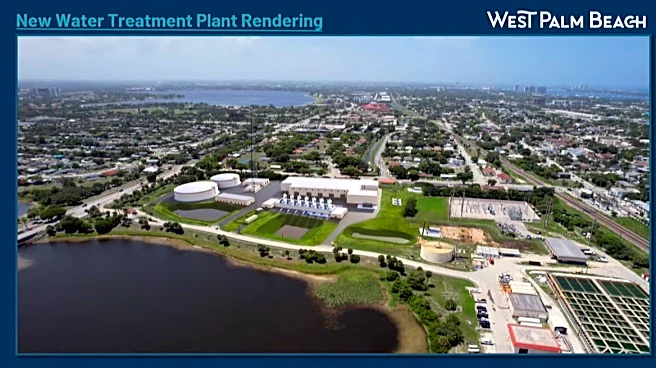
The new plant would be located on the premises of the city’s existing water treatment facilities, along the edge of Clear Lake north of Banyan Boulevard.

West Palm Beach is just the latest water utility in the county to look to desalinization to enhance its water supply.
The Seacoast Utility Authority, which provides water to nearly 100,000 customers in Lake Park, North Palm Beach, Palm Beach Gardens and the south end of Juno Beach, also uses reverse osmosis to treat water pulled from the Floridan Aquifer.
Four other Palm Beach County municipalities — Highland Beach, Jupiter, Lake Worth Beach and Manalapan — use reverse-osmosis plants to treat brackish groundwater.
In February, Riviera Beach broke ground on its own $400 million desalinization plant. To pay for it, Riviera Beach's water rates were expected to double during the next five years.
Andrew Marra is a reporter at The Palm Beach Post. Reach him at amarra@pbpost.com.
This article originally appeared on Palm Beach Post: West Palm needs more tap water. Its pricey plan to get it. | Exclusive