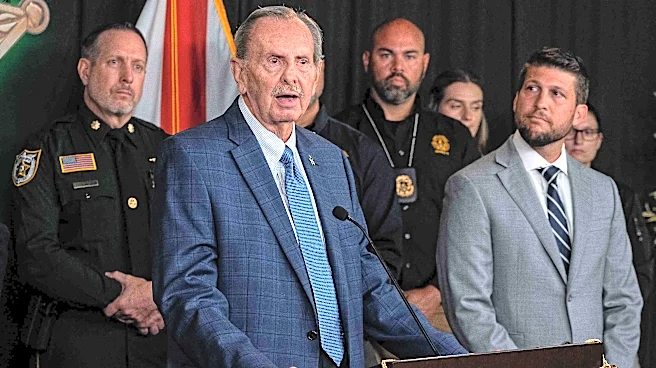








Palm Beach County Sheriff Ric Bradshaw has used taxpayer funds to fully finance additional retirement plans for 41 members of his executive team, a benefit that cost taxpayers more than $6.3 million over the past six years, according to a Palm Beach Post analysis of public records.
The retirement accounts are under the 401(a) program, which is the government employee equivalent of the 401(k) accounts for those who work in the private sector. The PBSO accounts are funded 100% by taxpayer money. For some employees, the taxpayer contribution is 20% of their salary.
Moreover, the law enforcement agency's 401(a) accounts are in addition to the pensions that PBSO employees are provided under the Florida Retirement System. That drew sharp criticism from
a watchgog group.
"When Florida property taxpayers are already funding guaranteed lifetime pensions, multi-million-dollar pension bonuses, and Social Security matches, adding a 100% taxpayer-funded 20% executive 401(a) account is outright taxpayer gouging,” said David Jaye, lead researcher for TripleDippers.org, an entity that monitors wasteful spending in the public sector.
How PBSO's 401(a) retirement accounts work for employees
The additional retirement plan is a perk for PBSO executives on top of pensions that often exceed $1 million, longevity pay that can boost salaries by up to 10%, and payouts for unused vacation and sick leave that can reach several hundred thousand dollars.
The Palm Beach Post analyzed the taxpayer-funded 401(a) accounts through a public records request. Public agencies statewide offer 401(a) programs, but records reviewed by The Post indicate PBSO's executive benefit is more generous than many comparable public-sector plans.
The county, for example, allows employees to transfer the value of some of their unused vacation and sick time into a 401(a) account.
PBSO itself has set up a 401 (a) program for employees below the rank of captain. Like the one for county employees, it also permits employees to convert unused vacation and sick time into their 401(a) account. Taxpayers are not contributing to the program.

For top executives at PBSO, however, 20% of their salaries are deposited into their 401(a) accounts. More specifically, 11 PBSO executives had $72,000 each deposited into their 401(a) accounts in 2026. The lincluded the agency's chief procurement officer, chief financial officer, four colonels and a major.
PBSO Chief Deputy Robert L. Allen and Chief Operating Officer George Foreman, a civilian, also were among those 11. Both are paid $352,752 annually.
Allen and Foreman have each accumulated nearly $400,000 in their 401(a) accounts since 2021. As their salaries have risen, so have their taxpayer-funded 401(a) contributions.
In 2021, the yearly contribution for Allen and Foreman was $58,000; 2022, $61,000; 2023, $66,000; 2024, $69,000; 2025, $70,000 and 2026, $72,000.
All told, the PBSO 401(a) extra retirement account has been funded by $6.3 million worth of taxpayer dollars since 2021.
Bradshaw himself has benefited from the program. From 2021 through 2024, he collected an average of $63,500 during those years for a total of $254,000. No deposits were made in 2025 or 2026.
How PBSO 401(a) account differs from private sector 401(k) plans
The benefit differs significantly in scale and offering from retirement contributions typically offered in the private sector.
Hundreds of companies in the private sector no longer offer 401(k) accounts, leaving it up to individual employees to manage and fund their retirement plans. The corporations that do match employee contributions do so at less than 5%, according to Vanguard, one of the world's largest investment management companies and a major provider of mutual funds.
Jaye at TripleDippers.org bristled at the taxpayer funding of the 401(a) accounts set up by PBSO for its top executives calling it an abuse of taxpayer funds.
“While everyday Florida families struggle with skyrocketing home insurance, these four-scoop retirement windfalls directly drive up local property taxes,” he said.
Top PBSO executives are also entitled to substantial pension payouts through the statewide DROP program, which allows eligible public employees to retire, receive their payout and then continue to work for a limited period.
TripleDippers.org reports that five PBSO employees are projected to receive $2 million or more from DROP over the next five years. County taxpayers contribute 22% of each DROP employee’s salary toward those benefits, according to Jaye's research findings.
The spending on the added retirement plan comes as county commissioners have been chafing over PBSO's submitted budget increases for the next fiscal year.
County commissioners have asked the county's Office of Management and Budget to explain why the PBSO budget has risen well above the rate of inflation. This year, even after a $20 million cut, the budget still increased by 7%. Departments under the county commission's control decreased by 2%.
Since 2007, PBSO budgets have increased by 216% and county departments by 67%, about the rate of inflation. County Commissioner Maria Marino said during a recent budget hearing that the Sheriff’s budget is not sustainable.

Salaries, bonuses, retirement plans add up at PBSO
Personnel costs, including salaries and benefits, account for much of the law enforcement agency's budget growth, according to financial documents submitted by PBSO. Personnel costs, according to the documents, account for nearly 80% of the spending plan. There is no mention in the budget documents of the special perks that top executives receive.
More than 100 PBSO employees earn at least $200,000 a year, and nearly 900 of the 4,500 employees have worked there for 20 years or more, according to a review of a databases provided to The Post.
Another perk impacting personnel costs is longevity bonuses of up to 10%. Longevity compensates employees for long service; at PBSO, a $200,000-a-year employee would receive a $20,000 annual bonus after 20 years.
Longevity pay is in addition to the 20% contribution made to the 401(a) account for the executive team. In neighboring Martin County, longevity pay is capped at $5,000.
The Post reported on Friday, Sept. 11, that PBSO has rehired nearly 40 employeees soon after they retired at their old salries, or, in some cases, new positions were created for them. After The Post questioned PBSO about the practice of rehiring retired employees, Bradshaw sent The Post a statement that, effective Oct. 15, the agency would no longer rehire retirees.
One of the rehires was Alfonso Starling Jr. He was initially hired in 1992, retired in 2023, and rehired on Sept. 9, 2023, as a colonel in corrections, the same position he held when he retired. Starling is one of the executives enrolled in the 401 (a) program. Taxpayers paid $72,000 into his account this year.
County commissioners are expected to adopt their budget on Wednesday, Sept. 16, following a public hearing.
At the commissioners' initial public discussion about the budget earlier this month, they diverted $16 million of the $21 PBSO budget surplus to the county general budget over Bradshaw’s objection. They also asked him to provide a more detailed budget for their analysis.
PBSO's budget increases in recent years have strained county budgets. This year, the ask was particularly glaring, as county spending has come under scrutiny by state officials and could be significantly pressured going forward by the proposed constitutional amendment that would drastically cut property taxes.
Mike Diamond is a journalist atThe Palm Beach Post, part of the USA TODAY Florida Network. He covers Palm Beach County government. You can reach him at mdiamond@pbpost.com. Help support local journalism. Subscribe today.
This article originally appeared on Palm Beach Post: 100% funded 401 (k) type plan for PBSO execs | Exclusive