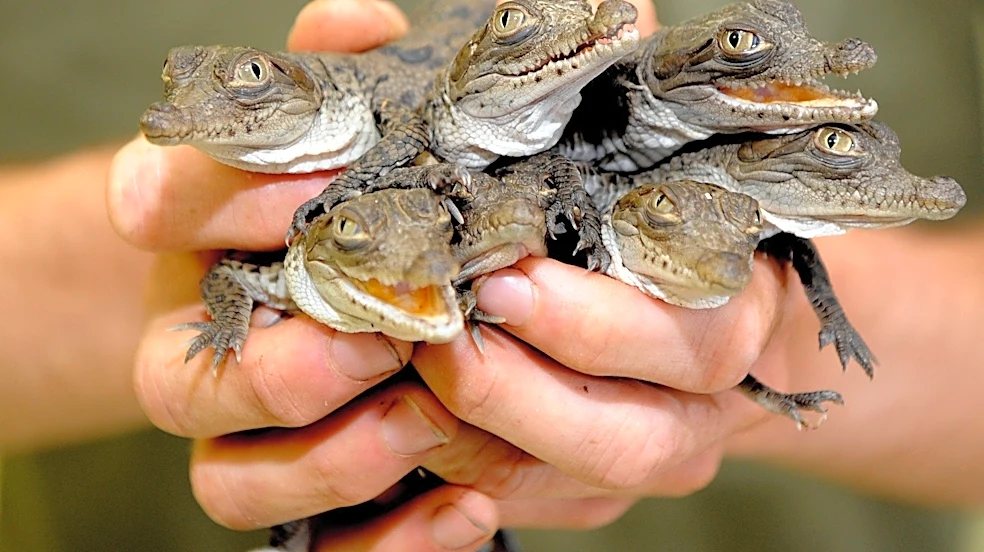




Below the surface of the Everglades’ shallow, lazy river, two distinct snouts poke around. For millions of years, the American alligator and American crocodile have shared the swamp, the only region where the two species occupy the same space.
But saltwater intrusion, driven by human activity, threatens this ecosystem and could drive both species away from the Everglades, scientists say.
Joel Heinen, a Florida International University professor in biodiversity conservation policy for more than 30 years, said American alligators and crocodiles occupy different niches.
Alligators are not tolerant of saltwater, Heinen said. While they can swim in saltwater, they can’t drink it, and therefore cannot live in it. Crocodiles are tolerant of saltwater, he said,
but also need to be near freshwater to breathe and breed. Because hatchlings haven’t developed salt glands yet, they can’t tolerate salinity, he added.
Because of these restrictions, the two species don’t overlap much, but both depend on the Everglades’ unusual mix of salt and freshwater marshes and mangrove estuaries to survive. For right now, Heinen said the relationship between the two is mostly peaceful.
“We don't really expect too much interaction between alligators and crocodiles,” he said. “We see it sometimes, but usually they just avoid each other.”
Heinen expects that calm coexistence to continue, albeit in a new setting.

As saltwater continues to intrude and shrink the Everglades, alligators and crocodiles in the habitat could begin to move north.
The trek has started among crocodiles. The species has already expanded its range to Key Biscayne and Marco Island, and Heinen doesn’t see it stopping there.
“We have had cases recently of crocodiles showing up as far north as Tampa,” he said.
There have been similar sightings in Melbourne and Satellite Beach, both on Central Florida's Atlantic coast.
A biologist with the South Florida Natural Resources Center said in a prepared statement that American crocodiles are doing well overall within the Everglades National Park. Their abundance and distribution have been increasing for decades, and this trend has continued in recent years.
Because the species' life cycle is sensitive to freshwater flow and salinity, continued Everglades restoration is expected to support population growth and expansion into suitable habitats, the center's statement said.
With changes in environmental conditions such as increases in water temperatures, it is expected that American crocodiles will likely start spreading up around Florida's coast, with some already surfacing around Melbourne, Tampa, and St. Petersburg, the statement said.
The Everglades primarily spans Miami-Dade, Monroe and Collier counties. According to South Florida Water Management’s saltwater interface, saltwater intrusion encroached inland from 2019 to 2024, particularly in cities along the southwest and South Florida coasts with dense populations like Naples and Fort Lauderdale.
While Heinen said the intrusion might not be apparent to the eye, it’s happening below the surface, and changes in the water’s appearance might not come for a long time.
He cited human activity, which he said has been contributing to rising global temperatures through fossil fuel emissions, as a main reason for this increased salinity. Heinen added while the Earth goes through normal heating and cooling periods, the current measures are extraordinary.
“The rate that we're witnessing right now is completely unprecedented as far as we could tell, and the only reason is global warming,” he said.
This poses problems for the Everglades ecosystem, Heinen said, because alligators and crocodiles are apex predators and keep the habitat “in check.” The absence of one of those species, he added, could disrupt the food chain.
“When you just start monkeying around and removing too many apex predators, you generally just get too many herbivores,” Heinen said.
And these reptiles aren’t just predators — they’re also prey. Raccoons, birds and otters depend on alligator and crocodile eggs for food, he added.

Casey Darling Kniffin, the policy director at Friends of the Everglades and a marine biologist, agreed with Heinen.
“Ecosystems rely on all of the organisms that inhabit them, and we need healthy ecosystems,” she said.
She also emphasized the importance of the 8 million people who rely on the Everglades for drinking water, especially in South Florida. She added the southern parts of the Everglades aren't receiving the same flow of freshwater they once did.
But she continues working for a solution. At Friends of the Everglades, Kniffin works to mitigate saltwater intrusion. This includes working to acquire more land for water storage, expand wetlands and filtration marshes and restore a freshwater flow through the Everglades.
“The North Star of our organization is to see Everglades restoration through,” she said.
While American alligators and crocodiles continue to roam the Everglades for now, their future in the swamp is uncertain. But Kniffin is confident the Friends of the Everglades' efforts will help restore the Everglades and help the ecosystem sustain itself.
“We have a plan to do that by having more water flowing at the volume that it once did and once contributed to this amazing coexistence,” she said.
This article originally appeared on Palm Beach Post: Saltwater intrusion in Everglades could push gators, crocodiles north