
In April, the world watched in awe as four intrepid astronauts were launched into space toward the moon atop NASA's most powerful rocket ever.
That mission, known as Artemis II, captivated the public for
10 days as three Americans and one Canadian made a trip around the moon and back to Earth. To many observers, Artemis II signified the dawn of a new era of space exploration as NASA aims to return Americans to the lunar surface for the first time in more than 50 years.
But while the mission has without a doubt been the most high-profile launch of 2026 – reigniting public interest in human spaceflight in a way not seen since the Apollo era – it hardly stands alone.
By now, rockets are launching almost every day from U.S. soil – most without people aboard. In fact, just one other mission so far in 2026 – a joint NASA and SpaceX mission launched Feb. 13 to the International Space Station known as Crew-12 – sent astronauts to space.
That includes in Texas, where Blue Origin and SpaceX have developed prominent operations, as well as New Mexico to the north, where Virgin Galactic has made its home at Spaceport America.
"Many do not realize that the U.S. is entering a new era of space operations," Scott McLaughlin, the executive director of Spaceport America, wrote in a July newsletter.
Here's why rocket launches are predicted to dramatically increase across the United States, and what that means for the spaceflight industry in Texas and nearby New Mexico.
FAA predicts commercial rocket launches to spike in next decade
As NASA increasingly cedes spaceflight missions to commercial companies that were once the realm of government space agencies, those sorts of missions have steadily been increasing year after year.
For instance, SpaceX, the commercial spaceflight company founded by tech mogul Elon Musk, has launched its Falcon 9 rocket hundreds of times – making it by far the most active rocket in the world. The two-stage 230-foot rocket is not only used to deliver SpaceX's Starlink internet satellites to Earth orbit, but is also used to propel astronauts to the space station and is contracted for a variety of commercial, civil and military payload deployments.
Now, the Federal Aviation Administration – which licenses commercial rocket launches – says the rate of rocket launches across the United States is only expected to grow in the next decade.
The FAA is predicting nearly 4,300 launches between fiscal 2026-2036, with spaceflights increasing annually from more than 200 a year to more than 500, according to the agency's 10-year forecast released in July.
America's launch dominance grows
The projection should be no surprise to even casual observers of the spaceflight industry in the United States.
SpaceX's pioneering method to recover and reuse rocket boosters has not only made manufacturing spacecraft cheaper, but has also led to faster turnaround times between missions. For years, SpaceX has taken advantage of the breakthrough in reusability to launch its Falcon 9 rocket from both Florida and California to build up a massive constellation of more than 10,000 Starlink satellites in a region nearer the atmosphere known as low-Earth orbit.
The Falcon 9 has helped usher in an era of American dominance in the spaceflight industry, with both coasts seeing record years in 2025 for rocket launches, largely thanks to the rocket. The Vandenberg Space Force Base in Santa Barbara County in Southern California hosted a record 71 rocket launches last year, while in Florida – where rockets launch from NASA's Kennedy Space Center and the nearby Cape Canaveral Space Force Station in Brevard County – a record 109 rocket launches were conducted in 2025.
Elsewhere, President Donald Trump and his Republican administration have sought to strip away regulations on the commercial spaceflight industry, while NASA is ramping up its objective of returning Americans to the moon under its Artemis program.
Texas home to Starship, paused New Shepard flights
Rockets don't exactly fly regularly from Texas, but the Lone Star State has still managed to establish itself as a mecca for America's spaceflight ambitions.
Jeff Bezos' Blue Origin has routinely made headlines with its New Shepard suborbital launches, which have transported nearly 100 celebrities and other civilians to the edge of space from West Texas near Van Horn, about 140 miles east of El Paso.
In South Texas near the U.S.-Mexico border, for instance, SpaceX has rapidly expanded its company town and headquarters known as Starbase into a bustling hub.
Since April 2023, Starbase in Cameron County has been the exclusive location for test flights of SpaceX's mammoth Starship rocket. Standing at more than 400 feet tall when fully stacked, the two-stage rocket is considered the largest and most powerful spacecraft ever launched – even surpassing NASA's iconic Saturn V of the Apollo era.
SpaceX is developing the rocket to be the first fully reusable spacecraft ever, with both its upper-stage vehicle and lower-stage booster capable of returning to the launch site instead of being expended during the flight. In the years ahead, Starship is due to be crucial to NASA's plans to land Artemis astronauts on the moon, while Musk also envisions using it to send humans to Mars.
Virgin Galactic to resume space tourism program in New Mexico
A little farther away, Spaceport America in New Mexico – about 100 miles north of El Paso – is home to Virgin Galactic. The aerospace and space travel company, part of British billionaire Richard Branson's Virgin Group conglomerate, has made its name in the space tourism industry.
Like its competitor Blue Origin, founded by billionaire Jeff Bezos, Virgin Galactic specializes in carrying paying customers on brief flights to the edge of space. But now that Blue Origin has paused its New Shepard program to focus on its lunar lander, Virgin Galactic has been left as the only major company still focused on taking tourists with deep pockets on trips to space, where passengers experience weightlessness and stunning views.
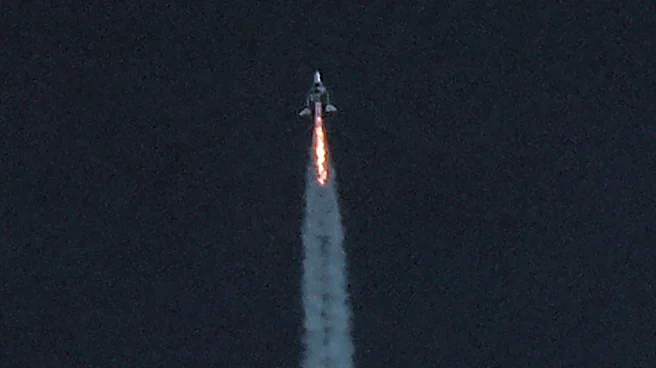
Virgin Galactic's program has itself been on a hiatus since 2024 as the company develops a new spaceplane.
Flights under the company's space tourism program were long expected to resume by the end of 2026. But Virgin Galactic announced in its most recent quarterly financial report that the timeline has now slipped to February 2027.
Developed to be reused for faster turnaround time between missions, the "SpaceShip" vehicle is an upgraded design of the company's now-retired VSS Unity spaceplane. With tickets costing $750,000 (and climbing), the vehicle can fly up to eight times a month with six passengers.
Spaceport America eyes expansion
Virgin Galactic is just one tenant at Spaceport America, a commercial spaceport designed, built and run by the state of New Mexico between Las Cruces and the U.S. Army's White Sands Missile Range.
The spaceport is home to unmanned aerial vehicles, rocket engine tests, suborbital launches like NASA's sounding rockets and other aviation activity.
And the facility is growing. In a newsletter released in July, the spaceport announced that an $18-million hangar facility and taxiway is due to be completed by end of 2026, while a $16-million public-facing reception area is slated for a summer 2027 debut.
"While no rocket yet exists that is safe enough to launch into orbit from an inland site, the opportunities for New Mexico and Spaceport America, which are growing alongside the launch cadence, are remarkable," McLaughlin wrote in the newsletter.
Eric Lagatta is the Space Connect reporter for the USA TODAY Network. Reach him at elagatta@usatodayco.com
This article originally appeared on El Paso Times: Rocket launches are increasing in US. Here's what it means for Texas