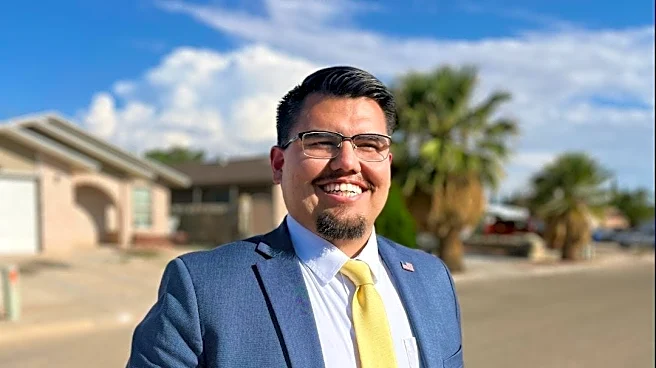








Meet the candidate: Jesse Moreno, City Council District 6
Age: 25
Occupation: I currently earn a living through work focused on increasing voter participation and registration, including on higher education campuses.
Please describe your personal and professional background.
I’ve spent the last three and a half years working inside city government as a city staffer for the City of El Paso, handling day-to-day policy issues, constituent concerns, and city budget review firsthand. I understand how City Hall policies and procedures actually work because I've lived it. I've also worked on political campaigns, organized around local issues, served as an elected member of the State Democratic Executive Committee, been a guest speaker on civic participation, local government and youth leadership testified before
multiple governing bodies. I am running to be a part of the change El Pasoans want and deserve and that’s authentic, effective transparent leadership.
Describe your political identity.
City Council races are nonpartisan by design, and I think that's exactly right and my voting record is democratically aligned. Potholes, water bills, and public safety don't have a party affiliation. What guides it's a record of pragmatic, results-driven work: get real things done for District 6, hold every dollar and every deal accountable to residents, and measure success by whether people's daily lives get better, not by who scores the political points. Especially fixing the basics first.
Questions related to El Paso City Council District 6 race
Do you support the proposed Downtown I-10 Deck Plaza project? Why or why not? If elected, would you support using city funds to help finance the project?
While the concept of the Downtown Deck Plaza is positive the reality is not reconnecting neighborhoods divided by the interstate and reclaiming public space downtown is worth pursuing. But I oppose using city general funds to finance it. We should still allow those seeking funding for it the time and tools they need but this should be funded through private partnerships, state, and federal transportation dollars. Asking El Paso taxpayers to foot the bill for a downtown amenity while basic infrastructure needs go unmet elsewhere in the city. While tourism and economic development is critical taxpayers' budgets are already stretched thin.
Property taxes remain a top concern for many El Paso homeowners. What specific actions would you support to slow the growth of property tax bills or reduce services?
Slowing property tax growth requires action on two fronts. At the state level, I'd continue advocating and hopefully alongside city staff, for structural relief, since so much of what drives our tax bills, like appraisal methodology and state mandates, originates in Austin, not City Hall. Locally, I'd push the city to practice real budget restraint: adopting the no-new-revenue rate whenever possible, scrutinizing budget growth that has outpaced inflation and population growth in recent years, and prioritizing the local homestead exemption as direct, immediate relief for homeowners. I’d seek to collaborate strongly with CAD and related stakeholders to guide citizens on protesting their property tax and make very accessible.
Road conditions continue to be a major concern for voters. What steps would you take to ensure adequate and sustainable funding for street maintenance and repairs across El Paso?
El Paso's streets are aging faster than the city can keep up with citywide, about half of our more than 6,100 streets are rated fair to very poor, and 52 miles need full reconstruction, not just resurfacing. The city currently invests $10 million a year through a two-year resurfacing list built on real pavement condition metrics, and staff have gotten faster at executing that list, but $10 million a year isn't enough to keep pace with a $3.6 billion street network. District 6 has felt this directly, and I hear about it at the doors every week. It's time we figure out a better way to fund this and not just accept $10 million a year as the ceiling and make sure District 6 gets its fair share of whatever funding solution the city ultimately adopts.
What is your assessment of the city's Data Center Policy Framework? Does it strike the right balance between economic development and protecting community resources, or would you propose changes?
I stand firmly against the current data center deal especially at its structure. This is being sold as economic development, but the price is too high: real pollution and resource concerns, real strain on our water and power grid, for public health and quality-of-life costs that fall on residents, not the companies. Meta cannot be trusted to self-regulate here and they're facing a public relations crisis over this project, while offering concessions to the community now is the least they can do, not a reason to trust the deal going forward. I remain skeptical of the resource impacts we still don't have full answers on, and I will stand firm on protecting our public health and our water and power resources over any future data center agreement that doesn't put the community first. This is a non-partisan issue, national crisis and more and more research shows the benefits are not what they seem and the business community cannot ignore this anymore. We must demand better at every level of this issue, layer by layer.
Should the city continue offering tax abatements and other incentives to attract profitable corporations or industries? Under what circumstances, if any, should those incentives be approved?
The way the city has approached economic development has too often worked for the wealthy and well-connected, not for the community. We don't need more deals like Meta, a study commissioned by one of El Paso's most prominent business leaders, set a real standard for when incentives are worth it, and the Meta deal fails that test: 50 permanent jobs for a $14 billion investment, paying below the wage floor the study recommended. What we need is good-paying jobs. Too many El Pasoans have left this city because the jobs here don't pay enough to stay, and that's directly tied to why our population is now declining rather than growing. Incentives should be reserved for deals that create real, well-paying jobs — not just headline-grabbing investment numbers. Elected officials ought to conduct their own research before signing off on any legally binding agreement before approving and at least defend and explain their vote if its against what their constituents ask.
Public safety remains a core city responsibility. What are your top priorities for police, fire and emergency services, and how would you pay for them?
Public safety is of the utmost importance to our community. El Paso has consistently been one of the safest large cities in the country, and that's because of the work our police and fire departments do every day. Under Texas law, police and fire are the only city employees with the legal right to collectively bargain, and the city is currently in active negotiations with our fire department. I absolutely support labor in these negotiations. At the same time, roughly 60% of our city budget goes to police and fire, so my priority is making sure that spending is fiscally responsible while still meeting the real needs of our officers, firefighters, and the community they serve without putting our city in risk of debt.
What do you see as El Paso's biggest economic challenge, and what specific policies would you pursue to address it?
El Paso's biggest economic challenge is that we're now losing people, not just failing to grow. In 2025, El Paso had its largest annual population decline on record, and from 2021 to 2023 we lost more than 8,700 residents to net out-migration…mostly young people leaving for cities that pay better. The average private-sector weekly wage here is $906, 38% below the Texas and national average, and that gap is the root cause: too many El Pasoans earn a degree here and then leave because the job that matches their skills doesn't exist locally. That decline is already hitting ourschools, which are closing campuses and cutting some of the best-paying jobs available to college educated women in this city. The fix isn't chasing every incentive deal that comes our way, it's building an economy that pays people enough to stay. That means holding economic development to a real standard, investing in workforce pipelines connected to higher-wage industries, and building the kind of infill housing and neighborhood investment that gives young families a reason to put down roots here instead of leaving for Dallas or Phoenix. El Paso’s economic challenges are a recurring concern I hear from fellow colleagues in school, work and recreation circles. It’s unfortunate we have yet to collaborate stronger and more publicly with local workforce pipelines.
Have you read the City Charter? What did you learn is the top City Council priority?
Yes, I've read the City Charter. It functions like the city's constitution…it governs what the City of El Paso can and cannot do, and it can only be changed by the voters themselves. One thing that stands out is that the Council's core duty isn't to run city departments day to day; it's to set policy for the City Manager, City Attorney, and City Auditor including appointing and directing them. It also shows their responsibility to enacte ordinances and resolutions, approve the budget, set the tax rate, and respond directly to citizen concerns. Understanding that distinction matters: the Council's job is to set direction and hold those offices accountable, not to manage operations directly.
City leaders often face divisive issues. How would you work with colleagues, stakeholders and residents to find common ground and build consensus on major city decisions?
I want to be the strongest voice for District 6 and know I already provide results what I’ve been hearing from voters. That means making decisions together with my constituents, not for them. I'll work to find common ground with my colleagues on council using data-driven negotiation, bringing real numbers to the table instead of just competing talking points all while never forgetting that many residents can't make it to a meeting or a vote because they're busy holding down a job, raising a family, or just keeping their home together. That's why I plan to host two community meetings a month virtual and in person regardless of the attendance rate and make sure they're informed and heard. I plan to also spend real time in the district, so every decision I bring to council reflects what I'm hearing from D6, not just from the loudest voices in the room. El Pasoans need to know who is representing them and bring back authentic leadership to neighborhoods and connect us for the best decision making on council.
What should be the city's next big civic project?
El Paso's next big civic project should come directly from our community, not from a corporation or a contract we approve out of financial desperation or a proposal from those with a financial legacy in the region. I'd start by asking residents directly what they want that next major investment to be, so whatever we build next has the public's buy-in from day one. True representation at work.
Learn more about Jesse Moreno
Do you plan to continue in your current employment if elected?
I do not plan to continue any outside work after election day. I will serve my constituents 24/7 if elected.
What experiences in leadership do you have that qualify you for this position?
My leadership experience includes serving as President-Elect of the Zaragoza Rotary Club, volunteering as Communications Director for voter education and managing political campaigns. During my time as a city council staffer, I regularly lead constituent casework and coordinate across city departments to resolve issues and major community events. I've also been trusted to testify before governing bodies representing voters’ values and concerns accurately. These experiences required representing constituent interests clearly and credibly before high-stakes audiences. I also understand the behind-the-scenes work of strategic initiatives whether it’s in government, on campus or in community.
Have you ever been arrested or charged with a crime? Have you ever had a civil judgment against you? Have you ever been in arrears on local, state or federal taxes? If so, please provide an explanation.
No.
If elected, would you have any potential conflicts of interest that you are aware of that would impair your ability to serve? Please explain what they are and how you would avoid the conflict.
No.
What does transparent government mean to you? Will you be personally accessible to answer questions while in office?
Transparent government means residents shouldn't have to chase down their representative to get an answer. It means being an authentic leader with empathy and the rationale to execute. It means having no hidden agendas for yourself or peer’s benefit. Concretely, that means regular office hours in District 6, a public commitment to respond to constituent inquiries residents can reach me at or even now at 915-247-2426. I've spent my career on the inside of city government, and I know how easily a constituent's question can get lost in the process. I'm committed to making sure that doesn't happen on my watch or in my office.
What distinguishes you from the other candidates in this race, and why should voters choose you?
I have the vision the community wants and the experience to know how to get it done. I worked behind-the-scenes and now want to answer the call to public service for results. What distinguishes me is that I don't need on-the-job training, I have the same struggles as most El Pasoans making ends meet and still advocate for better quality of life. I've spent the last few years inside City Hall, working through the same budget, policy, and constituent issues I'd be voting on as a council member. I bring real
The candidates' responses are being published largely as they were submitted.
This article originally appeared on El Paso Times: Meet the Candidate: Jesse Moreno seeks City Council, 6 seat