







Decades of preparation have helped El Pasoans avoid the crisis Arizona, California and Nevada face over reductions in the water they can draw from the beleaguered Colorado River.
But maintaining life in the Sun City has required challenging choices.
Watching a once mighty river — the Rio Grande — go dry for most of the year is one of them. This leads to an increase in groundwater pumping, which threatens the Borderland’s aquifers. But recharging treated water into the aquifers helps offset that threat.
El Paso Water eventually will skip that step and begin sending treated wastewater directly to residents.
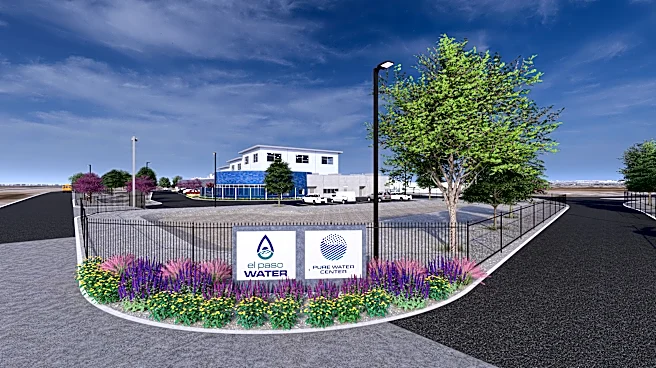
“The Pure Water Center is being constructed and expected to be complete in 2029,” utility officials said in response to emailed questions. “Similar
to the Fred Hervey Plant, wastewater will first be cleaned to level suitable for irrigation at a nearby facility and then treated again at the Pure Water Center. There it will go through a multi-barrier process that includes rigorous and proven treatment processes. Water is tested after every step and is kept and tested in storage before it is delivered to customers.”

The Pure Water Center will service the Mission Valley and East El Paso, along with other drinking water sources. It is expected to add up to 10 million gallons per day of water.
Christina Montoya-Halter, communications and marketing manager at El Paso Water Utilities, said in an interview that the treated water “will probably merge with other supplies … no one's ever going to get 100% Pure Water Center."
Water from the center will be used by residents, not for other purposes, such as golf courses, she said.
“This is probably some of the most pure water that we will have and it will be going directly to customers,” Montoya-Halter said.
Plant construction is ongoing
“We started construction last year and we're anticipating the plant will open in 2029,” she said. “And we're going to commission the plant so even when the plant is done, we’re not going to directly go online right away. We're going to run it for six months. We're going to send those results to TCEQ (the Texas Commission on Environmental Quality), make sure that they're on board with it, before we actually go online to distributing that to customers, so there's a very thorough, intense, consistent communication with our regulators.”

In the statement, the officials said: “Since 1985, EPWater has returned over 30 billion gallons of recycled water to the Hueco Bolson from the Fred Hervey Water Reclamation Facility in Northeast El Paso in 1985. Every gallon of reclaimed water used reduces the amount of water pumped from the Hueco Bolson. In addition to recharging the Hueco Bolson, recycled water from the Fred Hervey Plant is also used for irrigation purposes and El Paso Electric for its nearby power plant.”
The 1,200 El Paso Water employees oversee drinking water, wastewater, recycled water and stormwater, Montoya-Halter said
“We started out with groundwater," Montoya-Halter said. "We introduced river water in the 1940s and I like to remind people about this because everything that you're talking about we've already been doing since the 1940s in terms of a de facto type of reuse.”
Those who were in El Paso before the mid-1980s might remember that the biggest question regarding the area’s water quality was whether lithium that occurs naturally in groundwater helped residents maintain calm attitudes, leading to lower crime rates. They also might remember the excellent taste of the water delivered to residents.
Now, many might question what contaminants will make it into the system with direct reuse.
Treatment processes ensure residents’ safety
However, utility officials said the purification process helps ensure residents’ safety.
“The Fred Hervey Plant uses a robust process to treat wastewater to reclaimed water standards, and then it goes through another multi-step process to meet drinking water standards. These regulatory standards include underground injection control, which limits constituents of metals, nutrients, salts, herbicides, pesticides, and turbidity before water is allowed to be infiltrated into the ground.
“When removing these constituents, many trace organic chemicals such as organic chemicals found in medication can be removed. Water travels for two years in the aquifer before it is pumped back out from drinking water wells and delivered to customers.”
Other treatment methods filter out commonly used medical chemicals.

“Endocrine disruptors such as birth control medication are removed by advanced treatment, such as reverse osmosis, UV-AOP (Ultraviolet Advanced Oxidation Process), and carbon-based advanced treatment," according to the statement. “The treatment process at the Pure Water Center is similar to the Fred Hervey Plant in that they both use multi-step, redundant processes to purify water.
"However, the Pure Water Center will use membrane based advanced treatment, while the Fred Hervey plant uses carbon-based advanced treatment. The PWC process includes membrane filtration, reverse osmosis, ultraviolet disinfection with advanced oxidation, granular activated carbon filtration, and chlorine disinfection. Similar to our other treatment plants, chlorine will be used to disinfect the water and keep it safe to drink as it travels throughout the distribution system.”
Officials said El Paso Water pilot-tested the PWC purification process in 2015 and again in 2023, demonstrating its effectiveness in delivering top-tier water quality.
"An independent advisory panel – including public health experts, scientists, and engineers — reviewed our pilot project, analyzed test results, and fully supports the Pure Water Center,” the statement continues.
No requirement to completely remove contaminants
Still, Montoya-Halter said that “for any of our wastewater plants, there is no permit that requires removing completely those contaminants, but we do we test for it anyway, so there is no threshold or MCL (maximum contaminant level) with TCEQ that is for those contaminants, but the processes that we use both at Fred Harvey and both at this plant are effective in removing those, but I can’t tell you like exactly zero percent, that it is removed, but it is very effective in removing those constituents.”
There also aren’t any U.S. Environmental Protection Agency limits, she said.
“But the goal is that it'll provide 10 million additional gallons of water per day or an additional 3.6 billion gallons per year, and the big, big picture is it's local and it's drought resistant, so we're not relying on the river. We're not relying on any others. We know we have that local source. It's there. It's ours and we know we're always going to have it, so that's what makes it sustainable.”
Montoya-Halter said the El Paso Water plant “is the first plant that is direct to distribution,” although “there's other communities like Wichita Falls in Texas that did do direct potable reuse for an emergency period” after receiving an emergency permit from TCEQ during a severe drought in the Panhandle.

“But they've since gone back to indirect, where they treat their wastewater, put it into a surface water area and then put it back into a treatment facility that treats that surface water before it goes back out to customers.”
Water rights purchased
Over the years, the utility has purchased water rights stretching out to Dell City.
The Pure Water Center does not make those water rights redundant, Montoya-Halter said.
“We do need that; we're just pushing them back.”
She said the suitability of the center’s site and costs were factors in the decision.
The Pure Water Center cost is estimated at $290 million.
“This is the total cost of the pure water center,” she said, compared with the cost of “building a pipeline 90 miles east of here, pump stations. Sending it out here is probably three times that amount.”
Add to that the ongoing maintenance and operation of the Dell City project and “you can see how much more expensive it is,” she said.
“Even aquifers storage and recovery is expensive, as well as desalination, but the Pure Water Center comes right about in the middle, so that's why we wanted to implement this additional source sooner and really push back the more expensive processes to later.”
She said there has been a decrease in available river water and what is available has been inconsistent. The addition of direct reuse should help address that shortfall.
“I think so that's what we're hearing. I mean it's still very early.”
Montoya-Halter said the region’s water needs means the utility must continue to diversify, including treating water from the Rio Grande when it is available, desalination, recharging the aquifer and reuse.
‘We’re so vulnerable’
“We need to keep adding other components to our water resources because of this," she said. "Because you know we're so vulnerable; we're not sure what it will look like in years ahead for our Rio Grande supply and Elephant Butte, what it's going to look like. It's not what it used to be.
“We want to be more stable with what kind of water supplies we're using and know that we can provide those resources to our community.”
A dependable water supply is vital to economic growth, Montoya-Halter said.
“Absolutely, I mean, I think that's a big part of why we want to diversify our water resources, is the economic vitality," she said. "And continuing to attract businesses to El Paso.
“I know some of the latest census numbers were lower than we anticipated, but that doesn't mean that we don't want to continue to attract and continue to have a high quality of life for the people who are here.”

The utility’s Kay Bailey Hutchison Desalination Plant continues to attract both national and international visitors interested in applying the technology to their own water needs.
Montoya-Halter expects the Pure Water Center also will lure those needing answers to developing water crises.
“We are a trailblazer in terms of direct-to-distribution. We are known throughout the U.S. People are asking us for guidance. There are communities in California that are. There's even Phoenix.
“I think Phoenix is starting right now to do a direct-to-distribution facility very similar to what we're doing and they're probably going to open up right after we complete ours in 2029 and so they are also following our lead.”
El Paso Water officials want to help others learn about the process.
“We're also going to include an education center, a presentation area,” Montoya-Halter said.
“We know that we're going to be having visitors from really all over the world. And then we also want our community to be able to come in and learn about this,” she said. “So, we will have an area I'm working with some consultants on; we designed a visitor center where people are going to be able to walk through and actually see the processes, learn about it, understand our water resources.”
Visitors will be able to learn “why we have to do what we have to do here in El Paso.”
How Pure Water Center location was selected
The Pure Water Center’s site was key to the decision to build it there.
River water was available at the Roberto Bustamante Wastewater Treatment Plant in the Lower Valley because of the proximity of the Rio Bosque Wetlands Park, Montoya-Halter said.
“So, that's why we had available amounts at this location in the Valley and that's why we decided to build the Pure Water Center there, and that's where we're seeing the most growth. That's where the need is for an additional source of water in our community.”
Montoya-Halter said the utility has contracts with El Paso Electric for the treated wastewater from the Fred Hervey Water Reclamation Plant in Northeast El Paso. The electric utility uses the water for its cooling plants. “And then we put some into the aquifer and so everything that we treat over there is used for those purposes.”
She said, “We have another wastewater treatment plant on the West Side, (John T. Hickerson Water Reclamation Facility), but we have contracts with the irrigation district. Because we pull water out of the river, we have to put water back in so; there's not an available amount of river, of effluent, at that wastewater treatment plant.”
At the Bustamante plant, “the water goes through a treatment process and it's clean enough. This is water that leaves the Bustamante plant; it goes into the canal system and into the river and that is used for irrigation purposes.”
“It's water that's very clean already, but once it goes through that process, it's going to go to the Pure Water Center to be treated again to create that high-quality, purified water. … And then it'll be it'll go into storage. It'll be treated with chlorine before it goes out to customers.”
This article originally appeared on El Paso Times: Why El Paso will soon drink blended, purified waterwater from the tap