





Border enforcement officials claimed the agencies have had a "remarkable" year as drug seizures in El Paso, West Texas and New Mexico have increased, stopping the flow of deadly drugs into the U.S.
"The border is now more secure than ever," U.S. Customs and Border Protection El Paso Port Director Ray Provencio said. "As evidence of these recent successes, we've seen significant decreases in illegal border crossings, alongside substantial seizures of illicit narcotics right here in the El Paso area.
"Our field offices are seizing significant amounts of cocaine, fentanyl, marijuana, and methamphetamine during inspections. In fact, narcotic seizures in some categories have doubled or, in some cases, almost tripled over the last year."

Provencio, U.S.
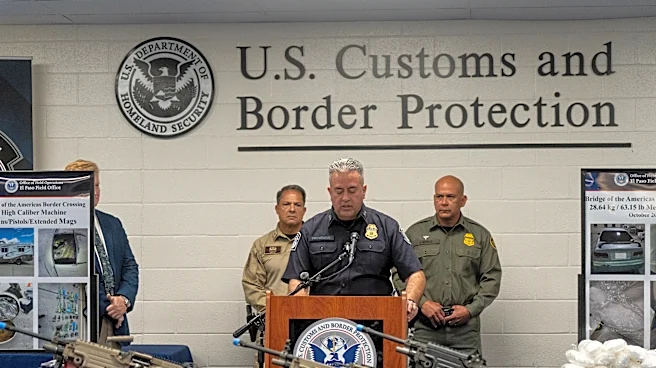
Border Patrol El Paso Sector Chief Jesse D. Muñoz and CBP Air and Marine Operations El Paso Director Efren Gonzalez announced the 2026 fiscal year drug seizures during a Friday, Oct. 23, news conference at the CBP Bridge of the Americas office.
The three border security leaders stood next to piles of methamphetamine and fentanyl and numerous guns that the agencies seized in the El Paso sector.
Marijuana seizures have increased by more than 230%, fentanyl by more than 119%, cocaine by over 50%, and methamphetamine by more than 9% in the 2026 fiscal year for the CBP El Paso sector, Provencio said.
The federal fiscal year runs from Oct. 1 to Sept. 30. The El Paso sector oversees El Paso and Hudspeth counties in Texas and all of New Mexico.
CBP officers seized more than 875 pounds of cocaine and methamphetamine "directly off our streets" in September, Provencio said.
Why have drug seizures increased in the Borderland?
Muñoz said the Trump administration's stricter immigration enforcement has let agents focus on border security instead of working at migrant detention or processing centers.
"We shouldn't have thousands of people in our custody, but if we do, we're going to take care of them," Muñoz said. "So what you saw with the previous administration, again here in the El Paso sector, we had six, seven thousand people in custody.

"Simply nobody to take care of them, so we had to pull Border Patrol agents off of the line to go and take care of those illegal aliens. Make sure they had food, blankets, everything that they needed. A lot of children came by themselves and with families. You have to separate them and take care of them."
The lower number of migrants is because of President Donald Trump's orders to deport migrants who illegally enter the U.S., Muñoz said.
"Since we don't have those large numbers in custody anymore, almost 100 of the agents are out doing patrol duty," he said. "So that's what I'm talking about when I say now we're allowed to go out and do our job."
Trump has deported more than 980,000 migrants in his first 18 months of his second term, the Migration Policy Institute reported.
“In fiscal year 2023, El Paso sector was seeing 2,700 encounters per day. Today the Sector is averaging less than 50 encounters per day,” Muñoz said. “Our known got-away numbers are down to single digits. We have not released any illegal aliens into the interior of the country in the last 17 months."
The El Paso sector recorded fewer than 20,000 apprehensions in the fiscal year 2026, compared with more than 420,000 in 2023.
"Our agents were pulled off the line to do other duties because of what some people call the migrant crisis, but it actually was a national security crisis," Muñoz said.
Drug cartels remain a major threat to Borderland
The Juárez cartel remains the most active drug cartel in the El Paso sector, with Sinaloa and other cartels also in the area, the El Paso sector leaders said.
"We know there's more work to be done, and we're committed to our mission," Provencio said. "Mexican cartels remain a persistent, evolving danger to our communities, and we continually need robust infrastructure, cutting-edge technology, and dedicated personnel in the field to disrupt their illicit activity."
Trump designated Mexican drug cartels as foreign terrorist organizations in February 2025.
"Let me be clear about the severity of the threat we are facing," Provencio said. "Mexican cartels operating south of the border in our region have been declared foreign terrorist organizations. Anyone aiding or working for them can now be charged with providing material support to a terrorist organization."
Mexican drug cartels are using drones to smuggle drugs and monitor agents' movements, Muñoz said. Cartels are also putting "an explosive on the drone and go attack their enemy," he added.
Muñoz declined to share details on where agents see the most drone activity because he did not want to hinder their investigations.
"The biggest threat is drones, and it's still very high on my list," he said. "But I think we're getting so many resources to mitigate those drones. We're starting to knock drones out of the sky, which is a good thing. So it's still probably our highest threat, but we're working in the right direction as far as mitigating that threat."
Aaron Martinez covers the criminal justice system for the El Paso Times. He may be reached at amartinez1@elpasotimes.com and @AMartinezEPT on X.
This article originally appeared on El Paso Times: CBP claims drug busts increased in El Paso as illegal crossings decrease