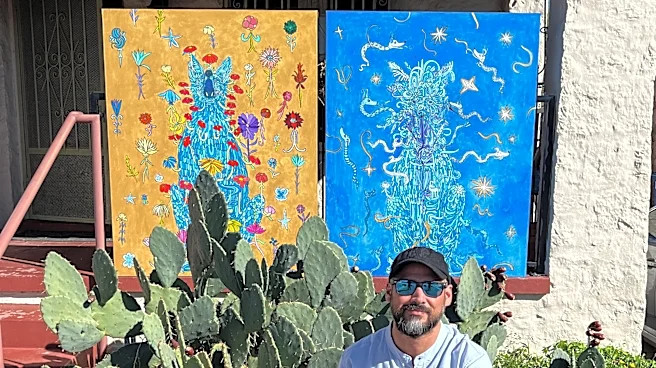









Borderland artist Gabriel Marquez honed his creations from Seattle, Washington, to Socorro, Texas, before eventually moving his Mystic Desert Studio gallery to the Lincoln Park area in Central El Paso.
Marquez will be taking his work down the road to Nova Art Space at The Falstaff.
Before his exhibition, “The Weight of a Flower,” opens, Marquez answered some questions about his style and the event.
El Paso Times: How long will your exhibition run at Nova Art Space?
Marquez: The exhibition runs for a minimum of at least two to three weeks. The opening will be Thursday, Sept. 24, from 6-10 p.m. at Nova Art Space, 3803 Frutas Ave., El Paso, Texas, at The Falstaff artist community space.
El Paso Times: How did the exhibition come about?
Marquez: I approached
David Delgado, who runs Super Ultra Nova Gallery, about a year ago. There was a long waiting list. He was happy to put me on the calendar.
El Paso Times: What is the advantage of showing your work outside of your gallery?
Marquez: I enjoy presenting my work to differing audiences, especially potential collectors and art enthusiasts. Artists create a certain type of culture, and I always want to be growing it.
El Paso Times: Where else can people see your art?
Marquez: Taconeta, Mas y Menos, Savage Goods, La Nube, Lincoln Park, and Mystic Desert Studio (3900 Rosa Ave., Suite B), or online at mysticdesertstudio.com
El Paso Times: What is the theme of your exhibition?
Marquez: The exhibition is titled “The Weight of a Flower.” The title comes from the idea that a flower is nearly weightless, yet it can carry an incredible amount of emotional weight. As delicate and temporary as flowers are, we give them meaning. We use them to express love, grief, celebration, loss, remembrance and things we cannot put into words.

El Paso Times: You have begun using a more diverse color palette in your work, adding more intricate patterns, creating curved, colorful works so intricate they spark an almost MC Escher vibe while still maintaining the surreal, alternate natural world your work is known for. How did those developments in style come about? What was the inspiration?
Marquez: I've had this winding, contour style for a long time and have been working with paint for years. In my drawings, I've always found it easier to work in a more geometric, pattern-based style, and I'm now starting to incorporate more of that into my painting practice. A lot of these ideas have been sitting in my archive, and I'm just now experimenting with bringing them into acrylic.
The color palette I'm using now is also part of that experimentation. I'm working more with percentages of color rather than using colors straight from the tube. The process has gotten a little more technical, but it's still me and still feels connected to the way I've always worked.
El Paso Times: You also appear to be focusing on larger-format works. Was that a conscious decision?
Marquez: I just like to work big. The paintings are powerful in the right spaces. The only time I like to work small is when I'm using graphite. To me, the paintings are like very big sketches. I approach the canvas the same way I approach a drawing — working through ideas, shapes and lines as I go. I don't want everything to feel too planned or perfect. I like being able to change things, leave certain marks visible and let the painting develop while I'm working on it.
El Paso Times: On average, how long does an artwork take to complete?
Marquez: My paintings can take anywhere from two weeks to a year to finish. Sometimes I'll start a painting and only get so far with it, then leave it alone for a while. It's almost like the painting has to reach a certain age before I know it's time to come back and add another layer. I don't always know what it needs right away. Sometimes it just needs time.
El Paso Times: What can people expect from your exhibition?
Marquez: They can expect to see my work in evolution. I'll be showing work from about five years ago to now, and somehow it all kind of fits together. Even though the work has changed over time, there are certain ideas, shapes and ways of working that continue to show up. You can see where the work has been and where it's going.
El Paso Times: What can they expect from your future work?
Marquez: They can expect to see new public works. After this show, I'll be working on projects for businesses around town that have been put on hold for a minute.
El Paso Times: How do you think the El Paso art scene is developing? What recent developments have you noticed?
Marquez: I think the El Paso art scene is growing. I'm seeing more artists creating their own opportunities, putting together exhibitions, markets and events instead of waiting for someone else to give them a space. There are also more businesses opening their doors to artists and finding ways to work with the creative community. It feels like there are more places to show work and more people making things happen on their own. There's still a lot of room to grow, but I think that's what makes it exciting right now.
El Paso Times: You are conducting regular art markets. How do you balance them in addition to being a working artist operating a gallery?
Marquez: It's definitely a lot to balance, but it all kind of works together. The market brings people to the studio, the studio gives artists a place to show their work, and being around all of it keeps me motivated to keep making my own work.
El Paso Times: How do you keep your love for art alive?
Marquez: It's what I know, and it's how I express myself. There's power in creating work and putting it out there for people to see. If people really enjoy it and connect with it, that makes it even more meaningful. I've always felt it was my calling. I grew up participating in art events like live painting and showcasing in public spaces, and I want other people to have that same experience. There's something about creating that kind of environment that people connect with.
This article originally appeared on El Paso Times: Artist Gabriel Marquez brings 'Weight of a Flower' to El Paso