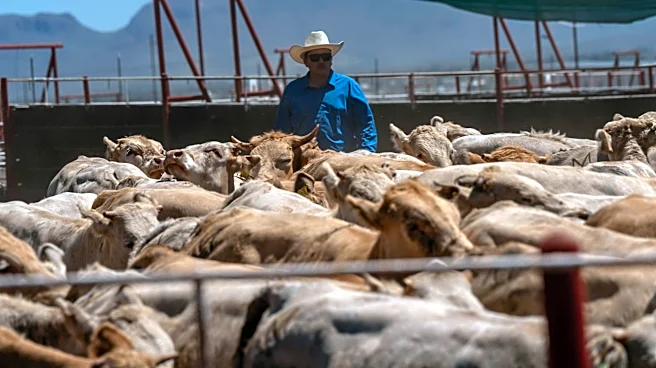







Cattle are once again going to be moving through the Santa Teresa, New Mexico, border crossing.
The Trump administration is planning on beginning the imports of cattle through Santa Teresa on Thursday, Sept. 24, after more than 15 months. The importation of cattle was suspended in May 2025 because of the rapid spread of the parasitic New World screwworm through Mexico.
Santa Teresa is the largest livestock crossing in the U.S.
The decision to renew cattle exports from Mexico through Santa Teresa comes one month after the Trump administration renewed imports through the Douglas, Arizona, cattle crossing on Aug. 24. The U.S. exported 719 head of cattle in the first export since May 11, 2025.
U.S. Department of Agriculture Secretary Brooke Rollins
announced the renewal after the success of the opening of the Douglas gate.
"What you all have proven for the last 20-plus days in Douglas is that this is manageable and doable, and the minute we believe there's another threat, we shut it down again," Rollins said, according to Reuters.

The renewed imports come as the USDA and Mexico's El Servicio Nacional de Sanidad, Inocuidad y Calidad Agroalimentaria, or SENASICA, have placed new requirements to check the health of animals before being exported. These protocols were first put in place before the renewal of imports on Aug. 24, expanding on previous standards.
Texas Agriculture Commissioner Sid Miller also announced on Sept. 22 that the Texas Department of Agriculture’s Del Rio Livestock Export Facility is open to horse exports effective immediately.
Mexico was exporting more than 1 million head of cattle annually before the closure of the border crossings in May 2025. Exports plummeted from 1.2 million head of cattle in 2024 to 229,055 in 2025, USDA data shows.
The renewal of exports comes as the Trump administration seeks to ease high beef prices in the U.S. The export also comes as the U.S. cattle herds are at their lowest levels in the last 75 years, USDA reported.
What is the New World screwworm?
New World screwworm, or Cochliomyia hominivorax, is a type of parasitic fly that once spread across the Western Hemisphere.
The parasite does not affect only cattle. The fly lays its eggs in wounds and body openings of warm-blooded animals and humans, where the larva completes its life cycle by feeding on the flesh and tissues of the host.
There have been hundreds of cases of screwworm infestation in humans across Latin America since 2023.
The parasite devastated the livestock industry in the 20th century, so the U.S. worked with the governments of Mexico and Central American countries to eradicate the fly. By the mid-1990s, there were no screwworm cases north of the Darien Gap in Panama.

The screwworm was under control until 2023, when Panama registered its first case. The fly quickly spread north, and by 2024, the southern Mexican state of Chiapas was registering its first cases.
Mexico has registered over 38,000 infections in 30 states since the parasite was first detected, including hundreds of cases in humans, resulting in the closure of cattle exports to the U.S. Sonora registered its first case of screwworm infestation on Aug. 19, but the exports still continued.
The U.S. has also registered cases of the parasite.
There are currently50 cases of screwworm infection, the USDA reported. There are three active cases found in New Mexico horses.
Panama, Mexico and the U.S. have launched efforts to produce sterile flies to combat the spread of the parasite. They are looking to release millions of sterilized flies to stop the spread of the parasitic fly.
Jeff Abbott covers the border for the El Paso Times and can be reached at:jdabbott@usatodayco.com; @palabrasdeabajo on Twitter or @palabrasdeabajo.bsky.social on Bluesky.
This article originally appeared on El Paso Times: Santa Teresa cattle imports resume as US seeks beef price relief