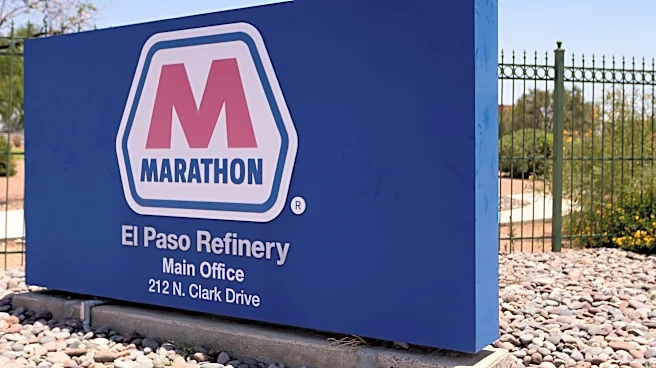




Late on the night of Tuesday Aug. 4, my office started seeing reports regarding a toxic leak at the Marathon refinery the same way most of you did: through social media. Neighbors described chemical odors strong enough to make people lightheaded. Sirens blared for hours. Families left their homes because the smell of gas was too much to bear. All of this gave rise to the real-time question: What is happening, and why won't anyone tell us?
We didn't have an answer either. My office reached out to the refinery, which is just off the highway in the center of town. Only then — nearly an hour and a half after residents first started reporting symptoms — did we learn that “trained professionals at Marathon Petroleum’s El Paso refinery are responding
to reports of odors in the surrounding area." We were told the source had been identified, monitoring was underway, and no readings indicated a health risk.
The next morning, after we followed up again, we received a vague explanation: odors from liquid hydrocarbons released from a storage tank due to "unanticipated operating conditions" had reached beyond the fence line.

At the time, that was all we had to go on. It wasn't enough, but it was what we were given.
Then the actual numbers came in from the Texas Commission on Environmental Quality, and the picture changed entirely.
Over a 24-hour period, the refinery released 862 pounds of sulfur dioxide — 3,591 times its permitted limit. In just the first two hours of the incident, it released 19 pounds of 1,3-butadiene and nearly 8,900 pounds of propylene, both far beyond what the facility is legally allowed to emit. These chemicals are significant irritants and health hazards, and these are not rounding errors. These are the kinds of numbers that should have triggered immediate, direct, and specific communication with the public and the officials elected to protect them. Instead, we got reassurance without substance, delivered on the refinery's timeline, not the community's.
Let's be honest about what that gap represents. For roughly 90 minutes, and arguably much longer, residents from the neighborhoods immediately surrounding Marathon were breathing unpermitted levels of hazardous pollutants with no idea what was in the air around them, no guidance on whether to stay inside, and no sense of when it would end. That is not a communications failure. That is a public health failure, and it was entirely avoidable.
This isn't the first time Marathon's conduct has raised serious questions. In 2023, I proposed that El Paso County challenge the refinery's permit renewal, and alongside neighborhood groups, we've continued pushing for a contested case hearing on that application. Marathon appealed the TCEQ's unanimous decision granting the county standing to pursue that hearing. That appeal period has now expired. We are moving forward.

This incident isn't a footnote to that fight — it's the argument for it. Marathon has a permit to operate in our community that should require transparency, communications, and adherence to best practices to protect public health. The initial silence regarding this documented, multi-thousand-fold permit violation was followed by minimization and then followed by an explanation only after independent data forced its hand.
Marathon Petroleum has operated in El Paso for decades, and there is a path forward where that continues responsibly. But that path requires real change: direct and immediate notification to local officials and the public when incidents occur, honest reporting of what's actually being released, expanded independent air monitoring in the neighborhoods closest to the facility, a genuine willingness to be held accountable when permits are violated at this scale, and ongoing improvements to set a standard for operating safely.
El Paso County residents deserve better than being an afterthought in their own air quality. We intend to make sure they get it.

David C. Stout has served as Commissioner of Precinct 2 since taking office in January of 2015.
This article originally appeared on El Paso Times: OPINION: Marathon refinery leak exposed as massive violation