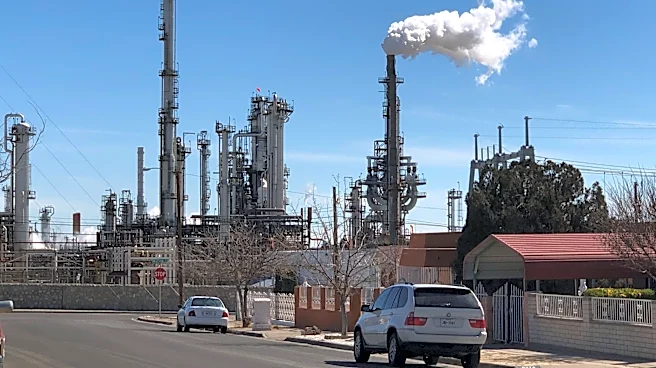








An equipment breakdown at the El Paso Marathon oil refinery in early August resulted in the release of much more pollution than previously reported.
The breakdown on the night of Aug. 4 resulted in the release of 31,100 pounds, or 15.6 tons, of 33 different pollutants, show a new report Marathon submitted to the Texas Commission on Environmental Quality, or TCEQ, on Tuesday, Aug. 18.
The 97-year-old refineryemitted a strong odor during the event and some nearby residents reported getting sick from the fumes, prompting a barrage of complaints and calls from El Paso politicians for accountability.
Most of the emissions were many times more than allowed under the refinery’s permitted limits, and over three times the 9,779 pounds of emissions from
three pollutants that Marathon reported in its initial report filed with the TCEQ on Aug. 5. Some of the pollutants could be harmful to people's health in certain amounts.

A Marathon statement sent Aug. 18 to the El Paso City Council conceded the odor from the event was strong, but said Marathon's air monitoring done in neighborhoods surrounding the refinery "did not detect (pollution) levels indicating a health risk." The air monitoring data was sent to the U.S. Environmental Protection Agency, the statement reported.
Marathon's submission of its final report on the incident triggers the TCEQ investigation. Officials at the agency did not immediately respond to an El Paso Times' request for information about the investigation.
This comes as Marathon is in the process of having its major air permit renewed and amended by the TCEQ. It's contesting a June decisionby the TCEQ's three commissioners to hold a trial-like hearing on the permit application, as requested by El Paso County and others.
Marathon's pollution estimates are based on emissions inside the refinery, which "are not the same as ground-level air monitoring in the neighborhoods beyond our fenceline," according to Marathon's statement.
"We never want our operations to negatively impact our neighbors, and we are sorry for the disturbance residents experienced," the statement said.

More: Meta backs Gov. Abbott data center standards, won't end El Paso tax deal
Numerous residents around the refinery reported a noxious odor on the night of Aug. 4, an odor that spread for miles beyond the refinery, which covers parts of East-Central and South-Central El Paso.
Some residents reported getting sick from the fumes, including two people who went to the hospital, Veronica Carbajal told City Council. She's an organizer for the Sembrando Esperanza neighborhoods coalition, which includes the Corbin Sambrano neighborhood next to the refinery.
The El Paso law firm Tawney, Acosta & Chaparro issued a news release Aug. 18 stating it's representing several families affected by the refinery incident and investigating whether others were affected.
Much of the odor may have come from hundreds of pounds of sulfur dioxide, a pungent, toxic gas released mostly from gas flaring during the refinery equipment problem. Short-term exposures to sulfur dioxide can harm the human respiratory system and make breathing difficult, according to the EPA.
The new Marathon report came after the El Paso City Council, Aug. 18, voted to request that the TCEQ and the U.S. Environmental Protection Agency hold a public meeting with Marathon refinery officials to provide an account of what happened, the potential public health implications, and the agencies’ response to the incident.
U.S. Rep. Veronica Escobar, D-El Paso, in an Aug. 12 letter, also asked the EPA to investigate the emissions event.

Most of the excess emissions occurred in the first two hours of the event, but emissions continued for three days, according to Marathon's final report to the TCEQ.
The emissions came from the refinery's fluid catalytic cracker, which shut down because of an electrical issue; a wet gas scrubber; hydrocarbons escaping from a storage tank tied to the catalytic cracker; and gas flaring to maintain safe operation during the catalytic cracker's restart, according to the report.
Thirteen pollutants were released from a refinery storage tank, 11 pollutants from gas flaring, and nine from the fluid catalytic cracker and wet gas scrubber, the report shows.
More: El Paso Community Foundation returning to broadcasting with KTEP deal

For just over 68 hours, beginning just before 8 p.m. on Aug. 4 and ending almost at 4 p.m. on Aug. 7, the refinery emitted just under 1,600 pounds of sulfur dioxide, with more than 1,000 pounds from gas flaring. That's well beyond the flare's permitted sulfur dioxide emissions limit of .01 pounds per hour, the TCEQ report shows. The refinery initially reported 862 pounds of sulfur dioxide emissions.
Another large emission was propylene, a chemical in gas form used as an octane-enhancing component in gasoline, according to the American Chemical Council’s chemicalsafetyfacts.org website. The refinery storage tank emitted 10,066 pounds of propylene over a 7½-hour period from 8 p.m. Aug. 4 to 3:30 a.m. Aug. 5, according to the TCEQ report. That's well above the permitted level of 1.25 pounds per hour. Initially, the refinery reported propylene emissions of about 8,900 pounds.
Moderate amounts of propylene in the air may cause dizziness, drowsiness, and unconsciousness, according to the American Chemical Council.
Vic Kolenc may be reached at 915-546-6421;vkolenc@elpasotimes.com; @vickolenc on X, and @vkolenc.bsky.socialon Bluesky.
This article originally appeared on El Paso Times: TCEQ probe starts as El Paso Marathon pollution estimate soars