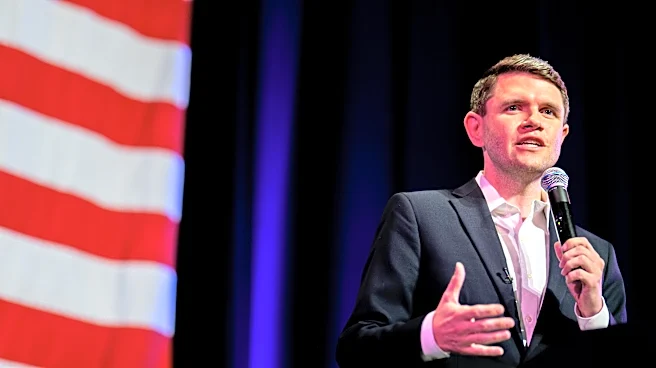





Meet the candidate: Chris Canales, City Council District 8
Age: 34
Occupation: Serving as the District 8 City Representative is my primary occupation and source of income. In addition to my work on the City Council, I also officiate professional soccer, which I have done since before taking office.
Please describe your personal and professional background.
I’m a native El Pasoan and the son of an immigrant father from Mexico and a mother from Boston, who met while working in Juárez and decided to stay in the Borderland. I grew up on the West Side of El Paso, departed when I was 18, and returned home in 2017 after living and working in New York City.
My professional background includes work in natural resources management, sustainability, public policy, and local government. In New York, I worked in the
Natural Resources Group at the New York City Department of Parks & Recreation, for a coalition of nonprofit organizations focused on education reform, and for a consulting firm specializing in sustainability, environmental conservation, and waste reduction.
After returning to El Paso, I spent six years working at City Hall before being elected to represent District 8 on the El Paso City Council in 2022. That experience gave me a firsthand understanding of city government and the neighborhoods and people of District 8 before I took office.
My wife, Nora, is a museum professional, and we live in District 8 with our two senior rescue dogs, Wyck and Q, and a rotating cast of foster dogs from El Paso Animal Services.
Describe your political identity.
I am a progressive, but I’m also a pragmatist. I believe government can and should be a force for improving people's lives, expanding opportunity, protecting individual rights and civil liberties, and making sure that people who have historically had less power have a meaningful voice in the decisions that affect them.
For me, being progressive means supporting working people and organized labor; protecting and advocating for marginalized people; expanding access to affordable housing and basic needs; protecting clean air, clean water, and natural resources; defending privacy and civil liberties; and investing in public services and infrastructure that create broadly shared opportunity.
I also believe strongly in fiscal responsibility and evidence-based policymaking. I have pushed to reduce city debt, scrutinized spending and economic development incentives, protected taxpayers and utility ratepayers, and made sure public investments produce a meaningful return for El Pasoans. I believe public resources should be used responsibly and directed toward policies and investments that meaningfully improve people's lives, not toward vanity projects.
Texas does not have formal party registration, but I have always voted in Democratic Party primaries, going back to when I first registered to vote at 18, and I am a card-carrying member of the Working Families Party, a national political party focused on building a multiracial working-class coalition to challenge economic inequality.
City government issues, however, often don't align neatly with the platforms of the major political parties. I approach each issue with a clear set of values, but also with an openness to evidence, compromise, and practical solutions.
Questions related to El Paso City Council District 8 race
Do you support the proposed Downtown I-10 Deck Plaza project? Why or why not? If elected, would you support using city funds to help finance the project?
I do not support moving forward with the proposed Downtown Deck Plaza under present circumstances, and I definitely would not support asking El Paso taxpayers to make up the enormous funding gap for the project.
I made my position exceptionally clear in an op-ed I published back in April 2025, and my opinion remains the exact same today. Since then, the financial case has only become increasingly more difficult to justify. Multiple applications for federal grants have been unsuccessful, and only $1 million in private philanthropy has been announced. Even the approximately $20 million design phase is not fully funded, and beyond that, approximately $188 million would still be needed to construct the deck itself and another $204 million for the surrounding infrastructure, based on the City's documented estimates.
There is currently no proposal before the City Council to have local taxpayers cover that gap, and I would never support one. Committing hundreds of millions of dollars in city resources to this project would mean either taking on substantial additional debt or diverting a massive amount of resources from other priorities at a time when El Paso has enormous existing needs, particularly streets and other basic infrastructure and deferred maintenance.
I am also strongly opposed to TxDOT's underlying I-10 widening project. I do not believe spending approximately $1.3 billion to substantially widen the freeway through the center of El Paso is the right transportation investment for our community. Established science shows that building more lanes of highway is not an effective long-term fix for congestion. Building a park over a portion of that expansion does not resolve those underlying concerns.
I understand and fully support the goal of reconnecting Downtown with the neighborhoods that were divided by the construction of I-10. I’m in favor of investments that improve connections between Downtown and surrounding neighborhoods, make it safer and easier to walk and bike, create quality public spaces, and repair some of the damage caused by past transportation decisions. But those goals need to be pursued in ways that are financially realistic and that would not require El Paso taxpayers to assume hundreds of millions of dollars in additional costs. The Deck Plaza doesn’t fit that brief.
Property taxes remain a top concern for many El Paso homeowners. What specific actions would you support to slow the growth of property tax bills or reduce services?
My goal has been to help put the city on a more sustainable financial path so that raising property taxes doesn't have to be the answer year after year. That requires controlling ongoing expenses, continually examining programs and staffing, eliminating spending that isn't producing enough value, managing vacancies responsibly, improving productivity, aggressively managing our debt, and growing the tax base so that the cost of city government isn't continually falling more heavily on the same taxpayers.
We have reduced the city's property tax rate significantly, from a peak of about 90.7 cents per $100 of valuation in FY2022 to about 79.8 cents in FY2027, including adopting the no-new-revenue rate twice in FY2024 and FY2025. That reduction is significant and will matter tremendously over the long term, but rising property values mean many El Pasoans have still seen their actual tax bills increase in the short term. Of course, people still feel the pinch of a higher bill, and it's disingenuous to pretend otherwise.
At the same time, continually cutting or deferring necessary investments can leave taxpayers with a much larger bill in the long run. We could save money in a given year's budget by resurfacing fewer streets, postponing building repairs, or keeping aging equipment in service longer. But those needs don't disappear. Streets deteriorate from needing regular resurfacing into much more expensive reconstruction projects. Buildings become more expensive to repair as they age even further. Old vehicles and equipment become increasingly costly to maintain and spend more time broken down. Saving a dollar today can easily create several dollars of costs tomorrow.
I have also focused heavily on debt. The city recently went nearly two years without issuing new debt, while we have made early payments, refunded bonds when interest-rate savings were available, and allowed other debt to mature. That has helped reduce the city's outstanding debt by more than $300 million since 2022 and bring down the debt-service portion of the property tax rate. I want the city to continue moving away from using long-term borrowing to solve recurring problems, particularly for things like routine street resurfacing.
When necessary, budget reductions should always start by examining programs and staffing, eliminating spending that isn't producing enough value, managing vacancies responsibly, and finding ways to improve productivity before dramatically cutting the services residents rely on. That's not hypothetical. In developing this year's budget, we eliminated 360 funded but currently vacant positions to save $26 million and also reduced or denied departmental requests for new positions and programs to save $18.7 million. I think that kind of scrutiny needs to be part of the budget process every year. We also need to distinguish between recurring and one-time expenses and avoid creating new ongoing costs without a sustainable way to pay for them. A City Council can always make one year's numbers look better by borrowing more, postponing maintenance, spending down reserves, or pushing expenses into the future. I think the better test is whether the decisions we make today leave taxpayers and the city in a stronger financial position in the years ahead, and that is what I have worked toward throughout my first term.
Road conditions continue to be a major concern for voters. What steps would you take to ensure adequate and sustainable funding for street maintenance and repairs across El Paso?
We need to treat street maintenance as an ongoing basic responsibility of city government and fund it accordingly. During my first term, we have committed more than $110 million to street resurfacing through a combination of cash funding in the city budget and the voter-approved Community Progress Bond. That is a substantial investment, but we still aren't spending enough annually to keep the overall condition of our street network from slowly getting worse.El Paso has more than 5,400 lane miles of streets, representing a total public asset worth about $3.6 billion, and about 28% of the network has been rated poor or very poor. Based on the city's own pavement management analysis, we need to resurface approximately 4% of the network each year just to maintain its overall condition. That would require roughly $75 million annually, compared with the approximately $35 million per year we have typically been spending in recent years.
That gap is exactly how we ended up with such a large backlog. Routine resurfacing is far less expensive than allowing pavement to deteriorate until a street requires reconstruction, which can cost approximately $14 million per mile. We need to spend enough on preventive maintenance to extend the useful life of streets before they reach that point.My long-term goal is therefore to establish a much larger, predictable annual resurfacing program and increasingly pay for routine street maintenance with recurring revenue rather than long-term debt. Borrowing money for something we know we will have to do every single year is not a sustainable way to manage our streets.
We also need to continue using objective pavement management data to decide which streets are resurfaced rather than allowing those decisions to become political. The City's Pavement Condition Index system gives us a way to evaluate the condition of streets across El Paso without personal or political bias and direct resources where they can have the greatest impact.
What is your assessment of the city's Data Center Policy Framework? Does it strike the right balance between economic development and protecting community resources, or would you propose changes?
I hope the City's Data Center Policy Framework is largely irrelevant when it comes to hyperscale AI computing data centers, because I do not want the City entertaining those projects at all. I don't believe that facilities consuming extraordinary amounts of water, electricity, and other scarce resources are a good fit for El Paso.
That said, I think the development of the Framework has been robust and has left us with a good set of protections for El Paso. A tremendous amount of work has gone into examining water and energy use, infrastructure, land use, environmental impacts, economic benefits, and the other consequences of these projects. I support having those protections in place, and I voted in favor of it.
There are really two separate policy questions. First: if a data center is proposed here, what requirements and protections should the city have in place? The Framework does a good job of answering that question. Second: should the city incentivize or even tolerate hyperscale AI computing facilities? My simple answer to that is no.
That is why I proposed and passed council direction that hyperscale data centers should not be incentivized by the city, including through tax abatements, rebates, fee waivers, public financing, or grants. Economic development should be judged by the return El Paso receives on our resources, including taxpayer dollars but also land, water, energy, and infrastructure capacity. I would rather use those resources to support industries that build durable local industries and skills, create a large number of good jobs, and make sense given El Paso's particular strengths and constraints.My position has also been informed by what happened with the Meta project. When I voted for the original agreement in 2023, the project presented to the city was an approximately $800 million conventional server farm. It subsequently grew into something essentially unrecognizable from what was originally pitched, with an investment now estimated at approximately $14 billion and a dramatically larger scale and energy demand as the project shifted toward AI computing. Many of Meta's public commitments that were part of the original discussion, particularly around electricity generation, have not materialized as originally represented. That is why I voted for the city to legally intervene in El Paso Electric's request to the Public Utility Commission of Texas to construct a makeshift $551.8 million power plant consisting of 813 gas-fired generators to initially serve Meta.
Given how substantially that project and its resource demands have grown, I believe it is appropriate for the City's response to shift to meet the moment. I also voted in favor of beginning negotiations toward terminating or renegotiating the existing agreement with Meta, though unfortunately that proposal did not pass.
I would rather have stringent protections in place than leave El Paso unprepared, but meeting a regulatory framework does not mean a project is necessarily good for the community, and my broader position remains that hyperscale AI computing data centers are not an industry that is a good fit for El Paso.
Should the city continue offering tax abatements and other incentives to attract profitable corporations or industries? Under what circumstances, if any, should those incentives be approved?
Yes, but very selectively. I don't believe tax abatements and other incentives should be offered simply because a project comes with a large capital investment number. They should be used only when there is an abundantly clear public benefit and El Paso is getting a strong return on what taxpayers are being asked to contribute.
That means looking closely at the number and quality of jobs created, wages and benefits, opportunities for local workers and businesses, the amount of new economic activity and taxable value generated, and the project's demands on public resources and infrastructure. Incentive agreements should also include clear and strict performance requirements so that companies actually deliver what they promised in exchange for public support, and the ability to claw back what has been paid out if a company falls into non-compliance.
Ultimately, incentives are one tool for economic development, but definitely not the goal itself. I support using them when they can help bring lasting economic opportunities to El Paso that likely would not happen otherwise, but only when the public benefit clearly justifies the public investment.
Public safety remains a core city responsibility. What are your top priorities for police, fire and emergency services, and how would you pay for them?
My top public safety priority is making sure our police, fire, and emergency services have the staffing, equipment, and resources necessary to respond quickly and effectively when El Pasoans need them.
Police staffing declined during and immediately after the pandemic, so for multiple years I voted to fund three police academies annually to help catch up on recruitment and replace officers lost through attrition and retirement. We need to continue monitoring staffing and response times and make sure our investments are actually putting enough first responders in the field.
We also need to make sure we are sending the right resources to the right calls. I have strongly supported expanded funding for the Crisis Intervention Team, which pairs specially trained police officers with mental health professionals to respond to people experiencing behavioral health crises, so they can receive a more appropriate response while also allowing patrol officers to remain available for calls that require a law enforcement response. On the Fire and EMS side, we need to make sure staffing, stations, ambulances, and other resources keep pace with population growth and emergency call volume so that response times do not suffer as the city grows.
At the same time, public safety funding needs to be financially sustainable. One important change during my term has been shifting the replacement of police and fire vehicles away from long-term debt and toward direct cash-on-hand funding through the annual budget. The city is still paying down old debt on public safety vehicles that have already reached the end of their useful lives. Incorporating predictable vehicle replacement costs into the annual budget saves taxpayers significant interest costs and better aligns the way we pay for these expensive assets with how long they are actually expected to remain in service.
What do you see as El Paso's biggest economic challenge, and what specific policies would you pursue to address it?
I think El Paso's biggest economic challenge is that our geographic footprint has continued to expand much faster than our population and economy. Every new area of development eventually requires streets, utilities, police and fire coverage, parks, drainage, and other public infrastructure that the city must build and maintain. If the tax base and population are not growing at a comparable rate, we are spreading the cost of city services across an increasingly large physical area without enough additional economic activity to sustainably pay for it, meaning each of us has to pay a larger share. I believe this dynamic has been one of the major underlying drivers of the increases in El Paso's property tax burden over the last several decades.
That is why I have been such a strong advocate for infill development, redevelopment, and adding more housing and economic activity within parts of the city where infrastructure already exists. It is generally much more financially sustainable to make better use of streets, utilities, public safety stations, and other infrastructure we have already paid for than to continually extend the city's footprint outward.
At the same time, we need stronger economic growth and more good-paying jobs. I want us to prioritize locally owned small businesses, which we have supported through the creation of the city's new Business One Stop Shop program, as well as advanced manufacturing, clean energy, international trade, and manufacturing that takes advantage of our unique position in a binational region, paired with workforce development that gives El Pasoans the skills to compete for those jobs.
Ultimately, those two challenges are connected. We need an economy that raises household incomes and creates durable local industries, while also managing growth in a way that doesn't continually increase the cost of providing basic services faster than our ability to pay for them.
Have you read the City Charter? What did you learn is the top City Council priority?
Yes. I have read the City Charter and regularly refer back to it in the course of doing my job. The Charter is essentially the local constitution for our home-rule municipality. It establishes the structure, powers, responsibilities, and limitations of city government, but it is not the document that establishes the City Council's policy priorities. The City’s Strategic Plan serves that purpose, translating the city's broader mission into multiyear goals and priorities that guide the work of the council, city management, and our employees. We completed a major update to that plan this year, and I’m grateful to the many constituents who participated in the process of doing so.
I also believe strongly in strategic planning at the district level. I was the first member of the City Council to create a Strategic Plan specifically for my district, built through direct engagement with constituents around the issues affecting their lives and the things they want their city government to prioritize. It gives residents a clear picture of what I am working toward and gives me a framework against which I can measure our progress.
One of the most important things the Charter reinforces is that city government has defined powers and responsibilities. It is vital in this role to understand what those are, use them effectively, and be equally clear about what falls outside the city's authority. Within that framework, I believe our priorities should be driven by the needs of the people we represent and translated into specific, measurable goals through the strategic planning and budgeting processes.
City leaders often face divisive issues. How would you work with colleagues, stakeholders and residents to find common ground and build consensus on major city decisions?
I take clear positions on many issues, but I don't think having established principles prevents you from working productively with people who sometimes disagree with you. I try to approach difficult issues by doing my homework, listening seriously to colleagues, stakeholders, and residents, and figuring out where there is genuine common ground.
Sometimes that means reaching agreement on the policy itself, and sometimes it means agreeing on a fair process for resolving a disagreement.
One good example was the proposed arena. Former Representative Brian Kennedy, Rep. Art Fierro, and I do not always approach issues from the same political perspective, but we jointly brought forward the proposal to return the remaining arena bond authority to the ballot. Whatever our individual views of the project and its complex history, we agreed that after more than a decade and major changes in both circumstances and cost, voters deserved the opportunity to weigh in again, because ultimately, it's their money.
I have worked similarly with colleagues across the council on other issues. I partnered with former representatives Cassandra Hernandez and Isabel Salcido on expanding paid parental leave for city employees; with Rep. Lily Limón on strengthening long-term public oversight and accountability for voter-approved bond projects; with former representative Alexsandra Annello on expanding access to naloxone to prevent overdose deaths; and with Rep. Josh Acevedo to secure continued funding for the Opportunity Center's Welcome Center, which provides emergency shelter and services for people experiencing homelessness.
Those collaborations worked because we started with something we agreed needed to be accomplished and worked from there. I am always willing to change the details of an idea, incorporate someone else's better suggestion, or share ownership of a proposal if doing so produces a better result. I don't think finding common ground requires abandoning your principles. It requires being willing to listen, recognize good ideas regardless of where they come from, and focus on getting useful work done.
What should be the city's next big civic project?
I don't think El Paso's next big civic project necessarily needs to be a single enormous building or attraction. I would like our next major undertaking to be reinvesting in the city we already have.
That means finally getting ahead of our street maintenance backlog, repairing aging public facilities and infrastructure, improving sidewalks and accessibility, and investing in parks and public spaces. It also means making it easier to build more housing and redevelop vacant or underused properties in areas where streets, utilities, transit, and other public infrastructure already exist.
I would particularly like to see that approach transform Downtown and the many neighborhoods in the core of the city. We have enormous potential in vacant and underused buildings, historic neighborhoods, existing infrastructure, public spaces, and our transit network. Bringing more housing, residents, locally owned businesses, and activity into those areas would strengthen the heart of El Paso while making better use of public investments we have already made.There will always be a place for major individual capital projects, but I think the most transformative thing we can do over the next decade is take better care of what generations of El Pasoans have already built. A sustained citywide reinvestment program may not fit the traditional definition of a single "big civic project," but I believe its impact on residents' everyday lives and El Paso's long-term financial health would be far greater.
Learn more about Chris Canales
Do you plan to continue in your current employment if elected?
Serving as the District 8 City Representative is my primary occupation and source of income. In addition to my work on the City Council, I also officiate professional soccer, which I have done since before taking office. I plan to continue if reelected.
What experiences in leadership do you have that qualify you for this position?
I have spent nearly a decade working in city government, first as a City Council staffer and, for the past four years, as the elected City Representative for District 8. In those roles, I have worked directly on municipal budgets, constituent services, legislation and policy development, land use, infrastructure, economic development, and many of the other issues that come before the City Council.
During my first term, I have also taken on significant leadership responsibilities beyond my council seat. I also serve as a trustee of the City of El Paso Employees Retirement Trust and a member of its Investment Committee, serve on the Financial Oversight and Audit Committee, and am the city's first appointee to the El Paso Continuum of Care Board, which coordinates the community-wide response to homelessness. I have also served on a number of other city and regional boards during my term, including with the El Paso Metropolitan Planning Organization and the Downtown Management District.
I also chair the City’s Animal Shelter Advisory Committee, and I co-founded and continue to run the Pet Pantries program in partnership with the El Paso Community Foundation's Borderland Rescue Fund. In just over a year, the program has provided nearly 400,000 pounds of pet food and supplies to pet owners and animal rescue organizations across the community.
Outside of city government, I have served in several elected and appointed leadership roles with my labor union, the Professional Soccer Referees Association, including on the bargaining team that negotiated my unit’s first collective bargaining agreement and subsequent agreements. I have also served in leadership roles with local nonprofit and community organizations including the Kelly Center for Hunger Relief, the Vitalant blood bank, and the Plaza Classic Film Festival.
Have you ever been arrested or charged with a crime? Have you ever had a civil judgment against you? Have you ever been in arrears on local, state or federal taxes? If so, please provide an explanation.
No. I have never been arrested or charged with a crime, had a civil judgment against me, or been in arrears on local, state, or federal taxes.
If elected, would you have any potential conflicts of interest that you are aware of that would impair your ability to serve? Please explain what they are and how you would avoid the conflict.
No. I am not aware of any potential conflicts of interest that would impair my ability to serve. As was the case throughout my first term, if a matter were to arise in which I had a conflict of interest, I would disclose it and abstain from participating or voting as required by law and by ethics standards.
What does transparent government mean to you? Will you be personally accessible to answer questions while in office?
Transparent government means that people should be able to understand what their government is doing, why decisions are being made, how public money is being spent, and where their elected representatives stand. I believe transparency should be active, meaning government and elected officials proactively provide information and explain their decisions, rather than passive, meaning information is technically available but residents have to know where to look or specifically ask for it. Complying with open meetings and public information laws is essential, but it should be the floor, not the ceiling.
Throughout my first term, I have regularly produced detailed explainers breaking down city budgets, property taxes, utility rate cases, major infrastructure projects, and other complicated issues in understandable terms. I also write op-eds on subjects of particular controversy or public interest so that residents do not have to guess where I stand or wait for a reporter to ask me. I think elected officials have an obligation to explain not only how they voted, but the reasoning behind their decisions.
Accessibility is an equally important part of that. In addition to regular community meetings, I created Café con Chris as a recurring opportunity for constituents to sit down with me in an informal setting, without an appointment or a formal agenda, to ask questions, raise concerns, or simply talk about what is happening in their neighborhood and at City Hall. I attend neighborhood and community meetings throughout District 8, make myself readily available to local media, and communicate directly with constituents through multiple channels including an email newsletter and social media including Instagram, Facebook, and Reddit.
What distinguishes you from the other candidates in this race, and why should voters choose you?
The things that most distinguish me are my dedicated hands-on approach, my independence from big-money influence, and the depth of experience I bring to the job. I do an enormous amount of the work myself. I research and develop policy, write my own agenda items and public communications, create the explainers I use to make complicated city issues understandable, and personally engage with constituents. I run my campaign the same way. I have no campaign manager, consultants, communications staff, or designers. It is entirely me, with the help of my wife Nora, and sometimes friends who volunteer their time. The words, ideas, designs, videos, website, and (most importantly) policy positions from my campaign come directly from me. Voters should be able to trust that the candidate described in the campaign literature is the authentic person who will represent them and not the creation of a consultant team.
My six years of experience working on the City Council plus four years in office mean that I understand city government in a way that simply takes time to develop. The City of El Paso is a large and complicated organization, with thousands of employees, dozens of departments, a budget of more than a billion dollars. It honestly takes years to truly learn the ropes, understand how all of those pieces fit together, and know where to dig deeper or ask the right questions. I can bring that experience to the job from day one of a second term.
I also care deeply about maintaining my independence from big-money influence in politics. Just as I did in my first campaign, I have voluntarily limited individual contributions to my campaign to $1,000. I would rather build a campaign supported by more people giving smaller amounts than become financially dependent on a handful of wealthy donors or special interests. I am also not independently wealthy, and I have never had the ability to simply write a large check to fund my own campaign.
Ultimately, I am asking voters for another term because I believe I have shown that I will put in the work, do my homework, be accessible, listen to constituents, take difficult issues seriously, and make decisions based on evidence and a clear set of values, free from big-money or corporate influence. I have a strong record of getting things done to help people that voters can evaluate, and there is much more that I want to accomplish for District 8 and El Paso.
The candidates' responses are being published largely as they were submitted.
This article originally appeared on El Paso Times: Meet the Candidate: Chris Canales seeks City Council, 8 seat