




Sarasota County homeowners could face a new assessment to help fund the purchase of the former Gulf Gate Executive Golf Course after commissioners directed staff to gauge support for a potential funding plan.
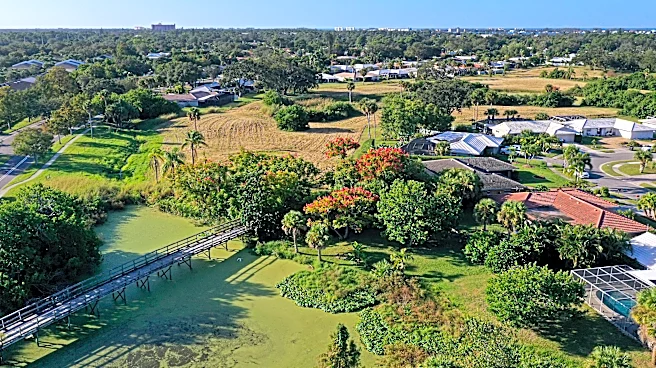
The county is seeking to acquire the 48.9-acre property for a stormwater project supporters say could improve water quality and reduce flooding in parts of the Gulf Gate area.
That’s the gist of the direction the Sarasota County Commission gave staff Sept. 8 on a 4-0 vote with Commissioner Joe Neunder absent.
The main hangup in more than three years of negotiations to purchase the property from 13th Floor Homes, a Fort Lauderdale-based developer that owns the former golf course through Gulf Gate Holding LLC, has been price.
The developer is
already entitled to build 106 homes on the property and lists the potential development as “Lotus Bay” on its website.
The property owner’s most recent asking price was $14.6 million, based on a March 2026 appraisal.
Sarasota County conducted an in-house appraisal in February 2025 that valued the property at $5.3 million, while an outside appraisal by Hettema Saba Appraisal valued it at $6.527 million in June 2025 and a second outside appraisal by Live Oak Analytics Appraisal valued it at $9.5 million.
The developer bought the property for $3 million in 2022.
Sarasota County Planning and Development Services Director Matt Osterhoudt told the commission that at a recent Value Adjustment Board hearing the developer asked that the market value of the parcel be reduced from $4.6 million to $2.3 million for tax purposes.
That discrepancy further complicates negotiations.
“We need to get serious about what the purchase price will be,” Commission Chairman Ron Cutsinger said, then added that the asking price is “significantly above what they themselves want to see it valued at.”
“That’s a dramatic difference from $2-to-$14 million.”
Why is the golf course significant for stormwater management?
The golf course is the largest available parcel west of Beneva Road and is less than one mile from Sarasota Bay and under two miles from the Gulf of Mexico.
Environmentalists, water quality proponents and area residents — includingmembers of the Gulf Gate Community Association — can envision the course, laid out on three sections already interspersed between existing homes, as the site of a county project that could both provide additional stormwater cleansing and help alleviate potential flooding.
Like many former golf courses, there are high levels of arsenic on the property and the developer is also working with the Florida Department of Environmental Protection for a remediation plan and pursuing a brownfield designation that could make the developer eligible for tax credits that would offset the cost of remediation.
As a stormwater treatment facility, it would help clear runoff that now flows into the Matheny Creek and Elligraw Bayou watersheds.
Matheny Creek, according to the Sarasota County Water Atlas, is a 2.7 square mile area of Sarasota County west of McIntosh Road and south of Clark Road that includes a small portion of Palmer Ranch and Gulf Gate.
Elligraw Bayou, according to the water atlas, is a slow-moving 2.1 mile stream that starts near the intersection of Brueckner Drive and Mariana Drive and meanders toward Pelican Cove.
It is located southwest of the former golf course property.
What would it cost to transform the golf course into a stormwater treatment facility?
Osterhoudt told the board that, based on estimates provided by Phillips Environmental, it could cost between $4.9 million and $7.3 million in capital costs plus $800,000 in remediation-related operations, for an estimated remediation cost of about $8.1 million
In addition to that, it would take between $6.9 million and $10.5 million to retrofit the property as a stormwater treatment facility, plus another $50,000 in annual operations and maintenance.
That would be on top of the negotiated purchase price.
Sarasota County Stormwater Director Ben Quartermaine said that the land in the Matheny Creek and Elligraw Bayou watersheds was developed long before current stormwater regulations — as well as the now current practices of using ponds and swales — existed.
Gulf Gate was built on the former Bispham family dairy farm after the family sold to First Development Corp. in 1957.
The former golf course clubhousehad once been the dairy milking barn.
Quartermaine noted that in addition to reducing the nitrogen load of stormwater that flows into Little Sarasota Bay, a stormwater project could help alleviate flooding in seven Gulf Gate streets.
During public comment, several speakers urged commissioners to buy the property.
Katherine Butler, speaking for the 1,500-home Gulf Gate Community Association, said that the open property affects drainage for as many as 7,500 local residents.
She also voiced concern that a remediation plan for Lotus Bay would allow those homes to be built on an additional two feet of topsoil that would elevate those new homes and “guarantee a flooding nightmare for existing taxpayers.”
Gulf Gate resident Terry Moore later voiced concern that the runoff would contain elevated levels of arsenic that would then flow unimpeded into Little Sarasota Bay.
How would the project be funded?
Since 2023 residents had pointed to federal Resilient SRQ grant funds as one possible source of funding but county officials opted against that.
County commissioners did earmark $15.6 million of Resilient SRQ funds awarded to Sarasota County after the 2024 hurricane season for aflood mitigation effort at Forest Lakes golf course that would have turned it into a regional floodplain, similar to theCelery Fields.
But when a local group stepped up to buy Forest Lakes and keep it in operation, Sarasota County backed off on the purchase.
In August, the county commissiondedicated that $15.6 million to the widening of River Road.
Now, county officials are contemplating creating a special district to glean the funds from property owners in the Matheny Creek and Elligraw Bayou watershed with a special assessment.
Funds would be collected in one of two ways.
One would be through a municipal services taxing unit, which collects funds based on taxable value.
The other option is through a municipal service benefit unit, which assesses property owners based on the value of the service provided. The easiest example of this is the fee property owners pay for solid waste pickup.
County staff noted that the extra cost could be between $340 and $500 a year for 20 years depending on the methodology and the purchase price.
For that estimate, staff used an $8 million cost to purchase the golf course.
County Commissioner Teresa Mast, who made the motion to direct county staff to poll residents on the proposed assessment stressed that, “There has to be some hard negotiations with the current property owner because the discrepancy in the appraisals is very significant.”
Once Sarasota County surveys affected residents, the board will then determine whether to go forward with an assessment.
Earle Kimel primarily covers local governments in Sarasota County as well as land development and environmental issues for the Herald-Tribune. Follow him on Facebook, and X. He can be reached by email at earle.kimel@heraldtribune.com. Support local journalism by subscribing.
This article originally appeared on Sarasota Herald-Tribune: Sarasota homeowners could face new fee under county plan