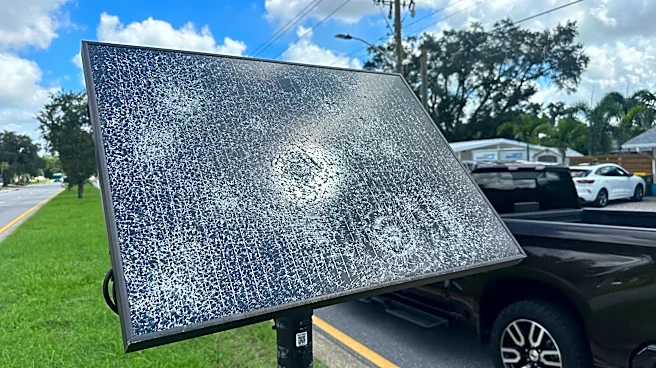








As Flock's network of more than 120,000 cameras continues to expand across the country, so has the backlash, with increasing reports of cameras being vandalized or destroyed.
License plate readers have been shot at in Tennessee, hit with a truck in California, beaten with a baseball bat in Virginia, cut down with a saw in Texas, and splattered with paint in New York
. Viral social media posts "jokingly" demonstrate how to disable them.ALPR cameras are not new; Florida cities have used red-light and speeding cameras for years. However, the Flock Safety-operated cameras use artificial intelligence to capture specific details, such as license plates, make, model, color, and unique features.
What happens to those who join in on destroying the cameras?
Here's what penalties they could face.
What is the penalty for vandalizing or destroying a Flock camera in Florida?
While there is no set penalty for specifically targeting a Flock camera, it would likely be considered criminal mischief under Florida Statute § 806.13.
"A person commits the offense of criminal mischief if he or she willfully and maliciously injures or damages by any means any real or personal property belonging to another, including, but not limited to, the placement of graffiti thereon or other acts of vandalism thereto," the statute says.
Since Flock cameras cost roughly $2,500 per camera and destruction could be considered an interruption of public service, which is a third-degree felony and carries a maximum penalty of up to 30 years in prison and a $10,000 fine.
Flock shared last month that it created the Camera Protection Plan, an optional annual add-on that helps agencies prepare for unexpected damage to the cameras, whether it's from natural disasters or vandalism. According to a news release, the company will repair or replace covered Flock LPR or video cameras at no additional cost when damage occurs.
Why are people protesting Flock cameras?
Pushback against Flock cameras has risen from citizens across the political spectrum over privacy and warrantless surveillance. Groups such as the ACLU and the Center for Democracy & Technology warn that networked license plate readers such as these can become warrantless mass-surveillance tools without retention, access, and data-sharing rules.
The ACLU warns it could chill First Amendment-protected activities such as attending protests, visiting abortion clinics or religious centers and other legal activities, and provide governments with insight into a person's beliefs and politics.
Others also highlight law enforcement using these cameras to invade others' privacy. Dozens of law enforcement officers have been arrested or resigned under accusations of reportedly misusing the Flock system to surveil romantic interests, partners, exes, or even just attractive women who caught their eye, according to the nonprofit public interest law firm Institute for Justice (IJ).
In Florida, these protests and incidents have occurred:
- 77-year-old Carl Gunn has been protesting Flock cameras in St. Petersburg by holding up a 10-foot-high sign directly in front of one that reads, "Down with Flock cameras."
- A Jacksonville Beach teen was arrested July 21, accused of spray-painting lenses of LPRs in three municipalities.
- Jaden Brooks, 18, of Port Orange, recently took a more direct route as police said he confessed to bringing down three cameras with a reciprocating saw. Brooks' actions got him arrested.
How to find Flock cameras in your neighborhood
The company does not provide a map of its camera placements, but volunteer-powered maps such as DeFlock and Eyes on Flock track sightings of Flock cameras, as well as ALPR systems from Motorola Solutions, Axis Communications, and others.
See map of Flock cameras around Florida
Can you opt out of Flock cameras? Not really
There is no way to completely opt out of being recorded on Flock's cameras. However, the company's website does offer an option for HOAs and neighborhoods to allow residents to join the "SafeList." This means images captured of their vehicle will be marked as “resident" and can be filtered out of searches.
As for cities and municipalities, more than 82 Flock Safety contracts have been terminated across 28 states since 2021 — nearly half of those in the first six months of this year. In Tallahassee and Pensacola, local officials are withholding earmarked funds for the cameras.
Flock rolls out new safeguards to protect privacy
The company announced new security and privacy safeguards after backlash over abuse of power and privacy concerns. On Aug. 13, Flock Safety shared that it will implement the new features to weed out bad actors in police departments and stop the misuse of its systems altogether. They include:
- Every vehicle search will require a reason. Law enforcement personnel will have to input a specific case code tied to the investigation they are working on and input the type of offense. For example, along with the code, they might select kidnapping or motor vehicle theft. Langley hopes this will stop officers from making up false reasons or inputting something overly vague such as “investigation.”
- Audit assistance will be mandatory for all police departments using Flock by the end of 2026. The tool flags abnormal search behavior, such as an officer repeatedly searching the same license plate day after day, or clusters of searches late at night. Users are locked out in real time until an administrator reviews the search.
- Multi-factor authentication (MFA) is now mandatory for anyone logging into Flock. This change began earlier this month.
- Flock Safety now suggests retaining data for seven days instead of 30, except for cases that need more time under the new “Evidence Mode,” when a search is tied to an ongoing case number. This limit will be voluntary and will not affect contracts with law enforcement agencies already in force. However, agencies adopting the 7-day limit will receive Evidence Mode for free.
- Departments can choose what types of cases can be searched for by other departments. For example, Department A might allow Department B to search its cameras for kidnapping, homicide, or theft cases but exclude Department B from searching for immigration-related offenses.
Samantha Neely is a trending reporter for the USA TODAY NETWORK-Florida, covering pop culture, theme parks, breaking news and more. You can get all of Florida’s best content directly in your inbox each weekday by signing up for the free newsletter, Florida TODAY, at https://floridatoday.com/newsletters.
This article originally appeared on Sarasota Herald-Tribune: Some Flock cameras have been vandalized. What is the penalty in FL?