



Nearly two years after hurricanes reopened Midnight Pass, Sarasota County has encouraging news for those who want it to stay open: The waterway appears stable.
Consultant Michael Jenkins told the Sarasota County Commission on Sept. 22 that data analysis found the pass is “dynamically stable.” Commissioners then approved five recommendations aimed at keeping the connection between Little Sarasota Bay and the Gulf open.
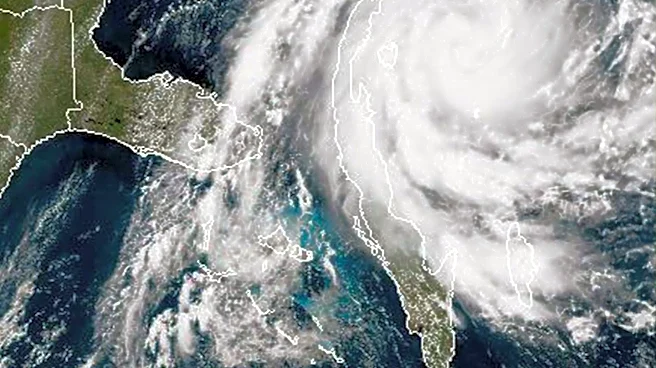
Researchers have been gathering data about Midnight Pass ever since Hurricanes Helene and Milton — which impacted Sarasota County Sept. 26 and Oct. 9, 2024 — opened a new pass and re-established a link between Little Sarasota Bay and the Gulf of Mexico for the first time in more than four decades.
Jenkins, a senior principal at Geosyntec,
an engineering firm specializing in complex problems, told the board that an emergency response plan to reopen the pass in the event of a sudden closure was already “in our back pocket,” which means the county would not need to go through a full permitting plan to reopen it.
The county could begin excavating material to reopen the pass with an emergency order.
What is the condition of Midnight Pass?
Since Midnight Pass reopened, scientists from a variety of universities and organizations have been monitoring everything from seagrass to water quality, Jenkins said, but research conducted on behalf of the county focused on the physical dimensions of the inlet.
Jenkins said there have been almost 90 surveys of Midnight Pass designed to establish the location of the pass.
The throat, or opening of the inlet, oscillates between two cross sections — depending on tide and water flow — with about 60-feet of difference between those two cross sections.
“We are seeing an overall increase in area,” Jenkins said. “It is now adjusting to an equilibrium area of about 1,400 square feet.”
The depth, he added, is stabilizing at about 16 feet, with a maximum water flow of about 100 cubic meters per second.
“That is enough flow at peak flow to fill an Olympic-sized swimming pool in less than 25 seconds,” Jenkins said.
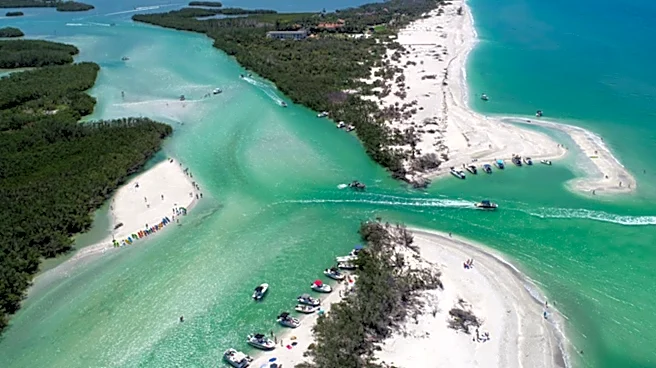
Water flows from Little Sarasota Bay to the Gulf from a northern channel that flows between Siesta Key and the spoil islands of the Jim Neville Marine Preserve and an eastern channel that separates the spoil islands and Palmer Point Park on Casey Key.
About two-thirds of that water flow occurs through the eastern channel and one-third through the northern one, Jenkins said, then added that at times water will flow in one channel and out the other.
Sand at Midnight Pass is coarse crushed shell and not the fine quartz sand at Siesta Beach, Jenkins noted, but that’s a good thing.
“It encourages inlet stability,” he said. “You can hold a steeper slope,” in the channel.
What could cause the pass to close?
The two most likely ways the pass would close are by a violent storm similar to the ones that opened in 2024, or from sand drifting south from an improperly designed south Siesta Key beach renourishment project.
“The two need to work together,” Jenkins said of future beach nourishment plans on and around Turtle Beach. “We don’t want to have a condition where we place sand on the beach and we have an inlet closure.”
County Commission Vice Chairman Mark Smith wanted to know how long it would take for “rapid response” to begin, in the event of an emergency.
Jenkins said the process still operates in consultation with the Florida Department of Environmental Protection, which could place the timeframe at “weeks” or “months.”
Under such an order, as much as 25,000 cubic yards of material would be removed from the pass and placed on the south side of the inlet.
“That is well within accepted practice of what can be moved with mechanical equipment,” Jenkins said.
Because of the time it would take to move a dredge to the area, land-based equipment would likely be used.
“We would be able to restore what’s there today,” Jenkins said. “There wouldn’t be any expansion.”
What’s next?
County staff are currently handling ongoing monitoring efforts, which frees the consultant up to pursue the creation of a long-term permitting plan for Sarasota County to maintain Midnight Pass.
The board still needs to make some decisions. For example, there is a de facto channel, but there are no markings or signs to help boaters find it.
Both continued data collection and modeling are among five recommendations Jenkins recommended for next steps, along with continued assessment of channel dredging, initiating the state and federal permit process to maintain the current inlet dimensions and continued engagement with area stakeholders.
Jenkins stressed that any future maintenance dredging would be strategic dredging, “so we have consistent depth so people aren’t running aground.”
Commissioner Joe Neunder moved that the commission adopt those five recommendations, with Commissioner Teresa Mast seconding it.
An interactive page to view updates on the conditions at Midnight Pass can be found at scgov.net/government/planning-and-development-services/midnight-pass#ad-image-0
Earle Kimel primarily covers local governments in Sarasota County as well as land development and environmental issues for the Herald-Tribune. Follow him on Facebook and X. He can be reached by email at earle.kimel@heraldtribune.com. Support local journalism by subscribing.
This article originally appeared on Sarasota Herald-Tribune: Sarasota's Midnight Pass deemed 'dynamically stable'