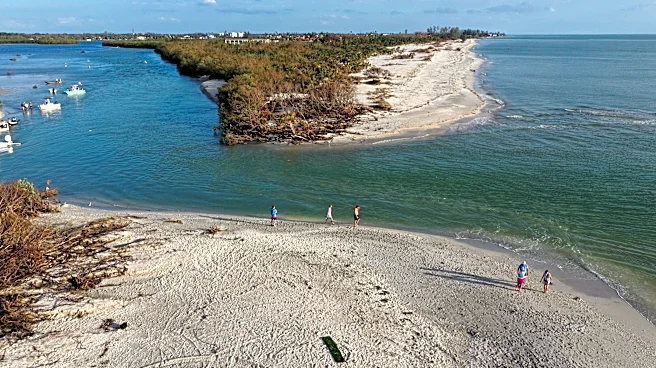

In the two years since Midnight Pass was reopened by hurricanes Helene and Milton, the 125 to 150-foot-wide water passage between Siesta Key and Casey Key went from being a wistful memory to a joyful reality
that has helped clean the waters of Little Sarasota Bay and become a must-see attraction shared on social media.
“The water is amazing,” said Mike Holderness, a board member ofMidnight Pass Society II, which was formed in 2021 with the goal of reopening the pass.
Holderness said there are now schools of mullet in the water, and he's seeing the biggest snook he has seen in years.
“The manatees are coming in and out of the pass now,” Holderness said. “It’s pretty badass to be honest with you.”
In addition to attracting wildlife, the reopened pass has attracted locals and tourists eager to marvel at the wildlife, enjoy the clear waters, or pull ashore and visit with friends.
“It’s become a big attraction, and we have a lot of folks renting boats,” said Ryan Gandy, executive director of the Sarasota Bay Estuary Program. “The rental fleets down in Little Sarasota Bay have really expanded."
Gandy said it's not unusual to see "50 or more boats" in the area during a holiday weekend.
"It's packed," he said.
The estuary program was concerned enough about the rising boat traffic tohost a workshop earlier this summerthat included 14 organizations.
The workshop addressed how the environment around the inlet has changed since the tidal connection was restored, as well as how increased recreation and vessel traffic may be impacting seagrass and wildlife species.
One major takeaway from that workshop was that more information was needed on that varied impact, just as more education is needed to remind boaters that Midnight Pass is unlike New Pass, Big Pass and the Venice Inlet – three other areas where Sarasota Bay links to the Gulf.
“It’s not what we call a navigable pass," Gandy said. "It’s a wild pass."
Multiple agencies are studying Midnight Pass
Much of that information is being generated by research that began shortly after Midnight Pass reopened Oct. 9, 2024.
In a Sept. 22 presentation to the Sarasota County Commission, Mike Jenkins, senior principal engineer with Geosyntec, the coastal engineering firm gathering data on behalf of the county, said almost 90 surveys of the cross-section of the inlet have been conducted since Oct. 29, 2024.
“The data analysis suggests that it is dynamically stable," said Jenkins, who added that officials "have an emergency response plan in our back pocket.”
In addition to that, more than a dozen organizations – ranging from the University of Florida and University of South Florida to the Florida Department of Environmental Protection and the United States Geological Survey – have been conducting coordinated studies of the pass.
Sarasota County maintains a website with much of that data at https://www.scgov.net/government/planning-and-development-services/midnight-pass#ad-image-0.
Now that Midnight Pass is open, Sarasota County’s goal is to maintain the connection to the Gulf.
In 2024, the state Legislature set aside $500,000 to develop a plan to do just that.
Sarasota County can also spend funds collected by the West Coast Inland Navigation Districton projects to keep the pass open. These funds became available after a January 2025 vote that saw the West Coast Inland Navigation District declare the pass – which includes the connection to the Gulf and associated north and east channels in Little Sarasota Bay – as “public channels.”
Should the measured “throat” of the pass get too small or if the center line of the inlet moves 100 feet north or south of its current position – or if the pass is closed by a subsequent hurricane – Sarasota County could take action to reopen it under an emergency order in consultation with the Department of Environmental Protection.
Sarasota County is in the process of developing an inlet management plan for Midnight Pass that would define conditions that would trigger the need for other corrective measures – most likely dredging – to maintain the pass.
Holderness and members of Midnight Pass Society II look at data that shows more water pressure from the eastern channel, and they are concerned history will repeat itself, with the pass migrating north or closing.
During a May 2025 Sarasota Tiger Bayforum on Midnight Pass,Holderness said Sarasota County should be actively pursuing permits necessary for dredging that may be needed to keep Midnight Pass open.
He is also critical of the county for not conducting a mean high water survey of the pass.
“Our goal is to keep it in its natural state,” Holderness said.
“Let’s create more flow out of the northern channel that was filled in by man so it can breathe like a set of lungs.”
Holderness said that when the channel breathes equally, "you’ll create shoals on both sides and a delta out front" that will keep the pass stabilized.
Why did Midnight Pass close?
Midnight Pass closed in part because of a change in water flow in Sarasota Bay and Little Sarasota Bay that was a result of the U.S. Army Corps of Engineers dredging of the Intracoastal Waterway in the early 1960s.
It was also impacted by Hurricane Donna in 1960 and Hurricane Agnes in 1972.
As part of the waterway dredging, the Corps deposited dredged material on “spoil islands,” including Snake Island near the Venice Inlet and the Jim Neville Marine Preserve, located to the north and east of Palmer Point Park.
It was finally closed in 1983 by Syd Solomon and Pasco Carter Jr., who received permission to close itin an attempt to save their south Siesta Key homes.
Solomon’s home was demolished by Sarasota County following Hurricane Ivan in 2004.
Mike Evanoff, a board member of Midnight Pass Society II, now owns the former Carter home.
The pass was created in October 1921 — before tropical systems were named — when a hurricane opened what was then dubbed Musketeers Pass between Siesta Key and Casey Key.
It was renamed Midnight Pass in 1924.
By 1955 Midnight Pass was more than 500 feet wide with a maximum depth of 13 feet.
How did Midnight Pass reopen?
Hurricanes Helene and Milton – which impacted Sarasota County Sept. 26 and Oct. 9, 2024, respectively — abruptly opened a new pass and re-established a link between Little Sarasota Bay and the Gulf of Mexico for the first time in more than four decades.
Gandy said the eye of Hurricane Milton basically hit the area where Midnight Pass reopened.
What is the status of Midnight Pass now?
Gandy said that current surveys over the past two years have shown a seasonal trend at Midnight Pass.
“It shallows up in the winter and gets deeper and wider in the summer,” Gandy said.
That change is literally tied to the summer rainy season.
“What keeps a pass open is the volume of water flowing through it and in the winter our tides are smaller so less water’s flowing through so it will drop to maybe nine feet or so and it may get a little narrower but then in the summer, once we hit that spring we get a lot bigger tides,” Gandy said.
Meanwhile, the center of the pass has migrated both to the north and south, depending on the tides, Gandy said.
"But it's largely in the same area – so it’s stable, which is good,” he added.
The inlet varies between 125 and 150 feet in width, which can be a little bit of a shock for some who have been enticed by social media buzz.
Gandy said he has brought friends out to Midnight Pass who have said, “‘Oh, I thought it’d be bigger.’”
The pass can be anywhere from 12 to 14 feet deep during the rainy season – though after a large volume of water has flowed through, 17-foot depths have been recorded.
What makes it tough for people not familiar with the area to navigate Midnight Pass is the “shoaling” and the force of the water traveling through the inlet.
“Several people have gotten in trouble with kayaks in there and they get pinned up against one of the points when they’re trying to get in and out,” Gandy said.
“You need to be a pretty experienced boater to go out through the pass and navigate those outer shoals.”
Has the reopened pass changed Little Sarasota Bay water quality?
While the pass is stabilizing, the volume of water passing through Midnight Pass has led to a dramatic improvement in water quality.
“I think it’s a long-term story to continue to be told but so far the area, from the clarity of water to the quality of water, looks really good,” Gandy said.
The opening of the pass has “increased the water exchange in Little Sarasota Bay significantly,” Gandy added.
“It has impacted all the way down even to Blackburn (Bay) and the north end of Little Sarasota Bay."
Gandy said that when the pass was closed, in a 10-day period it was only exchanging about 25% of its water.
But now that the pass is open, Gandy said, about 70% of its water is exchanged in a 10-day period.
The more frequent water exchange is making the bay both saltier and clearer, which should help seagrasses thrive.
Drought conditions that followed the 2024 hurricane system also allowed the bay to recover.
From Gandy’s perspective, the continued building of a long-term data set will illustrate and help predict what Little Sarasota Bay’s water quality will look like.
That data also includes charting how the water quality impacts everything from seagrasses to oyster beds that typically survive closer to freshwater sources.
“There’s a whole group of biologists and ecologists that are focusing on how that bay is changing,” Gandy said.
Earle Kimel primarily covers local governments in Sarasota County as well as land development and environmental issues for the Herald-Tribune. Follow him on Facebook, and X. He can be reached by email at earle.kimel@heraldtribune.com.
Support local journalism by subscribing.
This article originally appeared on Sarasota Herald-Tribune: The remarkable comeback of Sarasota's Midnight Pass