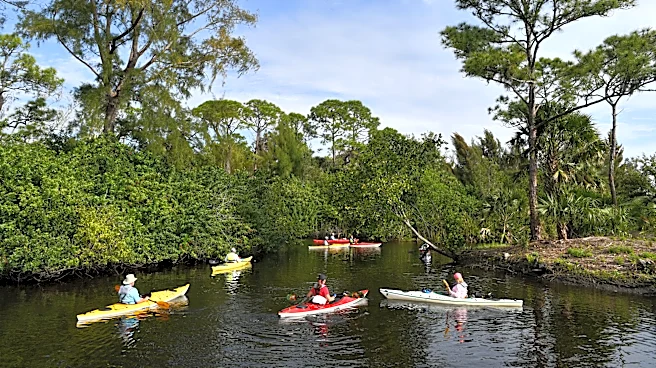




As a mischievous teen, Jon Thaxton and a friend, Dave Campbell would visit Red Bug Slough and frequently get in trouble.
Decades later, when Thaxton was a member of the Sarasota County Commission, developers eyed the land near Beneva Road as the site for 230 condominiums.
Instead, after being alerted by Joe Cleary, a real estate broker, Thaxton pushed for the purchase of the 72-acre park with funds generated by the then-new Environmentally Sensitive Lands Protection Program.
“Every time I drive by Red Bug Slough and see all the cars there and all the children there … there's no better feeling in the world than knowing that if not for you, that would have been another condominium development,” Thaxton added.
Sarasota County voters first approved
creation of the Environmentally Sensitive Lands Program in 1999 by voting to create a dedicated property tax and authorizing the sale of bonds to finance land purchases.
In 2005, voters then broadened the scope of the process to include creation of the Neighborhood Parkland Acquisition Program for another two decades.
Voters will decide on Nov. 3 whether to extend the programs for another 20 years.
The programs are funded through a dedicated 0.25-mill property tax designed to raise $250 million over the next 20 years.
From ‘Skeeter Drain’ to Red Bug Slough
Red Bug Slough, which Thaxton had wanted to dub “Skeeter Drain” after the nickname he and Campbell gave the property, was actually the second purchase made with the funds.
Manasota Scrub Preserve, a 145-acre tract of land that can be publicly accessed at 2695 Bridge Street, Englewood, was the first.
Since then more than 42,000 acres of sensitive land spread across more than 100 properties have been protected.
The Neighborhood Parkland program has also purchased 31 park sites, totaling another 143 acres.
To finance that, citizens in Sarasota County have overwhelmingly voted twice – in 1999 and 2005 – to tax themselves to save land under the Environmentally Sensitive Lands Protection and Parkland programs.
More than 21,000 of the acres are preserved by Sarasota County through conservation easements, which allow continued use but preclude future development.
A committee advises the county commission on everything from sites to purchase and land management.
There are now 33 areas of geographical interest where land may be purchased or protected.
Sarasota County Forever
In the weeks and months leading up to Nov. 3 – especially prior to Oct. 19, when early voting begins – Sarasota County voters will receive information from a special political action committee called “Sarasota County Forever” that will offer information about the land preservation program and the vote both in an active education campaign and on its website: sarasotacountyforever.org.
The slogan is “Vote ‘yes’ and ‘yes,’” noted Christine Johnson, president of Big Waters Land Trust, a key member of the PAC.
There will be two questions on the Nov. 3: whether to extend Sarasota County's Environmentally Sensitive Lands Protection and Parkland programs for another 20 years at the current 0.25-mil ad valorem rate; and whether to reauthorize bonding over the lifetime of the program, not to exceed $250 million.
Without a yes vote, both programs will sunset in 2029.
Former state Sen. Lisa Carlton and Rob Patten, a former environmental services department director with Sarasota County, are serving as co-chairs of the PAC that also includes other private citizens, Gulf Coast Community Foundation and The Trust for Public Land.
When asked how the protection program has shaped Sarasota County, Johnson said: “It’s magnitude is unfathomable, truly.”
She noted that, including Myakka State Park, Myakka State Forest and Orange Hammock Ranch, close to 35% of Sarasota County is protected from development.
“That has not only helped us make citizens have a better quality of life, it’s also increased our revenue from tourism, it’s also protected us from flooding,” Johnson said.
“Think about if these 42,000 acres – it’s not all that’s been conserved in Sarasota County but it’s what has been conserved in this program – had been paved over, what that would do to the quality of life, to stormwater runoff for flooding, you think about what that would do for our habitat for enjoying life.”
“If you’re concerned about development, this is the answer to that,” Johnson added.
ESLPP ended an ad hoc process
The Environmentally Sensitive Land Protection Program created both a reliable and transparent way for Sarasota County to preserve public lands.
Prior to that, Sarasota County voters would have to vote on specific land purchases by referendum.
The two most high profile examples of that are the purchases of Ted Sperling Park on south Lido Key and Caspersen Beach south of Venice.
Both were bought after voters approved a $7.75 million bond in a 1977 referendum.
Prior to that, there were plans to use South Lido for a golf course, marina and condominiums.
Finn Caspersen had “donated” what is now Caspersen Beach park to Sarasota County in the late 1960s, with a stipulation that it return back to the family in 20 years.
The two purchases were packaged in that referendum to widen the appeal for voters.
Retired New College of Florida professor Jono Miller noted that when he arrived in Sarasota County in 1970, ad hoc referendums were the primary way public lands were acquired.
It wasn’t a competitive process, he said. If someone became aware of a parcel, it may be considered.
“There was no citizen input at the front end,” Miller said of Sarasota County’s practice prior to the referendum, which passed in a March 1999 special election.
“When we passed the first referendum we didn't know if we would buy a single property,” because the seller has to be willing, Miller said.
A Nov. 2005 referendum that extended the program to 2029, raised the bonding limit to $250 million and created the Neighborhood Parkland Acquisition Program passed with 80% voter approval.
A push for ecotourism
In 2025, Sarasota County celebrated its 100th ESLPP purchase, Camp Venice RV Resort, a 20.8-acre site at 4085 E. Venice Avenue, adjacent to Snook Haven – the popular riverfront destination that is currently undergoing renovation.
Camp Venice, which includes about six acres of mesic hammock and riverine habitat along the Myakka River, which was designated as the only "Florida Wild and Scenic River" by the state Legislature in 1985.
U.S. Rep Greg Steube and U.S. Rep. Vern Buchanan are currently co-sponsors of the federal Myakka Wild and Scenic River Act that would give federal recognition of the scenic nature of 34 miles of the river.
Sarasota County owns several parcels along the Myakka River, including Snook Haven, the Sleeping Turtles Preserve to the north,the Jelks Preserve to the south, the Deer Prairie Creek Preserve–which is opposite the Jelks Preserve – on the east side of the river.
It also owns Sen. Bob Johnson’s Landing, which it purchased for about $2 million in 2009, with money from the Neighborhood Parkland Acquisition Program.
Sarasota County has an overall strategic plan to increase access to waterfront land and promote ecotourism as well as nature-based experiences for school children.
Conservation easements preserve working ranchlands
A vital part of the preservation program involved conservation easements – typically on working ranches – that stave off development while allowing the property owners to continue business as usual.
“The ranches are so important to have under conservation so they don’t turn into housing tracts,” said Clyde Butcher, an iconic landscape and environmental photographer who has worked with Big Waters Land Trust since its inception in 2003 as the Sarasota Conservation Foundation.
He photographed several ranches, including the 4,616-acre Longino Ranch and the 3,760-acre Walton Ranch.
The conservation easement model, Johnson said, reduces the cost of conservation.
“You’re only purchasing the development rights and the landowner is responsible for maintaining it,” she added.
The Walton Ranch, which Sarasota County purchased in 2010, is part of what Johnson refers to as a 130,000-acre bubble of conservation land that protects the Myakka River.
Next phase could be a last hurrah
Should Sarasota County voters approve an extension of the Environmentally Sensitive Land Protection Program another 20 years, Thaxton thinks it could be the last one that will finance significant land purchases.
“After this will be retrofitting and infill because after this, in another 10 to 15 years, Sarasota County will be pretty much developed all the way out to the county line,” Thaxton said.
“So whatever we don’t preserve will be lost."
Earle Kimel primarily covers local governments in Sarasota County as well as land development and environmental issues for the Herald-Tribune. Follow him on Facebook, and X. He can be reached by email at earle.kimel@heraldtribune.com. Support local journalism by subscribing.
This article originally appeared on Sarasota Herald-Tribune: Voters to decide on advancing push to protect land in Sarasota County