





I am sitting in a plush green train seat. Outside, the landscape is a familiar tapestry of yellowing grasses, eucalyptus, oaks, and waves from a west-facing seacoast. If I could ignore the French and Arabic conversations on the double-deck railcar, I might think I’m on a California high-speed train cutting through the Central Coast.
But this isn’t California. And I can’t travel through time to the distant decade when my home state gets high-speed rail.
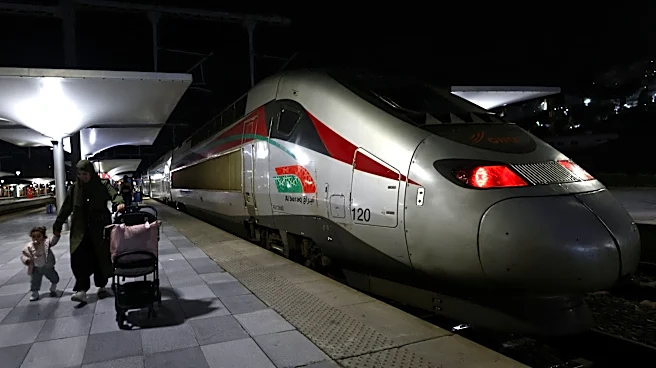
I am riding (in late June) the first high-speed railway in Africa. It’s called Al Boraq (“The Lightning” in Arabic).
My trek runs the line’s full length. I board on the Atlantic coast at Casablanca’s 10-track station. I disembark at Tangier’s station, 400 meters from the Mediterranean. The schedule
says the train will arrive in 2 hours, 17 minutes. Before Al Boraq opened in 2018, the same route took 5 hours.
Yes, you read that right. Morocco has high-speed rail.
California has excuses.
The comparison between these two places might seem random, but it’s revelatory. Morocco and California are similar in size (Morocco is 172,000 square miles, California 163,000) and population (California is 40 million, Morocco 37.4 million). Both rest on a continent’s edge, with coastal cities, interior deserts, and heavily irrigated agriculture.
One big difference: California is more than 20 times richer. Morocco’s GDP is $150 billion, while California’s economy creeps toward $4 trillion.
Yet California claims it doesn’t have enough money for high-speed rail, even as Morocco built its 201-mile line, requiring 286 engineering structures and 13 viaducts — including the landmark 3.5-kilometer Hachef viaduct south of Tangier.
How did Morocco pull this off? International partnership, structural simplicity, and raw political will.
Morocco’s Al Boraq line cost only $15 million per mile, one of the lowest high-speed rail construction prices in the world. The first, 171-mile Bakersfield-to-Merced segment of California’s line is projected at $35 billion — more than $200 million per mile.

Morocco’s national railway partnered with its French counterpart, SNCF, and the engineering giant Alstom, so high-speed rail experts worked with Moroccan teams for every major task.
California, meanwhile, has hired a rotating cast of executives and outside consultants who have bloated the project’s budget to more than $125 billion, while delaying its expected 2020 opening until 2033.
You can quibble with just how “high-speed” Al Boraq is. The train runs on conventional, shared tracks from Casablanca to its first stop, Rabat. Slowing the train in that segment was a pragmatic compromise that allowed the line to open quickly — at a station with links to the Casablanca airport — and start generating revenue and public adoration.
Which it has. Trains are so packed with younger riders that the loans for the project may be paid back early.
In Kenitra, 45 minutes north of Rabat, tracks become dedicated, high-speed only. From there the train races at 192 miles per hour to Tangier.
This coastal line is merely Phase 1 of a 1,500-kilometer high-speed network, slated for completion by 2030, when Morocco is co-hosting the 2030 FIFA World Cup.
The next steps, already underway, include dedicated high-speed service between Rabat and Kenitra, and a brand-new high-speed line south from Casablanca to Marrakech and onward to Agadir. From Tangier to Agadir is the distance of San Francisco to San Diego.
Yes, Morocco is highly centralized. When King Mohammed VI — the wealthiest individual in the country — decides a train will be built, it gets built. Nor must Morocco contend with California's labyrinth of zoning, lawsuits, and YIMBY-NIMBY politics.
But attributing Morocco's triumph to autocracy misses the point. Morocco’s success is rooted in things California desperately lacks: a reliance on institutional expertise rather than contractors and consultants, and a refusal to let the perfect be the enemy of the fast.
As my train reaches the Tangier station right on schedule — exactly 2 hours, 17 minutes — I feel respect and frustration in equal measure. The North African kingdom has lessons to teach our state. Are Californians willing to listen?
Joe Mathews writes the Connecting California column for Zócalo Public Square.
This article originally appeared on Ventura County Star: How California lost to Morocco in high-speed rail | Mathews