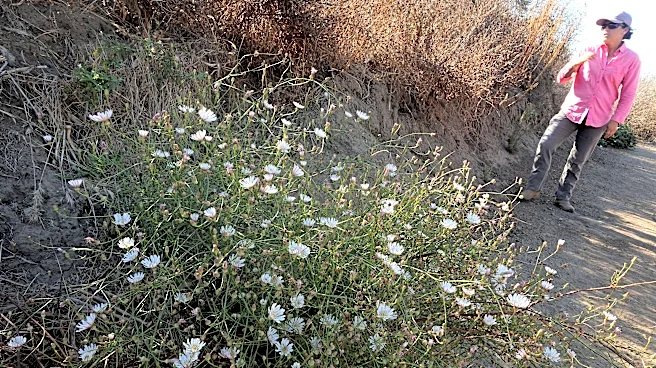




Laura Pavliscak stopped along a dirt trail in a popular Ventura preserve pointing out a thick stand of California brittlebush.
Darker spots near the sort of purple-brown colored brush were coastal cholla, she said, and a taller shrub nearby was elderberry – all California native plants, she said. The slope was one of the spots at Harmon Canyon dominated by coastal sage scrub, one of the most threatened ecosystems in California. There, it survived.
But over dozens of the 2,100 acres in the preserve off Foothill Road, native plants can face steep odds. Over the next four years, plans call for a large-scale restoration project, work that will try to give those native plants an edge in spots where invasive plants dominated, said Pavliscak, conservation
director for the Ventura Land Trust.

"We're trying to just help buoy the ecosystem to recover over time on its own," she said.
The trust opened the preserve six years ago, but decades of ranching and farming, nearby development and other uses had taken a toll. A utility corridor crisscrossed the landscape, and invasive plants like black mustard had spread.
Earlier this year, California's Wildlife Conservation Board signed off on providing the land trust more than $1.2 million to restore native habitat, efforts that could reduce wildfire risk while protecting the native ecosystem. In all, a dozen spots covering 45 acres were identified for the project. The largest spans 8 acres, several measure less than an acre and all sit alongside trails.
"Trails are great habitat for invasive plants because they are continually disturbed," Pavliscak said.
The well used paths represent one of the biggest risks for spreading the nonnative plants to other areas, when trail-goers and wildlife unknowingly carry seeds into other spots.
Plans call for crews to start removing invasive plants from the tall, willowy black mustard to nonnative grasses within the next year. Then, they'll spread seeds and plant some native vegetation in those spots.
What will change at Harmon Canyon?
The land trust owns and manages nearly 4,000 acres of protected open space in Ventura County. Along with the newly opened Ventura Hills preserve, the land trust manages other spots along the Ventura River and recently announced the acquisition of the old Petrochem site, just west of Highway 33 and south of Foster Park.
Harmon Canyon remains its largest preserve and most visited. Steps from the preserve entrance, Pavliscak pointed out thick stands of black mustard and crown daisy, both invasive plants. Some native plants broke through, too, but the nonnatives took up much of the space in the spot.
The state funding will pay for site preparation, restoration, monitoring and maintenance, officials said. Removing the plants is expected to happen in a variety of ways, from using mechanical equipment to herbicide. Some like black mustard will never be completely eradicated, officials said. But plans call for reducing its numbers, particularly in the project sites along the trail system.
Adding seeds and plants is expected to help the native plants get a sort of foot in the door, give them a chance to take up room and compete for space. The land trust will use seeds and plants already in Harmon Canyon.
Staff has collected over two dozen species so far, from purple sage to coyote bush, officials said. Some will be grown in a nursery before they are planted in the project areas.
What will trail-goers notice?
In the spring, the slope where Pavliscak pointed out the native brittlebush would be awash in green and golden blooms. But Pavliscak said she liked the summer view, one with less flashy colors but that showed something else.
"You see texture," she said, describing the spot as a sort of terrestrial coral reef.
The restoration efforts are expected to bring changes, ones trail-goers will notice in the longterm but also fairly soon. Crews will be on site working, and some vegetation people may have come to recognize will start to disappear.
The coastal sage scrub expected to make a comeback in the spots will be more diverse, and in Pavliscak's opinion, much more beautiful than the nonnatives that have taken over, she said. The native plants have evolved over millennia to have different structures and colors, she said, stopping to check out the tiny, complex petals of a native milkweed.
"The stories that those plants hold and tell are really powerful," she said.
Cheri Carlson covers the environment and county government for the Ventura County Star. Reach her at cheri.carlson@vcstar.com.
This article originally appeared on Ventura County Star: Changes on the way for popular Ventura preserve. Here's what to expect