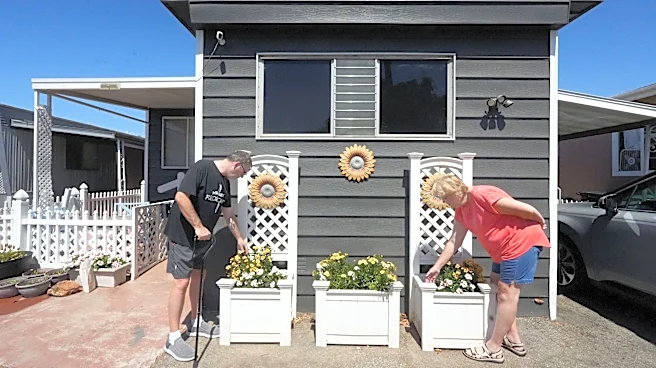

Tiffany Orr twice faced a rent increase of 45% or more in the last year since the new owners of her Santa Paula mobile home park asked the city to approve a rate hike.
Her efforts, along with those of a local
advocacy nonprofit, Central Coast Alliance United for a Sustainable Economy, and other residents to fight the hikes, helped spur Santa Paula city officials to adopt an urgency ordinance this year limiting how often mobile home park owners can raise rents.
“It was a relief," said Orr, who still pays $425 a month for her spot at the mobile home park owned and operated by Stockton-based River's Edge Manufactured Housing Community, LLC. The ordinance means residents won't have to worry about another rent increase for at least a year, she said.

Local ordinances can restrict rent increases in mobile home parks by placing caps on annual hikes. And some cities, including Santa Paula, Thousand Oaks and Camarillo, have stepped in to help residents like Orr.
However, those efforts are being challenged in court by park owners and corporations that argue they need to raise rents to keep pace with increasing operating costs.
Ventura County has 112 mobile home parks, according to the California Department of Housing and Community Development.
A 2021 think tank report from Real Capital Analytics showed institutional investors are increasingly snapping up mobile home parks nationwide. Many parks are owned by limited liability companies that include individuals, corporations and foreign entities.
Harmony Communities, a Stockton-based mobile home park manager, is suing Santa Paula, Thousand Oaks and numerous other California cities over rent-control measures.
Anne Anderson, state president of the Golden State Manufactured-Home Owners League, said the operator of Orr's mobile home park, River's Edge Manufactured Housing Community LLC, may be one of the most egregious in the state. It shares the same address with Harmony Communities, the Stockton-based mobile home park manager.
The homeowners league, based in Santa Barbara, advocates for the property rights of manufactured-home owners and residents statewide through legislation, education and organization, according to its website.
“Harmony is probably the top dog in this trend," Anderson said, referring to the company's efforts to raise rents and sue cities over mobile home park ordinances that prevent it from doing so. “This is happening all around the state.”
She said that homeowners are fighting back against “these big investor companies," including Harmony.
What is Harmony Communities?
Harmony Communities says it manages more than 100 properties across the western United States, according to its LinkedIn page. It says it employs more than 200 people, manages more than $700 million in assets and houses more than 5,000 residents in California and Oregon.
Harmony's description of its properties has changed on its main website over the years, going from 33 properties "owned and managed" in 2025 to "operating" more than 20 mobile home parks across Oregon and California.
Nick Ubaldi, a spokesperson for Harmony, said in an email that the private company operates a “family-owned,” “hands-on” business. It manages several mobile home parks, including the one Orr lives in.
Ubaldi said Harmony's lawsuits challenge Santa Paula and Thousand Oaks' mobile home park ordinances and rent adjustment rules. The cities cap annual increases and require owners to file formal applications when operating costs exceed those caps and rent increases are needed, Ubaldi said.
The cities of Santa Paula and Thousand Oaks declined to comment on the lawsuits, citing the pending cases in Ventura County Superior Court.
Santa Paula’s Mobile Home Rent Review Commission ultimately voted against rent increases of about 44% and 47% proposed by the owners in June 2025 and February 2026, respectively.
Corporate ownership of mobile home parks 'dangerous' trend
Michael Jenkins, a USC professor who teaches local government law, said it’s not unusual for companies to sue cities, as some of them regulate mobile home rent control.
"The most common areas of dispute occur when a park owner is seeking an increase in rents across the board in order to obtain a fair return and the city makes a decision that the park owner doesn’t like," Jenkins said. "Either the city denies the application for rent increases or a city gives them less of a rent increase than they’re asking for."
Jamshid Damooei, a professor of economics and executive director of California Lutheran University’s Center for Economics of Social Issues, said the increase in the Santa Paula cases is “quite substantial.”
There’s a housing affordability crisis that comes down severely on lower-income individuals and that includes mobile homes, he said.
Harmony has not made a strong case for a 45% rent increase that takes into account property tax, rent, insurance and management expenses, Damooei said. “I think what they’re asking is totally unreasonable,” he said.
Investment is not about “ripping people off,” Damooei said. A good business is about serving "the people who are actually receiving services from it," he said.
“With these kinds of reckless increases, we are complicating the issue of housing affordability beyond its limit for vulnerable households in our county or the state,” he said.
Damooei said corporate ownership of rental properties has expanded statewide, a trend that can lead to rent increases like those sought by Harmony. As owners gain a larger share of the market, they have greater ability to influence rents, he said.
"I think this is dangerous, not just bad, because housing is a right," he said.
What are the lawsuits in Santa Paula?
At the 400 Mobile Estates park in Santa Paula, where Orr lives, court documents show that a deed of trust was filed on Oct. 10, 2024, between the park owner Harmony Communities 1, LLC, River’s Edge Manufactured Housing, LLC and Heritage Bank of Commerce for the purchase of the property at $6.4 million. The application for a rent increase was filed with the city three months later on Jan. 24, 2025.
Between October 2025 and June this year, River's Edge and affiliated entities have filed three lawsuits in the Ventura County Superior Court against the city of Santa Paula challenging rent-control decisions, application procedures and the city's mobile home ordinance. The company argues the regulations prevent it from earning a fair return on its investment.
The first lawsuit filed in October 2025 argues that River's Edge was blocked from receiving a fair rate of return. It was filed after the city's Mobile Home Rent Review Commissionunanimously voted June 11, 2025, against a proposed 44.64% rent increase. Commissioners said park owners failed to provide sufficient historical rent data to justify the increase.
Days after the commission rejected the proposed rent increase, River's Edgefiled an application to try and raise the rent again on June 13, 2025. This time the company was seeking a 47% increase.
The commission unanimously denied the request Feb. 26, citing provisions in the city's municipal code and a lack of reliable and credible evidence.
On March 4, the Santa Paula City Council approved an urgency ordinance restricting how often mobile home parks can increase rents in a year. Residents pushed for the temporary ordinance after park owners sought two rent increases in 2025.
The second lawsuit, filed on May 12, alleges the city failed to present a proposed rent increase to its mobile home commission. The lawsuit states the city rejected a new March 27 application for an increase the company said was necessary to maintain net operating income and obtain a just and reasonable return.
According to the lawsuit, the city rejected the March application on April 15 because it was considered a “successive application,” despite involving a different operating year and financial records. The city did not determine whether the application was complete and did not set the application for hearing before the commission, according to the lawsuit.
River's Edge filed a third lawsuit, alleging civil rights violations, on May 28 in U.S. District Court in Los Angeles. The complaint seeks a jury trial and $53,048 in damages.
A mobile homes and mobile home parks section, including the city’s rent stabilization and hearings and procedures document, is listed in the lawsuit.
The city of Santa Paula has filed to dismiss the complaint.
In June, River's Edge filed a fourth lawsuit in Ventura County Superior Court saying the city’s mobile home ordinance has denied the company the “ability to avoid loss of the value of its income corrected by inflation.”
Orr, the Santa Paula resident, called Harmony “greedy.”
“They can't tell us they can't make the return on investment,” she said. She said the park owners should have understood the city's rules before buying the property.
Ubaldi said it “has made and continues to make substantial, documented investments in infrastructure, safety and compliance at these communities, including sewer, water, electrical, roadway, drainage and structural work.”
'Change cuts both ways' in Thousand Oaks
In Thousand Oaks, Harmony Communities, operating under the name Ranch Thousand Oaks MHP LLC, filed a lawsuit against the city March 19 over an application for a rent increase. A status conference concerning a pending stay of action and administrative proceedings is not scheduled until next summer.
The lawsuit alleges the city received the company's application but left it “in an open-ended state of review for completeness” without determining whether it met requirements or identifying any remaining deficiencies.
The Thousand Oaks park, according to the lawsuit, has an annual shortfall of $581.92 per space per month across the 73 affected spaces.
Marvin Sanders, who lives at Ranch MHP in Thousand Oaks, said he believes the owners made a mistake when they purchased the property.
Sanders said the park was developed as affordable senior housing. He said the park’s value was similar to that of an economical car for everyday use, but the owners see it as an expensive, higher-end vehicle.
“This park is a Honda, and Harmony should not expect a Mercedes,” he said.
Rent control was already in place when the parks were purchased, but that does not eliminate operating costs or a park owner's right to seek rent adjustments under local ordinances, Ubaldi said.
He said a rent control ordinance does not remove an owner's right to petition for a “fair return,” a process allowed under the ordinance.
“My family has owned and operated mobile home parks for more than four decades, before and after rent control took effect in various jurisdictions,” he said. “The argument that owners should have anticipated regulatory change cuts both ways.”
Leveling the playing field in Camarillo
The Camarillo City Council unanimously approved amobile home land rent stabilization ordinance in April to try and preserve the housing considered affordable.
The ordinance took effect June 12 at Camarillo Mobile Home Estates, Lamplighter Mobile Home Park and Casa Del Norte Mobile Home Park.
The ordinance allows rent increases of up to 8% when a space with an existing mobile home is rented to a new tenant. It also allows park owners to charge market-rate rent if a space is rented to a tenant bringing in a new mobile home.
“I would say that the City Council did a good job in finding a fair and just middle ground,” saidDevo Brown, a resident of Camarillo Mobile Home Estates who helped advocate for the ordinance. He added that the park owner, Investment Property Group, can still earn a profit while residents can maintain their home values.
“Everybody makes a little bit," he said.
Jarryd Gonzales of the Western Manufactured Housing Communities Association, who spoke against the Camarillo ordinance, said he opposes mobile home rent stabilization measures.
“Show us an ordinance that lowers rent, doesn't cost a fortune to operate and allows owners to keep up with rising costs,” he said.
Instead, Gonzales said he favors more flexible memoranda of understanding that allow cities, park owners and stakeholders to develop binding agreements that can include owner-funded rental assistance.
Anderson, the head of the nonprofit for mobile home owners, said the main problem is that mobile home residents are effectively captive consumers, people who don't have the financial flexibility to pack up and move elsewhere.
City mobile home ordinances help to level the playing field between the investor mobile home companies and their residents, she said.
What is the next step for Santa Paula?

Santa Paula officials hope to adopt a permanent ordinance before the end of the year, following approval of an urgency ordinance limiting how often mobile home parks can raise rents, said James Mason, the city's community and economic development director.
Orr said she hopes that the city adopts a permanent ordinance soon and that residents in a similar situation don’t give up.
"It's important others in the situation aren’t afraid to fight back,” she said. “That’s the only way that we’re going to stop these people.”
Wes Woods II covers West County for the Ventura County Star. Reach him at wesley.woodsii@vcstar.com, 805-437-0262 or @JournoWes.
This article originally appeared on Ventura County Star: Mobile home rent wars in Santa Paula, Thousand Oaks reach courts