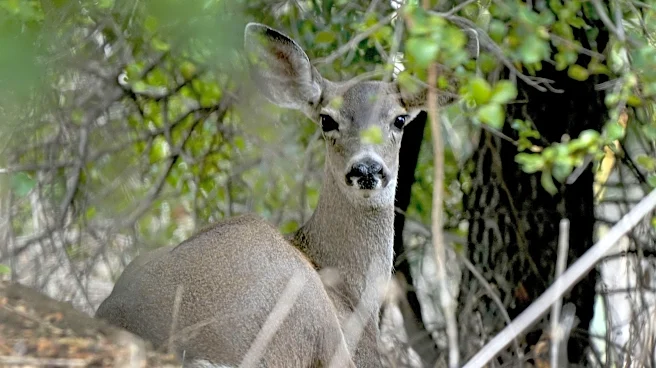

Jeff Brown hiked over a hill near Highway 101 in Agoura Hills on a hot September afternoon, listening for the telltale beeps that a mule deer known as D-63 was somewhere nearby.
He carried a radio receiver
to pick up a signal from the doe's collar, one researchers put in place in July. The deer was one of a half dozen tracked by the National Park Service in the Santa Monica Mountains near a new 101 wildlife crossing.
Expected to open later this year, the Wallis Annenberg Wildlife Crossing will span the wide, busy freeway, a longtime barrier for mountain lions, mule deer and other wildlife in Ventura and Los Angeles counties. Billed as one of the largest urban crossings, experts say the 210-foot-long bridge near Liberty Canyon will reconnect the Santa Monicas to other areas.

Since July, Brown, a wildlife ecologist with the Santa Monica Mountains National Recreation Area, and others captured five does and one buck in the hills south of the crossing. He called it a "once in a lifetime" opportunity to study how the crossing affects deer and other wildlife. Scientists expect to answer questions, from how and when the animals use the crossing to where they go once they reach the other side.
Two of the six deer were found near the construction just south of Agoura Road, adjacent to the freeway. The other four hang out in a patch of open space east of Liberty Canyon. Plans call for finding deer to track north of the 101 as well.
In September, the first monitor – a small device that records heart and respiration rates, temperature and estimates body condition – also was placed on a deer. When paired with the GPS collars or tags, it will allow researchers to not only know the location of the deer but also provide clues about how they react to different surroundings, Brown said.
Beth Pratt, founder and president of The Wildlife Crossing Fund, described the crossing as the result of decades of land-use planning, wildlife research, design and engineering. Monitoring deer and other wildlife in the area showed why the crossing was needed and will be key to learning how it functions, she said.
"Especially now that the crossing is about to open, we want to be able to see how they're using it, what their movement data shows," said Pratt, who has worked on the crossing project for more than a decade.
Researchers track deer in Ventura, Los Angeles
The National Park Service has studied mountain lions and bobcats in the area for decades to see how they're surviving in an increasingly urban area. They have found animals approach both sides of the 101 but few attempt to cross.
The small cougar population in the Santa Monicas Mountains is boxed in by development and highways, obstacles that have led to inbreeding, low genetic diversity and lions killing each other. Experts say the 101 crossing could help save the isolated population from extinction.
Tracking mule deer started later, with the first collars put on deer around eight years ago. The study expanded in 2020 to find out more about the largest herbivore in the Santa Monicas and monitor wildlife before construction began on the 101 crossing, officials said. The deer are the primary prey for the area's mountain lions and face challenges from frequent fires to vehicle collisions, according to the park.
In the years since, researchers used GPS collars designed to stay in place for 18 months, tracking pockets of deer from the Rancho Sierra Vista area in Newbury Park to King Gillette Ranch in Calabasas. While in some parts of the country, deer can migrate over 100 miles each year, those in the Santa Monicas didn't migrate at all. They also had "very small" home ranges, less than half a square mile, according to Brown.
The study initially focused on female deer, because of safety concerns. A male deer's neck swells during breeding season, creating concerns with traditional collars. The park service later started testing small, solar-charged GPS tags that can be attached to the deer's ear, allowing bucks to also be tracked.
As of late September, researchers were tracking 11 mule deer, from areas near the wildlife crossing in Agoura Hills to others in and around the Palisades burn scar in Topanga State Park. The fire burned a large swath of the canyons near the Pacific Palisades in January 2025.
Buck struck and killed on Highway 118
On the warm afternoon in late September, D-63 stuck around a shady spot, one thick with shrubs and oaks.
Brown said she regularly heads into the flat, vegetated area near construction, despite the work getting louder recently. At times, she also crosses Agoura to reach a patch of green space between the road and the freeway.
During the study, mountain lions and vehicle collisions were the leading causes of death for mule deer. While deer crossed other roads, at least the females did not attempt to cross the 101, appearing to see the freeway as a barrier or boundary. That may change as the study expands to include more male deer.
The bucks may be more likely to search out new areas, particularly during breeding season, Brown said. A buck tracked during the study crossed Highway 118 near Rocky Peak in the Simi Valley area during a previous breeding season. Whether he ran across or found a path over or under the route was unclear.

The buck successfully made it to the other side but was struck and killed when he headed back across the highway, Brown said.
At savelacougars.org, the public can vote on what animal will be first to cross the 101 wildlife bridge. Coyotes garnered the most votes recently. But Pratt said her money was on deer, which have been the first at other crossings and regularly spotted near the Agoura Hills site.
"I think they're getting pretty adventurous with these crossings," she said.
Cheri Carlson covers the environment and other news for the Ventura County Star. Reach her at cheri.carlson@vcstar.com.
This article originally appeared on Ventura County Star: Deer to be tracked via GPS, monitors as 101 wildlife crossing opens