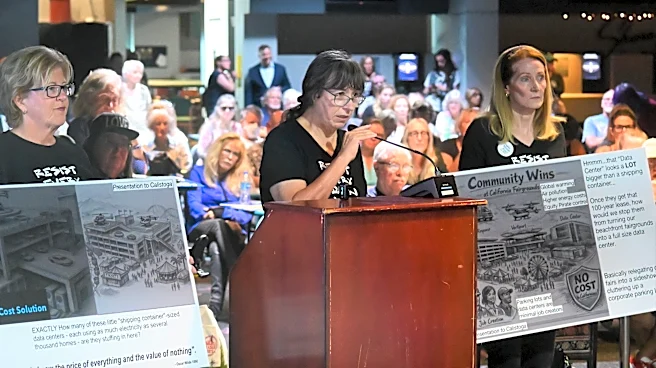






A packed room of frustrated community members urged Ventura County Fairgrounds leaders to reject a proposal they fear will bring an artificial intelligence data-processing center to the beachside Ventura site.
More than 100 people filled a conference room at the fairgrounds Aug. 25 to express their concerns about a proposal to build a self-contained computing unit the size of a shipping container, a parking garage and a landing pad for helicopters at the fairgrounds.
Leaders of the Orange County company Global Stack USA are pitching the proposal to some 70 fairgrounds across California as a way of creating a statewide emergency response network.

People streamed to the podium for public comment during the fairgrounds board meeting. They characterized
the proposal as a land grab, worried about enviornmental impacts and expressed distrust about the company’s assurances the project is not a large-scale processing system and would not use or impact local water systems. They expressed shock the plan was even being deliberated.
“The short-sightedness of this consideration is appalling,” said Lucie Leake of Ventura.
Memorandum of understanding
A day before the meeting, Ventura County Fairgrounds CEO Heidi Ortiz confirmed she has signed a memorandum of understanding with Global Stack. She emphasized the document is non-binding.
"It’s not an agreement in any shape and form," she said, noting the memorandum allows the company to explore what the proposal might entail at the Ventura fairgrounds. "lt’s basically continuing the discussion."
Ortiz said that as CEO she is authorized to sign such documents and did so with the knowledge of the fairgrounds board of directors. So far, there has been no formal presentation from Global Stack, and Ortiz said that might take months to happen.
“It’s within our fidicuiary responsibility to hear out any and all proposals,” she said, noting fairgrounds leaders need more information to assess the plan. "Is this proposal, whatever it is, the best thing for the fairrounds? That's one of our main responsibilities.”
Board President Guillermo Ceja Jr. told the crowd state law prevents directors from responding to questions and comments because the Global Stack proposal wasn’t on the agenda. At the end of the meeting, Board Director Leslie Cornejo asked for the issue to be put on the September agenda for public discussion.
She said the proposal should have been brought to the community earlier, noting previous discussions have happened in closed session.
“It’s high time,” she said of a public conversation. Directors Dan Long and Miriam Mack voiced their support for making the discussion public. Ceja said he would confer with the state’s fair and exposition division before a decision is made on the agenda.
The fairgrounds sit on state land but is within Ventura’s city boundaries. Ventura City Councilman Alex Mangone told the fair board that the City Council has asked its staff to present information on the possibility of a citywide ban on data centers.
During public comments, community members urged the board to sever all communications with Global Stack and reject the planned emergency resilience project outright. Some expressed their opposition to the proposal by leading others in chants of “No.”
People worried the project would put undue pressure on the water system and the power grid. They cited concerns about noise pollution and health impacts. Lisa Cook of Oxnard Shores asked for answers about how much power the system would consume and the length of the lease.
Global Stack documents that company leaders say are no longer accurate said the lease would run 100 years and that that the edge computing units would be 8 megawatts to 10 megawatts.
Some at the meeting questioned the track record of Global Stack, contending their leaders have never run an emergency system network. Dan Kang, the company’s CEO, said he has been working for six years on ways to bring private capital, public resources, technology and existing community infrastructure together to strengthen emergency preparedness.
'Resilient community hubs'
Kang said the goal is to create a connected network of emergency centers on fairgrounds in a project that would improve response efforts to wildfires, floods and other disasters. He said it would also provide needed improvements and revenue to underfunded, often deteriorated fairgrounds.
“Imagine a major emergency where roads are blocked, cellular infrastructure is overwhelmed, and portions of the electrical or communications network are compromised,” Kang said in an email. “A distributed network of resilient community hubs could potentially provide localized communications and computing capabilities while supporting emergency mobility, triage, logistics and evacuation.”
He reiterated that the computing units are not large-scale processing centers. He said the Global Stack proposal uses compact, self-contained units in technology known as edge computing.
Every enclosure is sealed and heat is managed by a closed-loop system in which coolant recirculates continuously inside the unit, company leaders said.
Kang expressed frustration that community discussions of the project across California focus on data centers.

“Despite repeatedly explaining our concept in both technical and layman’s terms, localized edge computing continues to be portrayed as though Global Stack’s initiative were fundamentally about developing hyperscale data centers,” he said. “It isn’t.”
At the Aug. 25 meeting, community members said they still worried about the impact on water. They also questioned the need for a new emergency resilience network, asserting such systems already exist.
Andy Khan of Ventura pointed to what appeared to be the near unanimous opposition to the proposal from the crowd packed into the meeting room.
“If all these people say something is wrong, something is definitely wrong,” he said.
People objecting to the proposal also cited a San Francisco Chronicle story asserting that California Department of Food and Agriculture Deputy Secretary Michael Flores’ daughter works with Global Stack. State leaders, including Flores, reportedly played a role in introducing the Global Stack project to fairgrounds.
In his email to The Star, Kang said Ellesse Flores is an outside consultant who has worked with the company on issues including communications. The California Department of Food and Agriculture did not immediately respond to questions about the Flores connection.
Others threatened lawsuits against the fairgrounds and boycotts if the Global Stack proposal is approved.
Ortiz, fairgrounds CEO, said the day before the meeting she didn’t know when Global Stack would make a presentation to the fair board but suggested it might not happen until next year. She said fairgrounds leaders need to know more about the proposal in order to determine its fate.
“We’re looking for as much information as everyone else is,” she said.
Tom Kisken covers health care and other news for the Ventura County Star. Reach him at tom.kisken@vcstar.com.
SUPPORT LOCAL JOURNALISM: To see more stories like this, subscribe.
This article originally appeared on Ventura County Star: Crowd protests fairgrounds proposal, worries about data centers