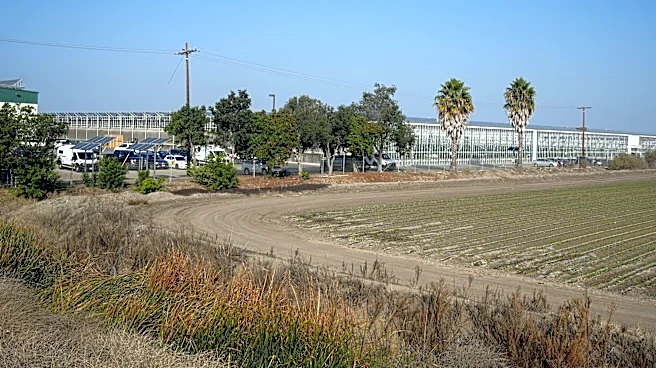







Glass House Brands, Ventura County’s only major cannabis grower, will pay hundreds of thousands of dollars a year less in property taxes after appealing the assessed value of its massive greenhouse operation near Camarillo.
The July 29 ruling on that appeal by the Ventura County Assessment Appeals Board was a partial victory for Glass House.
When it filed its appeal in 2022, Glass House was asking the Ventura County Assessor’s Office to revise the taxable value of its 160-acre greenhouse property down from $183 million to $99 million. That would have cut the company’s property tax bill by nearly $1 million a year.
Instead, the Assessment Appeals Board landed somewhere in the middle, revising Glass House’s assessed value for the 2022 tax year down
from $183 million to $144 million.
The $183 million valuation was the county’s assessment of the value of the property when it was last sold in September 2021. The assessed value then rose in the following years to reach $191 million in 2026.
Properties in California are typically only reassessed for tax purposes when they are sold. The assessed value can then increase by no more than 2% per year, or the rate of inflation, whichever is lower.
With the partial success of Glass House’s appeal, the assessor’s office will now recalculate the property’s value for every year from 2023 to 2026, based on the new, lower starting value for 2022, said Travis Ekema, the chief deputy assessor in the office’s valuation division.
Glass House will get a refund for the difference between what it has paid since 2022 and what its tax liability would have been under the new valuations.
Until the reassessment is complete, it’s not clear how big that refund will be or exactly how much Glass House will pay going forward. But the refund will be substantial, perhaps more than $1 million, and the company’s future tax bills will be lower by hundreds of thousands per year.
Last year Glass House paid about $2.8 million in Ventura County property taxes, according to county records. That was based on a total value of $251 million, a figure that includes both the property itself and the buildings on it, as well as equipment and other non-real estate property.
Glass House is also appealing the county’s assessment of its non-real estate property, but the Assessment Appeals Board has not heard that appeal yet.
Conversion to cannabis farm 'systematically planned,' board says
The Assessment Appeals Board is a quasi-judicial body appointed by the Ventura County Board of Supervisors. The appeals board heard Glass House’s case regarding its real estate value in November and December.
During those hearings, Glass House’s representatives argued that the property should be evaluated as a tomato and cucumber growing operation, not a cannabis farm, because when Glass House bought the property in 2021 it had been a Houweling’s vegetable farm for decades.
The average value of a tomato greenhouse is lower than that of a cannabis greenhouse, and Glass House submitted an appraisal of $99 million that was based on recent sales of other vegetable greenhouse properties.
Representatives of the county assessor argued that the property should be treated as a cannabis operation, because Glass House bought it with that purpose in mind and soon began renovating the greenhouses to grow cannabis. County permits to grow cannabis were issued one month after the sale.
In its ruling, the Assessment Appeals Board sided with the assessor's office and decided that growing cannabis was the "highest and best use" of the property for purposes of its property tax assessment. That led the board to uphold the assessor's valuation of $40 million for the land itself, not including any of the buildings on it, and to disregard the appraisal commissioned by Glass House that compared the property to vegetable farms.
The board stated in its ruling that "the use of the subject property for cannabis was not speculative but systematically planned for in connection with the sale."

The board sided with Glass House on some of the other aspects of its appeal.
Its ruling values the buildings and other improvements on the land at $104 million, below the county assessor's estimate, because Glass House presented evidence that the greenhouses were unusable without major investments to renovate them.
The board also thought the assessor's adjustments for the likely profitability of cannabis were too high.
2021 sale 'not an open market transaction'
The property is the only one in Ventura County with the legal right to grow large quantities of cannabis. In 2020, Ventura County voters passed Measure O, which permitted commercial cannabis cultivation, but only in existing greenhouses in the county's unincorporated areas.
The property now owned by Glass House is the only large greenhouse property in the county that meets the requirements of Measure O.
That wasn't an accident. Though it was not disclosed at the time, the campaign for Measure O was almost entirely funded by a company controlled by Casey Houweling, the owner of Houweling's.
Houweling's had sold the property in 2019 to a real estate investment company for $110 million, according to the Assessment Appeals Board's ruling. Houweling's then leased back the property to continue farming on it.
The 2019 sale agreement included an option to sell the property in the future to a cannabis grower who would be identified by Casey Houweling, according to testimony before the Assessment Appeals Board last year.
"Mr. Houweling had always believed the assets could be worth more as a cannabis greenhouse, which is why he structured our original deal to give him an option to find a cannabis buyer who might be willing to pay more," Gavin Haladay, an executive with the real estate investment firm that owned the property from 2019 to 2021, told the appeals board.
"Literally, right after we closed our deal, Mr. Houweling began marketing the property to cannabis purchases and working to secure Measure O," Haladay said.
When Houweling found Glass House to buy the property in 2021, he was paid $29 million worth of Glass House stock in exchange for exercising that option, according to the Assessment Appeals Board's ruling. He also could have received up to $35 million more in payouts related to the sale, though a lawyer for Glass House said during the Dec. 15 hearing that not all of that was paid.
Along with $93 million in cash that went to the investment firm, that brought the total that Glass House disclosed on its balance sheets for the acquisition to $157 million.
The Assessment Appeals board rejected the $93 million cash payment as a relevant measure of the property's value.
"Due to Casey Houweling's involvement in the transaction, the subject transaction was not an open market transaction," the appeals board's ruling states.
Tony Biasotti is an investigative and watchdog reporter for the Ventura County Star. Reach him at tbiasotti@vcstar.com. This story was made possible by a grant from the Ventura County Community Foundation's Fund to Support Local Journalism.
This article originally appeared on Ventura County Star: Pot grower Glass House wins partial victory in property tax dispute