





This story was originally publishedat Capital & Main.
The billionaire-funded political action committee Building a Better California has spent more than $304 million to defeat California’s proposed billionaire tax on the November ballot and is far outspending groups that support the measure, according to a Capital & Main analysis of state campaign finance records.
Through Oct. 20, the analysis shows that Building a Better California has given $118.5 million to a committee opposing Proposition 40 — a one-time wealth tax on about 200 billionaires — and another $186 million to support Propositions 41 and 42 that could nullify the measure if they receive more votes, according to the state Legislative Analyst’s Office.
Opponents of the billionaire tax
have outraised supporters by a ratio of more than 9 to 1 across the three ballot measures, the analysis of state election data shows.

The fight over the wealth tax is attracting more money than other propositions — accounting for nearly half of all spending on California ballot measures for the Nov. 3 election, the analysis shows.
About 96% of the opposition spending on the wealth tax measures has come from Building a Better California, which is overwhelmingly funded by billionaires and other ultrarich individuals, led by $102 million from Google co-founder Sergey Brin.
The group of ultrawealthy donors includes some of Silicon Valley’s best-known leaders and investors.
Building a Better California has raised more than $333 million overall. While most of its money has gone to oppose the billionaire tax, the political action committee has also contributed $10 million to support Proposition 45, which opponents said would weaken California Environmental Quality Act rules, and $6 million to support Proposition 37, which would create a $25-billion California homebuyer loan fund.
If approved by voters, Proposition 40 would impose a one-time 5% tax on the net worth of billionaires who were living in the state at the beginning of the year. The measure is intended to make up for a $100 billion shortfall in federal healthcare cuts triggered by last year’s One Big Beautiful Bill Act, which paid for tax breaks for the wealthy through safety net cuts, supporters said.
Opponents said Proposition 40 will drive companies and wealthy residents out of the state, costing billions in lost tax revenue. They also said it lacks oversight provisions to ensure money goes to families struggling to afford healthcare and could instead lead to more profits for health insurance companies.
“We’re standing with doctors, teachers, firefighters, Planned Parenthood, Gov. [Gavin] Newsom, and the many others who oppose Prop 40, because it will devastate the state’s budget, tax base, and economy, all while making the problem it claims to want to fix — healthcare funding — much worse,” Building a Better California spokesperson Abby Lunardini said in a statement.
Major supporters of the wealth tax include Service Employees International Union-United Healthcare Workers West, the California Democratic Party, the California Federation of Labor Unions (AFL-CIO) and U.S. Sen. Bernie Sanders (I-Vermont). Proponents argued that Proposition 40 is both critically needed and aimed at those who can easily afford it.
SEIU-United Healthcare Workers West crafted the ballot measure and has contributed nearly $32 million in support of the tax proposal through its political action committees. (SEIU is a financial supporter of Capital & Main.)
Suzanne Jimenez, chief of staff for SEIU-UHW, said it’s “not surprising” that a group of billionaires is spending heavily to derail a tax measure that would affect them directly.
“It’s very disappointing that they’d go to these lengths and spend all of this money when really they could do the moral and ethical thing of being part of our social contract,” Jimenez said. “They could pay a very minimal tax that, quite frankly, folks like Sergey Brin are going to make up in mere months after they would have to pay this tax.”
Facing a serious money disadvantage, Proposition 40 supporters are working to get their message to voters through phone banks, canvassing and one-on-one conversations, Jimenez said.
Proposition 40 is well-suited to overcome such a fundraising disadvantage because of the negative public sentiment toward the billionaire class, said Dan Schnur, who teaches political communication and leadership classes at the University of Southern California, UC Berkeley and Pepperdine University.
“It’s a populist measure that taps into progressive voter anger at almost the perfect moment in American politics,” Schnur said. “There are more billionaires in America than ever before, and they are more disliked than ever before. That’s a recipe for a very strong ballot argument.”
But a coalition of labor organizations including the California Teachers Association and California Professional Firefighters oppose the initiative because the proceeds would ultimately benefit healthcare workers more than members of other unions, he said. (CTA is a financial supporter of Capital & Main).
Support for Proposition 40 has declined slightly since early August, according to a recent poll from UC Berkeley’s Institute of Governmental Studies. The poll, conducted in mid-September, found that 45% of likely voters supported the measure; 42% opposed it, and 13% were undecided.An NBC News poll conducted from Sept. 21 to 24 found stronger support for the measure, with 48% of likely voters saying they would vote yes, 38% saying they would vote no and 14% undecided.
Here is a selection of notable billionaires bankrolling Building a Better California.
Google cofounder Sergey Brin: $102 million contributed
Brin stepped down as president of Google’s parent company in 2019. Forbes lists him as the world’s fourth wealthiest person, with a net worth of roughly $253 billion as of Oct. 21. He reportedly relocated to Nevada last year to avoid being subject to the billionaire tax.
In a statement to The New York Times in April, he said, “I fled socialism with my family in 1979 and know the devastating, oppressive society it created in the Soviet Union. I don’t want California to end up in the same place.”
During this election cycle, he also gave $3 million to Jobspac, a political action committee sponsored by the California Chamber of Commerce that spent more than $15 million to oppose Democratic gubernatorial candidate Tom Steyer, the analysis shows.
Brin contributed $1 million to a committee supporting Democrat Matt Mahan’s campaign for governor and gave $39,200 each to Republican gubernatorial candidates Steve Hilton and Chad Bianco.
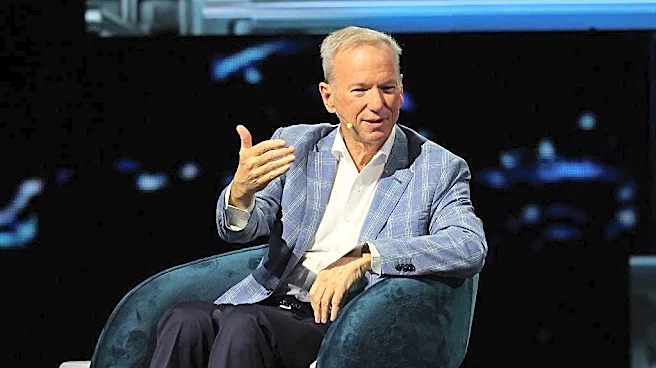
Former Google CEO Eric Schmidt: $40.2 million contributed
Schmidt was Google’s CEO and chairman from 2001 to 2011 and later served as a technical adviser to parent company Alphabet until 2020, according to a biography on his website. (Disclosure: The Schmidt Family Foundation is a funder of this website.)
This election cycle, he has also given $2.6 million to the California Business Roundtable Issues political action committee, the analysis shows. That committee contributed $700,000 to the Proposition 40 opposition campaign and nearly $10 million to support Proposition 43, which would make it harder to increase local taxes by increasing the percentage of votes needed to approve such ballot measures from a simple majority to a two-thirds majority, beginning next year.
Kleiner Perkins Chairman L. John Doerr: $40 million contributed
The venture capitalist is known for leading the firm into big early investments in Google, Amazon, DoorDash and Slack, according to the Kleiner Perkins website.
Doerr gave nearly $1 million to Mahan’s campaign this year.
Stripe CEO Patrick Collison: $33.2 million contributed
Collison is the cofounder of Stripe, a technology company that builds programmable financial services. He is also a cofounder of the Arc Institute, a biomedical research institute that is pioneering a new model for basic research, according to his company biography.
He also contributed nearly $1.5 million to Mahan’s campaign this year.
Khosla Ventures founder Vinod Khosla: $12.6 million contributed
The venture capitalist was the founding CEO of the computer hardware company Sun Microsystems, according to Khosla Venture’s website. He also spent 18 years at Kleiner Perkins before launching his own fund, according to Forbes.
Khosla Ventures is the primary backer of Mainspring Energy’s linear generator systems to power data centers.
Khosla contributed $1.1 million to Mahan’s campaign for governor this year.
Ripple cofounder Chris Larsen: $12.5 million contributed
Previously the CEO of the financial technology company, Larsen serves as the executive chairman of Ripple’s board of directors.
In June, Larsen also gave $5 million to Golden State Promise, another political committee that opposes the wealth tax. Ripple Labs also made a separate $5 million contribution to the same committee in February.
The Wonderful Company Chairman Stewart Resnick: $4.5 million contributed
Resnick is the president and co-owner of the agricultural giant The Wonderful Company, known for its pistachios, mandarin oranges and pomegranate juice.
This year, Resnick gave $78,400 to Eric Swalwell’s campaign for governor before the candidate dropped out of the race after allegations of sexual misconduct surfaced against him in April.
Resnick also gave $70,600 to Xavier Becerra’s campaign and $25,000 to Mahan.
DoorDash CEO Tony Xu: $3.5 million contributed
Xu is a cofounder of the delivery app company and has served as CEO since 2013, according to the company’s website. In 2022, he joined the board of directors of Meta Platforms Inc.
Earlier this year, Xu gave $250,000 to a committee supporting Mahan for governor and another individual contribution of $39,200 to Mahan. This August, Xu gave $39,200 to Becerra.
Aaron Cantú contributed to this report.
This article originally appeared on Ventura County Star: Who are the billionaires behind $304M effort to defeat Proposition 40?