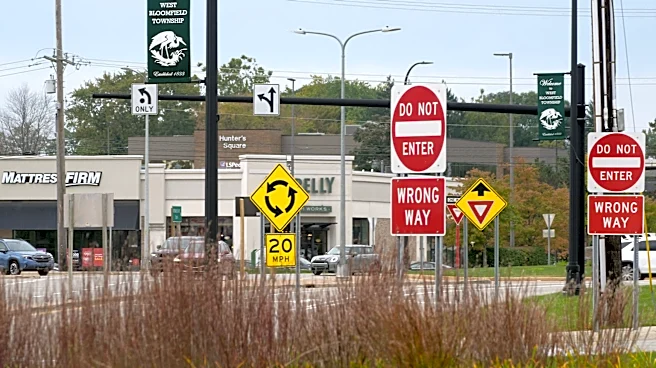






First a white BMW drifts in front of a work van − wrong place for a lane change, dipstick! − and there's a honk.
Next, a white Ford Escape takes too much time to lurch into the roundabout. Honk! A white GMC pickup cuts off a sedan. Honk! A white Jeep slows almost to a stop to let someone in, and no, you're being clumsy, not courteous! There's a flow to be maintained!
Honk, definitely. Plus a question: what's with all the white cars fouling things up? And another question on recent Tuesday afternoon September: given that we've had roundabouts in Michigan since 1999, shouldn't we be better at them?
Stick around for a few tips, or perhaps reminders is a better word.

As for this roundabout, you'll find it at 14 Mile and Orchard Lake Road in Farmington
Hills. It's on the West Bloomfield border, and it's on a list: No. 4 among the 20 intersections with the most accidents statewide in 2025.
The Free Press reported on the annual list when the current version was released a few weeks ago, and what brought me out to watch cars spin in a circle was a paradox. (Also, a Buick. You can't drive a paradox.)
We've been told since the first roundabout cameabout in Rochester/Rochester Hills that they're safer. But roundabouts took four of the top six spots in the Treacherous Twenty and six overall, and the one at 18 ½ Mile at Van Dyke Avenue in Sterling Heights was at the top of the hit parade, with 210 crashes.
Okay, that's not really much of a mystery. Transportation experts will tell you that crashes in roundabouts are typically less severe than at four-way intersections.
No head-ons or T-bones. Slower speeds. That's why 14 Mile/Orchard Lake had only nine injuries in its 118 crashes. Meantime, the No. 10 intersection in the ranking − five miles away, at Maple Road and Telegraph Road in Bloomfield Township − had only 83 incidents, but 47 people hurt.
Attorney Brandon Hewitt is COO of multi-city Michigan Auto Law, the personal injury firm that uses police reports and ambulance calls to compile the list. As a litigator, and as someone who lives in Grand Rapids, works a few days every week in Farmington Hills, has in-laws in Traverse City and drives 25,000 miles per year, he can attest:
"Roundabouts are still safer than normal intersections. Full stop."

Too bold? Too timid? Toot-toot
The U.S has about 15,300 roundabouts, according to some number crunching by Roadsigns.com. Florida has the most, at 1,628, which is somewhat alarming since it also has a large number of old people.
Michigan ranks 15th with 326 of them − roundabouts, not old people − all basically descended from a design that became popular in England in the 1960s.
Rotaries sputtered over there at first, then gained traction when someone figured out that cars already in the circle should have the right-of-way.
From where Hewitt sits, in court and behind the wheel, it’s probably time for the state to re-make that point here.
“Like with anything, there’s a big push at introduction,” he said. “It’s like the cell phone ban. We probably heard about that for six months, and now it’s periodic.”
So, as a reminder from MDOT, with some help from me:
Choose your lane before you enter the roundabout. Yield to cars already inside. Watch for pedestrians, who ideally will be in marked crosswalks.
Signal your exit with your turn signal, not your middle finger. Follow posted signs and pavement markings. Figure out the comfortable midpoint between timidity and foolishness; it drives your fellow motorists batty when you don't seize opportunities to merge into the flow, but it's always a bad idea to broadside somebody.
And, don't expect roundabouts to go away.
Changing more than lanes

Civil engineer Elaine Chen works in Southfield for Kimley-Horn, an infrastructure engineering company with offices in more states than not.
She attended a traffic engineers conference a few months ago, she said, and roundabouts “are a big, hot-ticket item throughout the country.”
In her industry, she said, “there’s always talk about alternative intersection types.”
Diverging diamond interchanges, for instance, like at I-75 and Big Beaver Road or a few miles north at I-75 and University Drive, temporarily push traffic to what feels unsettlingly like the wrong side of the road.
“The first of something is going to be the hardest to convince the public on,” Chen said, but drivers ultimately get used to new wrinkles.
Some places, for instance, might be resistant to what the industry identifies as the “median U-turn crossover.”
It sounds complicated – but around here, we just call it a Michigan left.
Reach Neal Rubin at NARubin@freepress.com.
This article originally appeared on Detroit Free Press: We're getting sloppy in roundabouts, and the crash numbers show it